


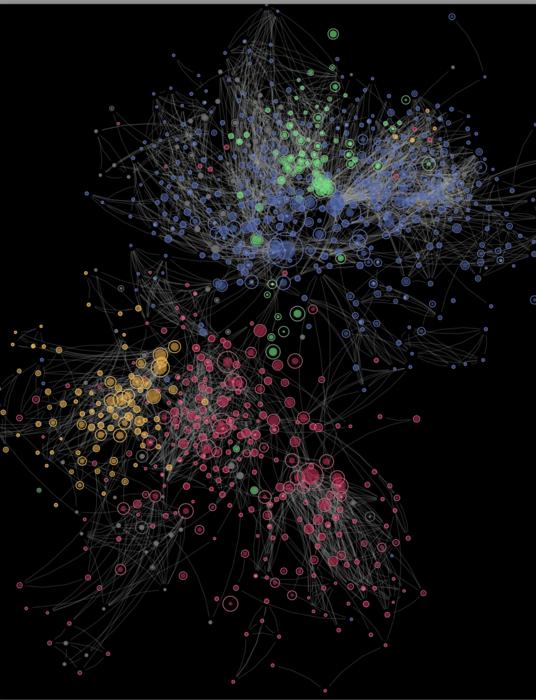
In the scientific literature, a citation acts as a mechanism to signal prior knowledge, enhance credibility, and protect against plagiarism. But it also gives credit to the individual or team who established or discovered the knowledge in question, and citations have thus emerged as a metric to measure the impact of a work or researcher. However, when a discovery or technique becomes common knowledge, scientists often stop bothering to cite it. Thus, the most impactful work is often undercited. Albert-László Barabási and colleagues from Northeastern University attempted to detect hidden citations in the physics literature by using machine learning to automatically detect phrases representing in-text allusions to 343 specific discoveries that can each be traced back to a foundational paper. For example, papers using the phrase “quantum discord” are almost certainly using concepts that derive from a 2001 paper by Harold Ollivier and Wojciech H. Zurek, but the ideas in that work have become so widespread that more than a third of papers that engage with quantum discord fail to cite the foundational paper. In some cases, citations are diverted to other works, such as reviews or books on the topic. In general, papers tend to acquire hidden citations at the same rate as they acquire explicit citations, but there is considerable variation from paper to paper. For example, the 1981 paper by Alan H. Guth introducing the cosmological inflation theory has acquired 8.8 times more hidden citations than explicit citations. Were these hidden citations made explicit, this paper would be the most cited paper on the preprint database arXiv. According to the authors, hidden citations represent a “price” of success. The more influential an idea is, the more likely it is to become so familiar and well understood that researchers no longer feel the need to explicitly cite the source.

Credit: BarabasiLab [Alice Grishchenko (alice.ccnr@gmail.com), Xiangyi Meng (x.meng@neu.edu), and Albert-László Barabási (alb@neu.edu)]
In the scientific literature, a citation acts as a mechanism to signal prior knowledge, enhance credibility, and protect against plagiarism. But it also gives credit to the individual or team who established or discovered the knowledge in question, and citations have thus emerged as a metric to measure the impact of a work or researcher. However, when a discovery or technique becomes common knowledge, scientists often stop bothering to cite it. Thus, the most impactful work is often undercited. Albert-László Barabási and colleagues from Northeastern University attempted to detect hidden citations in the physics literature by using machine learning to automatically detect phrases representing in-text allusions to 343 specific discoveries that can each be traced back to a foundational paper. For example, papers using the phrase “quantum discord” are almost certainly using concepts that derive from a 2001 paper by Harold Ollivier and Wojciech H. Zurek, but the ideas in that work have become so widespread that more than a third of papers that engage with quantum discord fail to cite the foundational paper. In some cases, citations are diverted to other works, such as reviews or books on the topic. In general, papers tend to acquire hidden citations at the same rate as they acquire explicit citations, but there is considerable variation from paper to paper. For example, the 1981 paper by Alan H. Guth introducing the cosmological inflation theory has acquired 8.8 times more hidden citations than explicit citations. Were these hidden citations made explicit, this paper would be the most cited paper on the preprint database arXiv. According to the authors, hidden citations represent a “price” of success. The more influential an idea is, the more likely it is to become so familiar and well understood that researchers no longer feel the need to explicitly cite the source.
Journal
PNAS Nexus
Article Title
Hidden citations obscure true impact in science
Article Publication Date
7-May-2024
COI Statement
A.-L.B. is the scientific founder of Scipher Medicine, Inc., which applies network medicine to biomarker development, of Foodome, Inc., which applies data science to health, and of Datapolis, Inc., which focuses on human mobility.
Cite Scienmag News
Katie Riggs. (May 7, 2024). Hidden citations in physics. Scienmag. https://scienmag.com/hidden-citations-in-physics/
Katie Riggs. "Hidden citations in physics." Scienmag, 7 May 2024, https://scienmag.com/hidden-citations-in-physics/. Accessed 5 September 2026.
Katie Riggs. "Hidden citations in physics." Scienmag. May 7, 2024. https://scienmag.com/hidden-citations-in-physics/

