


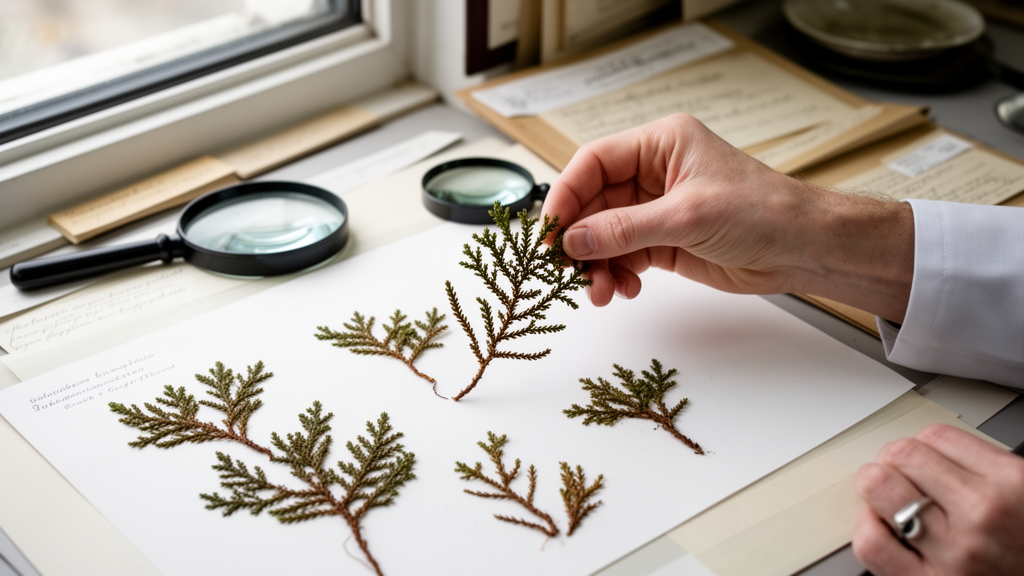
A taxonomic revision of herbarium specimens, type material and scanning electron micrographs has reinstated Selaginella brachyclada as a species distinct from S. rhodostachya, resolving a naming problem that dates to the late nineteenth century. The study also corrects the recorded type locality of S. rhodostachya, which had been placed in Guyana even though its type was collected on the Venezuelan side of Mount Roraima. The researchers concluded that S. brachyclada should again be recognized, with the later name S. diminutifolia retained as its synonym. By contrast, S. brevispicata and S. valdepilosa subsp. tricholoma remain synonyms of S. rhodostachya.
The investigation focused on the Selaginella valdepilosa group, a set of morphologically similar taxa defined by a suite of overlapping features. Members generally have a ribbon-like or leafy liverwort- to moss-like habit, creeping stems, filiform rhizophores, small lateral leaves that vary from ovate to elliptic, and light yellow, yellow or cream megaspores. Because these traits overlap extensively among species, their boundaries have historically been unstable, particularly where original collections were scarce and type material received limited study. S. brachyclada has at times been treated as a synonym of S. porelloides or S. rhodostachya, while S. rhodostachya itself has been interpreted broadly enough to include several distinct taxa.
To reassess the group, the authors examined the types of S. brachyclada, S. brevispicata, S. diminutifolia, S. rhodostachya, S. valdepilosa and S. valdepilosa subsp. tricholoma. They also studied additional collections from the Guayana Highlands and Venezuelan tepuis, checked herbarium specimens and digital images held by numerous institutions, and consulted records through the PteridoPortal. Scanning electron microscopy was used to inspect minute structures on leaves and spores, including epidermal cells, stomata, marginal idioblasts, hairs and spore surfaces. The combined evidence was intended to establish the species circumscriptions directly from type material rather than rely on the historical names attached to later collections.
Type evidence clarified the tangled naming history. S. brachyclada was described from a collection made in Guyana in May 1887, represented by G.S. Jenman 1481. Jenman subsequently used the same gathering to describe S. diminutifolia on July 23 that year, so the earlier epithet brachyclada has priority. S. rhodostachya had been described from an earlier collection made on the Venezuelan side of Mount Roraima by E.F. im Thurn. Its correct type citation is im Thurn s.n.; numbered labels attached to isotypes at the Natural History Museum and Smithsonian Institution were interpreted as errors involving positions or numbers in Baker’s earlier botanical synopsis rather than genuine collector numbers. The revision also corrected the type collection of S. valdepilosa subsp. tricholoma from 58016 to 58916 after checking Steyermark’s collection record.
The reinstated S. brachyclada can be distinguished from S. rhodostachya through leaf shape, margins, apices and microscopic anatomy. Its median leaves are ovate, broadly ovate, ovate-deltate or cordate, with rounded to subcordate bases and usually one to four short, stiff, tooth-like hairs at the apex. Its lateral leaves on main stems are ovate-deltate with subcordate bases, whereas those of typical S. rhodostachya are elliptic to elliptic-ovate with rounded bases. The axillary leaves of S. brachyclada are ovate-deltate, subcordate or ovate-lanceolate, and its leaf margins are only sparsely denticulate. It also differs from the form formerly assigned to S. valdepilosa subsp. tricholoma, whose leaf margins bear conspicuous long cilia.
Scanning electron microscopy supported the separation by revealing differences in cell structure and arrangement. On the upper surface of the median leaf of S. brachyclada, the midrib is prominently raised along its distal one-half to three-quarters, with stomata arranged in one to four rows along the keel and additional stomata near the outer margins. Its lateral leaves carry bands of elongated, straight-walled, papillate idioblasts along the margins. Lower surfaces contain elongate, sinuate-walled, laevigate cells together with scattered papillate idioblasts. Typical S. rhodostachya instead bears elliptic to elliptic-ovate median leaves with conspicuously keeled midribs, narrow hyaline margins one or two idioblast cells wide, and apices that may be obtuse or rounded or carry either short projections or two long, divergent cilia.
The revision also changed the proposed relationship between S. microdonta and S. brachyclada. Previous work had suggested that S. microdonta was closely related to S. brachyclada, but examination of the relevant types and additional specimens placed S. microdonta closer to S. cardiophylla, S. hemicardia and S. rostrata within the Selaginella microdonta group, which the authors renamed the S. valdepilosa group. The review of historical sheets also found that some collections had been divided incorrectly or treated as a single species. Several were mixed gatherings containing S. rhodostachya together with S. vernicosa, while material cited by earlier researchers as S. rhodostachya from Kaieteur was identified as S. sandwithii.
Selaginella brachyclada grows terrestrially or on rock in moist settings, including ledges and seepage surfaces near waterfalls, tropical savanna, gallery forest and riparian forest. It is confirmed from its type locality at the foot of Kaieteur Falls in Guyana and from five collections in the Gran Sabana region of Bolívar State, Venezuela, at elevations of 995–1,200 metres. The authors considered occurrence in neighboring Roraima in northern Brazil likely because suitable habitat is continuous, but stressed that Brazilian presence has not been confirmed. S. rhodostachya occupies muddy soil, rock crevices and the bases of wet bluffs in shrubland and forest at 1,350–2,800 metres. It has been recorded from the Mazaruni-Potaro region of Guyana, Amazonas and Bolívar states in Venezuela, and Roraima in Brazil.
The authors also applied IUCN assessment standards to the revised geographic records, using mapped occurrences and a recommended two-kilometre grid. S. brachyclada is known from only six collections: its type from Kaieteur National Park in Guyana and five Venezuelan collections from Gran Sabana, including sites in or near Canaima National Park. Its estimated extent of occurrence is 4,128.942 square kilometres, but its area of occupancy is only 20 square kilometres. It was assessed as Endangered under Criterion B, specifically B1ab(iii)+B2ab(iii), because of its restricted distribution and continuing decline in habitat quality. Human-ignited fires associated with shifting cultivation and hunting, as well as informal and often illegal gold mining, were identified as threats. S. rhodostachya has a larger estimated extent of occurrence of 21,005.349 square kilometres but an area of occupancy of 28 square kilometres. The authors recommended a preliminary Vulnerable assessment under Criterion B2ab(iii), citing mining, logging, agriculture and infrastructure development as continuing pressures in parts of its range.
Subject of Research: Taxonomic revision and conservation reassessment of Selaginella brachyclada and S. rhodostachya
Article Title: Selaginella brachyclada reinstated from synonymy under S. rhodostachya ( Lycopodiopsida , Selaginellaceae ), with updated descriptions of both taxa
Article References: Valdespino, I. A., & López, C. A. (2026). Selaginella brachyclada reinstated from synonymy under S. rhodostachya (Lycopodiopsida, Selaginellaceae), with updated descriptions of both taxa. PhytoKeys, 274, 303-320. https://doi.org/10.3897/phytokeys.274.190998
Image Credits: AI Generated
DOI: 10.3897/phytokeys.274.190998
Keywords: Selaginella brachyclada, Selaginella rhodostachya, plant taxonomy, species reinstatement, herbarium specimens, scanning electron microscopy, Guayana Highlands, tepuis, species conservation, IUCN assessment, type specimens, leaf morphology
Cite Scienmag News
Mark Graham. (October 20, 2026). Herbarium revision reinstates Selaginella brachyclada as distinct species. Scienmag. https://scienmag.com/herbarium-revision-reinstates-selaginella-brachyclada-as-distinct-species/
Mark Graham. "Herbarium revision reinstates Selaginella brachyclada as distinct species." Scienmag, 20 October 2026, https://scienmag.com/herbarium-revision-reinstates-selaginella-brachyclada-as-distinct-species/. Accessed 20 October 2026.
Mark Graham. "Herbarium revision reinstates Selaginella brachyclada as distinct species." Scienmag. October 20, 2026. https://scienmag.com/herbarium-revision-reinstates-selaginella-brachyclada-as-distinct-species/


