


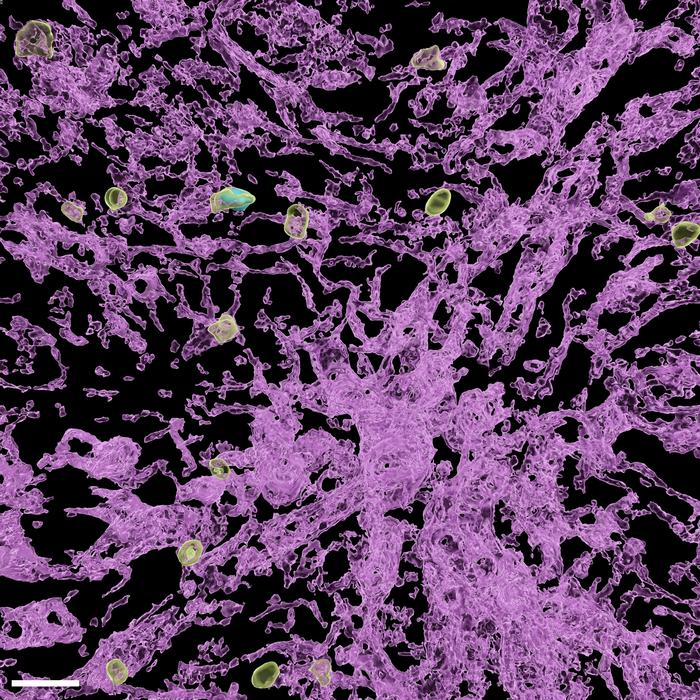
In chronic hepatitis B, the liver contains immune cells that could destroy hepatitis B virus infected cells but are inactive. A team from the Technical University of Munich (TUM) has discovered that cells blood vessels in the liver start a “sleep timer” that switches off immune cells. Targeting this mechanism could be a starting point for immunotherapies.

Credit: Percy A. Knolle / TUM
In chronic hepatitis B, the liver contains immune cells that could destroy hepatitis B virus infected cells but are inactive. A team from the Technical University of Munich (TUM) has discovered that cells blood vessels in the liver start a “sleep timer” that switches off immune cells. Targeting this mechanism could be a starting point for immunotherapies.
Hepatitis B is a widespread disease. According to estimates by the World Health Organization (WHO), 250 million people worldwide suffer from chronic hepatitis B. The most common health consequence of chronic hepatitis B is liver damage. Often, the body’s immune response against infected cells causes the damage, not the virus itself: Immune cells trigger inflammatory processes that can lead to fibrosis – scarring of the liver tissue – and liver cancer.
“In chronic hepatitis B, the body’s immune system tries to destroy infected liver cells, causing long-term damage and still does not get rid of the virus,” says Percy Knolle, Professor of Molecular Immunology at TUM. Notably, in in chronic infections, some immune cells whose receptors could recognize and destroy the Hepatitis B virus, are inactive.
Cells in blood vessels set a time limit
A team led by Prof. Knolle describes the reason for this in “Nature“. The hepatitis B virus specifically infects hepatocytes. These cells make up the largest part of liver tissue. They are supplied by small blood vessels that are lined with endothelial cells. Immune cells that enter the liver via the blood only reach infected hepatocytes through special openings in these endothelial cells. They protrude extensions through these openings to reach the infected hepatocytes and trigger their destruction. In doing so, they are forced into close contact with the endothelial cells.
“We show that the endothelial cells start a kind of molecular sleep timer in certain immune cells – cytotoxic T cells that can detect hepatocytes infected with the hepatitis B virus,” says Dr. Miriam Bosch, first author of the study. “The timer starts running as soon as the T cells get into contact with the infected hepatocytes.” The longer the T cells are in contact with the endothelial cells, the weaker their activity becomes – comparable to the volume of music decreasing before the sleep timer stops it altogether.
Specifically, the endothelial cells use the cAMP-PKA pathway to switch off the signal transmission of the receptors with which the T cells recognize the Hepatitis B virus and through which they are activated. As a result, the immune cells no longer attack the infected cells and, above all, are unable to proliferate.
Presumed protective function
“We think that this mechanism evolved to protect the liver,” says Percy Knolle. “The time limit prevents immune cells from proliferating too much during an infection and potentially critically damaging the liver when destroying infected hepatocytes.” In some cases, however, the time window for fighting the virus is apparently too short, and the virus escapes the control by the immune system. As new T cells keep attacking the infected hepatocytes, chronic hepatitis B leads to organ damage despite the protective mechanism.
“Now, the search begins for ways to influence this mechanism,” says Percy Knolle. “By doing so, we might support the immune system in effectively combating a chronic hepatitis B infection.” On the one hand, targeted immunotherapies are conceivable in which T cells are manipulated in such a way that they are no longer receptive to the signals from the endothelial cells. On the other hand, it may also be possible to switch off the mechanism by small molecules targeting this mechanism. To do this, however, it is crucial to deliver active substances selectively to immune cells in the liver and thus avoid impairing vital processes in other cells of the body. The researchers believe that such therapies could enhance the effect of vaccinations and thus help to combat chronic hepatitis B, which is particularly prevalent in poorer regions of the world.
Publication:
M. Bosch, N. Kallin, S. Donakonda, J. D. Zhang, H. Wintersteller, S. Hegenbarth, K. Heim, C. Ramirez, A. Fürst, E. I.Lattouf, M. Feuerherd, S. Chattopadhyay, N. Kumpesa, V.Griesser, J.-C. Hoflack, J. Siebourg-Polster, C. Mogler, L. Swadling, L. J. Pallett, P. Meiser, K. Manske, G. P. de Almeida, A. D. Kosinska, I. Sandu, A. Schneider, V. Steinbacher, Y. Teng, J. Schnabel, F. Theis, A. J. Gehring, A. Boonstra, H. L. A. Janssen, M. Vandenbosch, E. Cuypers, R. Öllinger, T. Engleitner, R. Rad, K. Steiger, A. Oxenius, W.-L. Lo, V. Klepsch, G. Baier, B. Holzmann, M. K. Maini, R. Heeren, P. J. Murray, R. Thimme, C. Herrmann, U. Protzer, J. P. Böttcher, D. Zehn, D. Wohlleber, G. M. Lauer, M. Hofmann, S. Luangsay and P. A. Knolle. “A liver immune rheostat regulates CD8 T cell immunity in chronic HBV infection.” Nature (2024). DOI: 10.1038/s41586-024-07630-7
Subject matter expert:
Prof. Dr. Percy A. Knolle
Technical University of Munich
Institute of Molecular Immunology
Tel: +49 (0)89 4140-6921
percy.knolle@tum.de
TUM Corporate Communications Center contact:
Paul Hellmich
Media Relations
Tel. +49 (0) 89 289 22731
presse@tum.de
www.tum.de
Journal
Nature
Method of Research
Experimental study
Subject of Research
Animals
Article Title
A liver immune rheostat regulates CD8 T cell immunity in chronic HBV infection
Article Publication Date
10-Jul-2024
COI Statement
The authors declare that there is no conflict of interest and no financial conflict related to the study published here. SL, JDZ, NK, VG, JH and JSP are Roche employees but do not declare any conflict of interest to the current study.
Cite Scienmag News
Kristina Jarvis. (July 10, 2024). Hepatitis B: “Sleep timer” for immune cells discovered. Scienmag. https://scienmag.com/hepatitis-b-sleep-timer-for-immune-cells-discovered/
Kristina Jarvis. "Hepatitis B: “Sleep timer” for immune cells discovered." Scienmag, 10 July 2024, https://scienmag.com/hepatitis-b-sleep-timer-for-immune-cells-discovered/. Accessed 3 September 2026.
Kristina Jarvis. "Hepatitis B: “Sleep timer” for immune cells discovered." Scienmag. July 10, 2024. https://scienmag.com/hepatitis-b-sleep-timer-for-immune-cells-discovered/

