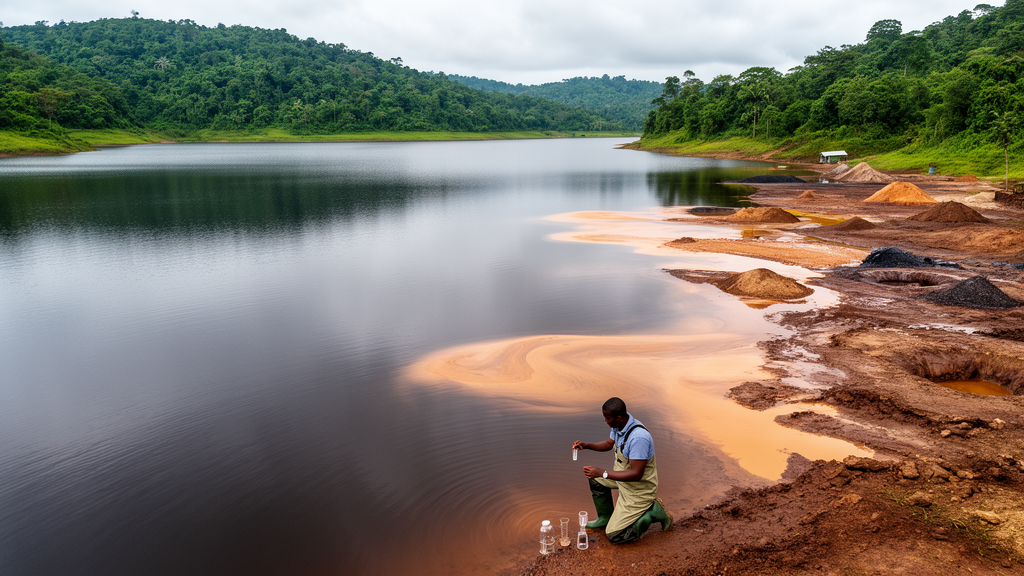
A new modeling study of Lake Sonfon, a freshwater lake in Sierra Leone’s artisanal and small-scale gold mining region, has produced the first fully parameterized simulation of how cadmium, lead, arsenic and mercury move through the lake’s coupled water, soil and aquatic plant system. The research, published in Environmental Science and Pollution Research, applied the Water Quality Simulation Program (WASP) Advanced Toxicant module, supplemented with first-order soil-equilibrium and plant bioaccumulation sub-models, over a six-month wet-season monitoring window from July to December 2025.
The field campaign gathered 360 analytical records from six water-quality stations, six soil stations and three aquatic-plant stations around the lake. Mean water-column concentrations came out at 0.148 mg/L for arsenic, 0.078 mg/L for cadmium, 0.057 mg/L for mercury and 0.031 mg/L for lead, with all four metals exceeding international freshwater quality guidelines. Sediment concentrations were substantially higher in absolute terms — lead at 10.25 mg/kg, cadmium at 1.79 mg/kg, arsenic at 1.51 mg/kg and mercury at 0.133 mg/kg — reflecting the strong partitioning of these toxicants onto soil and sediment particles.
The team quantified this partitioning through soil-to-water enrichment ratios, which reached 330 for lead, 23 for cadmium, 10 for arsenic and 2.3 for mercury. Aquatic plant tissues accumulated metals at plant-to-water bioaccumulation factors of 922 for lead, 325 for mercury, 50 for arsenic and 47 for cadmium. A single hotspot station, PLTS 01, recorded lead in plant tissue as high as 67.92 mg/kg, marking it as the most contaminated biological sampling point in the study.
Temporal trends over the wet season revealed a striking seasonal inverse relationship. Water-column and sediment concentrations rose progressively from July to December, increasing by 14–23% and 2–10% respectively, while plant tissue concentrations declined by 5–27% over the same period. The authors attribute this inverse pattern to growth-dilution dynamics, in which expanding plant biomass dilutes the metal burden per unit of tissue even as absolute environmental loads climb.
Model calibration relied on July-to-September observations and independent validation on an October-to-December dataset, but both sets consisted of only three monthly means each. The authors explicitly caution that the resulting correlation statistics should be read as indicative rather than definitive given this small sample size. Within that limitation, sediment validation skill was strong for cadmium (r = 0.984, RMSE = 0.014 mg/kg), arsenic (r = 0.975) and mercury (r = 0.992), and moderate for lead (r = 0.482, RMSE = 0.135 mg/kg).
Plant tissue compartments performed far worse in validation, with correlation coefficients ranging from −0.985 to 0.553 — a result the study flags as evidence that current plant sub-models need to account for growth-stage-dependent physiology.
Spatially, the analysis identified stations SOMP 03 and PLTS 01 on the northern shoreline as coincident sediment and bioaccumulation hotspots, a pattern consistent with adjacent mine-waste deposits.
Beyond its scientific baseline, the parameterized WASP framework is presented as management-relevant evidence for source control, phytoremediation and adaptive monitoring in the ASGM-affected watershed. The authors emphasize, however, that the small validation datasets and poor plant-model skill mean the model’s bioaccumulation outputs should guide future monitoring design rather than serve as final answers about ecological risk.
Subject of Research: Heavy metal fate, transport and bioaccumulation modeling in the water–soil–plant system of Lake Sonfon, an artisanal gold mining lake in Sierra Leone.
Article Title: Modeling heavy metal fate, transport, and bioaccumulation in coupled water-soil–plant systems of Lake Sonfon, Sierra Leone
Article References: Conteh, B., Sang, J. K., Gathenya, J., & Tarawally, M. (2026). Modeling heavy metal fate, transport, and bioaccumulation in coupled water-soil–plant systems of Lake Sonfon, Sierra Leone. Environmental Science and Pollution Research. https://doi.org/10.1007/s11356-026-38346-y
Image Credits: AI Generated
DOI: 10.1007/s11356-026-38346-y
Keywords: Lake Sonfon, Sierra Leone, heavy metals, WASP model, artisanal and small-scale gold mining, bioaccumulation, sediment contamination, water quality, cadmium, lead, arsenic, mercury
Cite Scienmag News
Violet Maxwell. (October 30, 2026). Heavy Metals Accumulate in Lake Sonfon as First WASP Model Maps Mining Contamination. Scienmag. https://scienmag.com/heavy-metals-accumulate-in-lake-sonfon-as-first-wasp-model-maps-mining-contamination/
Violet Maxwell. "Heavy Metals Accumulate in Lake Sonfon as First WASP Model Maps Mining Contamination." Scienmag, 30 October 2026, https://scienmag.com/heavy-metals-accumulate-in-lake-sonfon-as-first-wasp-model-maps-mining-contamination/. Accessed 4 November 2026.
Violet Maxwell. "Heavy Metals Accumulate in Lake Sonfon as First WASP Model Maps Mining Contamination." Scienmag. October 30, 2026. https://scienmag.com/heavy-metals-accumulate-in-lake-sonfon-as-first-wasp-model-maps-mining-contamination/