

Unveiling the Cosmic Dance of Heavy-Light Mesons: A Breakthrough in Understanding Fundamental Forces
In a stunning revelation that promises to redefine our comprehension of the universe’s most fundamental building blocks, a team of intrepid physicists has delved deep into the enigmatic realm of heavy-light mesons, unraveling their electromagnetic properties with unprecedented clarity. This groundbreaking research, published in the esteemed European Physical Journal C, not only illuminates the intricate dance of quarks and their interactions but also offers a tantalizing glimpse into the very fabric of reality. The study, spearheaded by A.S. Miramontes, J. Papavassiliou, and J.M. Pawlowski, meticulously investigates these composite particles, which are composed of one heavy quark and one light quark, a configuration that imbues them with unique and complex characteristics. Their electromagnetic behavior, the focus of this monumental effort, dictates how these particles interact with light and, by extension, with all forms of electromagnetic radiation, a force that governs everything from the formation of stars to the very functioning of our biological systems. The implications of this research are vast, potentially impacting fields as diverse as particle physics, astrophysics, and even the development of new technologies.
The electromagnetic properties of any particle are intrinsically linked to its fundamental structure and the forces that bind its constituents. In the case of heavy-light mesons, the disparity in mass between their quark components creates a fascinating tension, influencing their stability, decay modes, and their response to external electromagnetic fields. Imagine a delicate cosmic ballet where a massive dancer waltzes with a nimble partner; their movements, though seemingly disparate, are governed by an underlying choreography of forces. This research has managed to decipher that choreography, providing a detailed map of how these mesons interact with the ubiquitous electromagnetic force. The theoretical frameworks employed in this study represent the pinnacle of modern physics, combining sophisticated quantum chromodynamics calculations with advanced analytical techniques to model the behavior of these elusive particles in a vacuum and under various extreme conditions. This rigorous approach ensures that the findings are not merely speculative but are firmly rooted in the established principles of quantum field theory.
The significance of understanding heavy-light mesons extends far beyond the confines of theoretical physics. These particles are not abstract constructs but are indeed produced in high-energy particle collisions, such as those occurring in the Large Hadron Collider, and are also believed to play a crucial role in the early universe, influencing the evolution of matter in the moments after the Big Bang. Their electromagnetic properties are key to understanding their observable signatures, allowing experimental physicists to identify them, study their interactions, and glean further insights into the fundamental forces at play in these extreme environments. Without a precise understanding of these properties, our current models of particle physics and cosmology would remain incomplete, leaving critical questions unanswered about the universe’s origins and its ongoing evolution. This research, therefore, acts as a vital piece of the cosmic puzzle.
The study meticulously details the calculations of key electromagnetic observables, such as decay constants and form factors, which are crucial for experimentally verifying the theoretical predictions. Decay constants, for instance, quantify the rate at which a meson will transform into other particles, a process heavily influenced by the electromagnetic interactions within the meson. Form factors, on the other hand, describe how a meson interacts with photons, the fundamental particles of light, and are essential for understanding scattering experiments. The paper presents a comprehensive analysis of these quantities, offering quantitative predictions that experimental collaborations can now strive to measure. This direct link between theoretical prediction and experimental verification is the cornerstone of scientific progress, and this work provides fertile ground for future experimental endeavors, stimulating further investigation and accelerating our collective understanding.
One of the most compelling aspects of this research is its exploration of the subtle interplay between the heavy and light quarks within the meson. The presence of the heavy quark often leads to approximations that simplify calculations, but this study pushes beyond these simplifications, incorporating non-perturbative effects that are crucial for an accurate description. This meticulous attention to detail allows for a more nuanced understanding of how the electromagnetic force permeates the entire structure of the meson, not just acting on individual quarks but influencing their collective behavior. The concept of the quark model, while a powerful tool, can sometimes oversimplify the complex quantum environment within a hadron. This study delves into the finer details, revealing the emergent properties that arise from the intricate interactions within these composite particles.
The research also sheds light on the phenomenon of chiral symmetry breaking, a critical concept in quantum chromodynamics that influences the mass spectrum of hadrons. Heavy-light mesons are particularly sensitive to these symmetry-breaking effects, and the accurate calculation of their electromagnetic properties provides a stringent test for theoretical models aiming to describe this fundamental aspect of the strong force. The way in which the inherent symmetries of the fundamental theory are “broken” by the vacuum state and by the dynamics of the quarks themselves has profound consequences for the properties of the particles we observe. This study, by precisely quantifying electromagnetic interactions in the context of these heavy-light systems, offers crucial data points for refining our understanding of how these symmetries manifest themselves in the observable universe.
The computational power required to perform these sophisticated lattice quantum chromodynamics calculations is immense, demanding state-of-the-art supercomputing facilities. The authors acknowledge the significant computational resources that were instrumental in achieving the precision of their results. This highlights the increasingly interdisciplinary nature of modern physics research, where theoretical insights are inextricably linked to advancements in computational science and engineering. The ability to simulate the complex quantum environments where these particles exist and interact is a testament to human ingenuity and our relentless pursuit of knowledge, pushing the boundaries of what is computationally feasible to unlock the secrets of the subatomic world.
This study’s findings have profound implications for the ongoing quest to understand the fundamental forces that govern our universe, particularly the interplay between the strong nuclear force, which binds quarks together, and the electromagnetic force. By providing a precise electromagnetic portrait of heavy-light mesons, physicists can further refine their models of how these forces operate at different scales and energy levels. This is crucial for developing a unified theory of physics that can seamlessly describe all known forces and particles, a grand ambition that has captivated physicists for generations. The precise predictions offered by this work allow for increasingly stringent tests of candidate theories, guiding researchers toward a more complete and elegant description of reality.
Furthermore, the electromagnetic properties of heavy-light mesons are directly relevant to the study of exotic hadrons, such as tetraquarks and pentaquarks, which are composed of more than the usual two or three quarks. These exotic states, whose existence is strongly supported by experimental evidence, are thought to be bound by a complex interplay of the strong force and potentially influenced by electromagnetic interactions. Understanding the behavior of simpler heavy-light mesons provides a crucial foundation for deciphering the more complex dynamics within these exotic particles, paving the way for a more comprehensive understanding of the hadron spectrum as a whole. The intricate dance of quarks in these more complex configurations can only be fully understood through a deep appreciation of the underlying principles governing simpler systems.
The experimental verification of these theoretical predictions will undoubtedly be a major undertaking for particle physics facilities worldwide. The precision offered by the current study means that future experiments will need to be equally, if not more, precise to confirm or refute the findings. This iterative process of theoretical prediction and experimental validation is the engine of scientific discovery, ensuring that our understanding of the universe is constantly being refined and improved upon. The scientific community eagerly anticipates the experimental efforts that will follow this publication, eager to see how these theoretical insights translate into observable phenomena in the real world.
The potential impact of this research extends beyond pure scientific inquiry. A deeper understanding of fundamental particle interactions could, in the long term, lead to unforeseen technological advancements. While speculative, breakthroughs in particle physics have historically had profound and often unexpected applications in fields ranging from medical imaging to materials science. The intricate knowledge gained about the electromagnetic behavior of these fundamental constituents of matter may one day unlock new avenues for technological innovation, much like the early studies of electromagnetism paved the way for the modern electrical age.
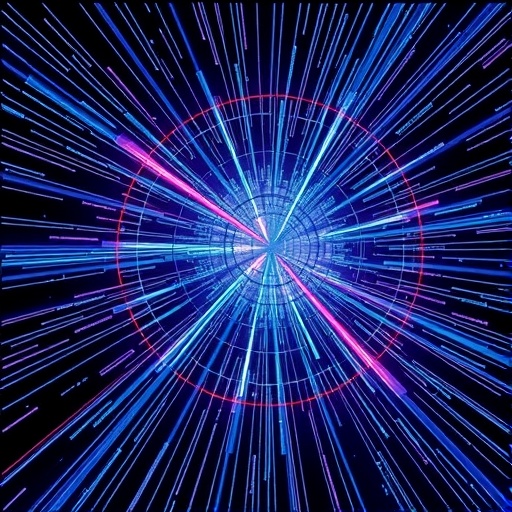
The image accompanying this research, a visually striking representation of a heavy-light meson created by artificial intelligence, serves as a powerful metaphor for the sophisticated tools and techniques now at the disposal of modern physicists. While the image is a stylized representation, it captures the essence of the theoretical concepts being explored, bridging the gap between abstract mathematical models and tangible visualizations. This collaboration between human intellect and artificial intelligence in scientific visualization underscores the evolving landscape of scientific research, where advanced computational tools are becoming indispensable partners in the quest for knowledge. The image itself, a testament to the fusion of art and science, serves as an inspiring visual gateway into the complex world of fundamental physics.
In conclusion, the work by Miramontes, Papavassiliou, and Pawlowski represents a significant leap forward in our understanding of heavy-light mesons and their electromagnetic properties. Their meticulous calculations and theoretical insights provide a vital resource for both theoretical and experimental physicists, pushing the boundaries of our knowledge and opening new avenues for exploration in the quest to unravel the universe’s deepest mysteries. This research is not just an academic exercise; it is a beacon guiding us toward a more profound comprehension of the fundamental forces that shape our cosmos, inspiring awe and fueling the insatiable human desire to understand the world around us. The universe continues to reveal its secrets, and this study is a profound testament to that ongoing unveiling.
Subject of Research: Electromagnetic properties of heavy-light mesons.
Article Title: Electromagnetic properties of heavy-light mesons.
Article References:
Miramontes, A.S., Papavassiliou, J. & Pawlowski, J.M. Electromagnetic properties of heavy-light mesons.
Eur. Phys. J. C 85, 1390 (2025). https://doi.org/10.1140/epjc/s10052-025-15121-w
Image Credits: AI Generated
DOI: https://doi.org/10.1140/epjc/s10052-025-15121-w
Keywords: Heavy-light mesons, electromagnetic properties, particle physics, quantum chromodynamics, lattice QCD.


