

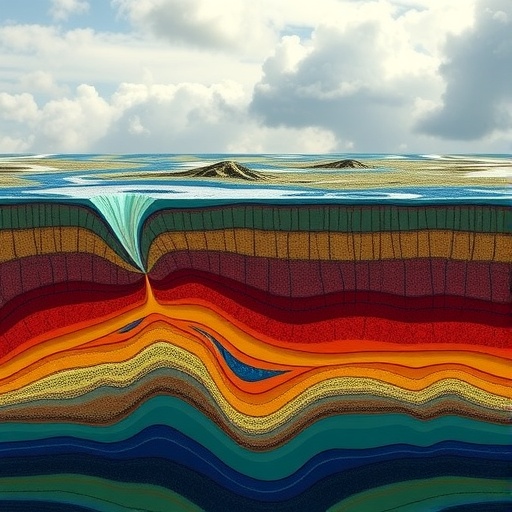
A groundbreaking study published in Communications Earth & Environment unveils a fascinating aspect of subduction zone dynamics by analyzing heavy iron isotopes in arc rocks. This research presents compelling evidence for the recycling of anoxic sediments in the deep Earth, providing new insights into geochemical processes that have remained elusive for decades. By delving into the isotopic signatures preserved in arc volcanic rocks, the scientists have illuminated a hidden conveyor belt where oxygen-starved sediments are carried back into the Earth’s mantle and influence arc magmatism.
Subduction zones are regions where tectonic plates collide and one plate plunges beneath another into the mantle. These zones are critical to understanding global geochemical cycles as they return surface materials into the Earth’s interior. Traditionally, it was thought that sediments subducted into these trenches undergo oxidation, but the new discovery challenges this notion by profiling sedimentary iron isotopes that retain signals of anoxic—or oxygen-poor—conditions deep into the subduction environment.
Iron exists in multiple isotopic forms, and its behavior under varying redox conditions can serve as a proxy to infer the oxidation state of geological materials. The team of researchers led by Wang et al. utilized state-of-the-art mass spectrometry to precisely quantify heavy iron isotope concentrations in volcanic arc rocks formed above subduction zones. Their analysis revealed distinct isotopic anomalies that could only arise from the incorporation of iron derived from sediments that remained anoxic during subduction.
This revelation is pivotal because it implies that sediments, traditionally perceived as heavily oxidized due to exposure to surface environments, are in fact subducted into the Earth’s mantle retaining their reduced (anoxic) state. This process has significant implications for the chemical evolution of subduction zones and the mantle source regions of arc magmas, fundamentally altering our understanding of Earth’s interior redox balance.
Understanding how sediments retain their anoxic signatures requires an exploration into the physical and chemical conditions within subduction channels. These narrow zones between the descending slab and the overlying mantle wedge are dynamically complex, where sediment layers are caught and subjected to variable pressures, temperatures, and fluid interactions. The research indicates that limited fluid rock interaction and rapid subduction rates might inhibit extensive oxidation, thereby preserving isotopic evidence of the original sedimentary environment.
Moreover, the study of heavy iron isotopes sheds light on the mechanisms of element transfer from the subducting slab into the mantle wedge. Iron is one of the key redox-sensitive elements, influencing the stability of minerals and the oxidation state of magmas generated in arcs. The heavy isotopic signature present in arc rocks suggests that anoxic sediments contribute iron in a form that affects the oxygen fugacity of the deeper mantle regions, possibly impacting volcanic gas compositions and eruption dynamics.
This work further ties into broader cycles of carbon and sulfur, which are intimately linked with redox chemistry in subduction systems. The presence of reduced iron forms in subducted sediments might also help to explain enigmatic signatures of carbon and sulfur in arc volcanism, bridging gaps between deep Earth processes and surface geochemistry. Essentially, by tracing iron isotopes, the study opens a window into the interconnected nature of volatile recycling and elemental exchange in the subduction factory.
Advanced geochemical modeling complemented the empirical data, allowing the scientists to simulate the isotope fractionation during sediment subduction under varying temperature and pressure regimes. The models convincingly demonstrated that observed heavy iron isotope enrichments match scenarios where iron-bearing phases remain anoxic, corroborating the mass spectrometry findings. Such integrative approaches underscore the novel methodological framework employed by the authors.
Aside from illuminating deep-Earth recycling, this study has broader implications for understanding the origins and evolution of Earth’s oceans and atmosphere. Since subduction zones regulate the return flux of oxidized and reduced materials to the mantle, knowledge of the redox state of recycled sediments can inform models of Earth’s redox evolution over geological timescales. The revelation that anoxic sediment recycling occurs may necessitate revisions to current paradigms addressing the oxygenation of the atmosphere and the chemistry of oceanic reservoirs through Earth’s history.
The research also presents a compelling narrative for future explorations using isotopic tracers as tools to decode other elusive cycles within the Earth system. Iron isotopes join a growing suite of geochemical indicators that researchers can use to investigate complex geological processes occurring far beneath our feet. This approach enhances our capacity to link surface geochemical signatures with deep mantle processes, enabling novel perspectives on plate tectonics and planetary differentiation.
Notably, the findings may influence the interpretation of arc magmatism worldwide, as iron isotope data can now be used to reassess the contribution of recycled sediments to mantle melts. This insight is highly relevant for understanding volcanic hazards, as magma composition influences eruption style and intensity. A refined grasp on sediment recycling could lead to better predictive models linking subduction zone chemistry with volcanic behavior.
This study is an exemplar of the power of interdisciplinary collaboration, blending geochemistry, isotope geoscience, petrology, and tectonics to solve longstanding mysteries of sediment recycling. Through meticulous sample collection from various arc volcanic rocks, state-of-the-art instrumentation, and sophisticated theoretical modeling, Wang and colleagues have set a new standard for investigating mantle geochemistry.
The insights gained extend beyond academic curiosity; they hold relevance for natural resource exploration, especially for metals associated with subduction-related magmatism. Understanding iron isotope signatures in arc rocks might help pinpoint ore-forming processes influenced by sediment contributions, potentially guiding exploration strategies in arc-related mineral deposits.
Ultimately, this remarkable research enriches our comprehension of the Earth’s internal workings by revealing that the mantle is a more chemically diverse and dynamic reservoir than previously appreciated. The recognition of anoxic sediment recycling promises to reshape fundamental notions of mantle geochemistry and the cycling of matter between the Earth’s surface and interior.
As the field moves forward, continued analyses of iron isotopes alongside other trace elements and isotopes will likely unlock further secrets about the subduction factory. The approach pioneered in this study encourages a multidisciplinary methodology that integrates geochemistry, tectonics, and isotope geoscience to illuminate the complex processes shaping our planet’s evolution.
In summary, the discovery of heavy iron isotope fingerprints in arc volcanic rocks revives the idea that sediments are subducted into the mantle in a reduced state, a concept with significant ramifications for understanding mantle redox dynamics, arc magmatism, and global geochemical cycles. This novel insight sharpens our perception of the Earth as a vibrant, evolving system governed by intricate feedbacks between geological reservoirs.
Subject of Research:
Anoxic sediment recycling in subduction zones deciphered through heavy iron isotope analysis in arc rocks.
Article Title:
Heavy iron isotopes in arc rocks reveal anoxic sediment recycling in subduction zones.
Article References:
Wang, Z., Dai, LQ., Zhao, ZF. et al. Heavy iron isotopes in arc rocks reveal anoxic sediment recycling in subduction zones. Commun Earth Environ (2026). https://doi.org/10.1038/s43247-026-03315-3
Image Credits:
AI Generated


