


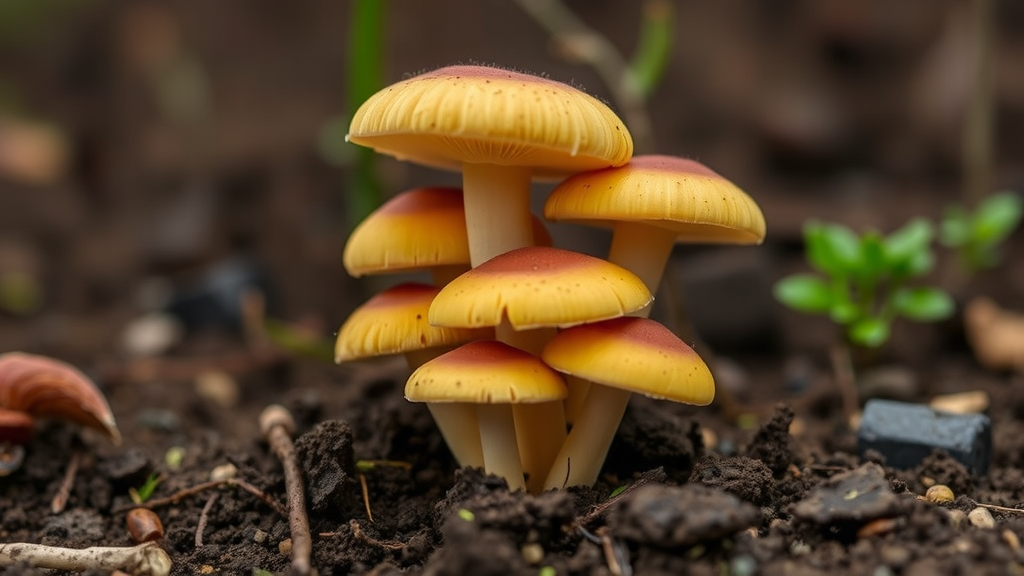
Beneath every scorched European heathland lies an invisible workforce: saprotrophic fungi that decompose dead plant material, recycle nutrients, and keep ecosystems running. As climate change pushes summer soil temperatures ever higher, scientists have wondered how these microscopic decomposers cope when a heatwave strikes. A new experimental study, published in the journal Microbial Ecology, offers one of the most detailed looks yet at how realistic heatwave temperatures alter the functional traits of soil fungi—and the answer is far more complicated than a simple up-or-down response.
A team of researchers led by Maria Moreno-Druet of Hasselt University, working with colleagues at the University of Namur, set out to test whether trait-based frameworks—a popular tool in ecology for predicting how organisms respond to environmental change—could capture how fungi react to short-term soil heating. Their experiment compared how six abundant and taxonomically diverse saprotrophic fungal species performed under two conditions: an ambient soil temperature of 18 degrees Celsius and a heatwave temperature of 25 degrees Celsius. Both values were chosen to reflect genuine summer soil conditions in a European dry heathland, rather than the exaggerated warming scenarios often used in laboratory studies.
The choice of temperatures matters. Much of the existing literature on microbial thermal responses relies on extreme laboratory conditions that bear little resemblance to what fungi actually experience during a natural heatwave. By grounding the experiment in realistic field temperatures, the researchers aimed to answer a practical question: when a soil fungus in a temperate heathland is suddenly exposed to a 7-degree jump, which of its observable characteristics change, and can those changes predict how fast the organism grows?
The team measured a suite of traits spanning fungal form and function, including intrinsic growth rate, mycelial density, metabolic activity, and the capacity to decompose complex organic compounds such as chitin. These traits were then analyzed both individually and in combination, allowing the researchers to construct a multivariate picture of how each species occupies what ecologists call trait space—the abstract landscape defined by all measured characteristics simultaneously.
The results revealed a striking degree of species-by-species variation. At both temperatures, the six fungal taxa occupied significantly different positions in multivariate trait space, confirming that these species are functionally distinct from one another. Temperature itself produced a modest but statistically significant shift in the overall trait structure of the community, but that shift was driven mainly by taxon-specific responses rather than by a uniform community-wide pattern. In other words, the heatwave did not push all fungi in the same direction; each species responded in its own idiosyncratic way.
That individuality extended to the single-trait level. Heatwave temperatures induced pronounced changes in individual traits, but these changes were again taxon-specific, and when the researchers averaged trait values across all six species, the mean responses were insignificant in most cases. This finding carries an important methodological warning for the field: studies that aggregate fungal responses at the community level may completely miss the biologically meaningful changes happening within individual species. A heatwave could substantially reshape the functional makeup of a fungal community even while community-level averages appear stable.
Perhaps the most surprising result concerned trait coordination. In plants, ecologists have long documented covariation among traits—species with high leaf nitrogen, for example, tend also to have high photosynthetic rates—which allows simplified trait schemes to predict performance. The researchers found no such covariation among the fungal traits they measured, suggesting a lack of coordination among fungal trait values. If fungal traits vary independently of one another, predicting a fungus’s overall response to warming from one or two easy-to-measure characteristics becomes far harder, and the multidimensional nature of fungal thermal biology must be taken seriously.
The study also probed whether trait changes could forecast growth. For most traits, the answer was no: shifts in trait values did not predict the intrinsic growth responses of the fungi under heatwave conditions. Three traits did show modest predictive power, however—chitin decomposition capacity, mycelial density, and metabolic activity. These characteristics, tied to how densely a fungus builds its network of hyphae, how actively it metabolizes, and how well it breaks down recalcitrant organic matter, may offer the most promising entry points for future trait-based models of fungal performance under warming.
The broader implications reach into climate science and soil carbon cycling. Saprotrophic fungi control the pace at which dead organic matter breaks down, which in turn regulates how much carbon is released from soils into the atmosphere. If heatwaves alter fungal trait expression in species-specific and multidimensional ways, then predicting soil carbon fluxes under future climate scenarios will require models that explicitly account for fungal functional diversity rather than treating the decomposer community as a uniform entity. The authors conclude that fungal trait responses to realistic warming are multidimensional and highly taxon-specific, and that temperature can reshape individual fungal responses independently of other environmental variables such as moisture or nutrient availability.
As heatwaves grow longer, hotter, and more frequent across Europe and beyond, the invisible fungal networks beneath our feet are being tested in real time. This study suggests that they will not respond as a single unit. Some species will accelerate their metabolism and decomposition work, others may slow or shift their growth strategies, and the net effect on nutrient cycling will be the sum of many divergent, species-level stories. Untangling those stories, trait by trait and species by species, is now one of the central challenges for scientists seeking to understand how soils will weather the climate of the coming decades.
Subject of Research: Effects of realistic heatwave soil temperatures on functional traits of saprotrophic soil fungi
Article Title: Exploration of the Effect of Heatwave Temperatures on Traits of Soil Saprotrophic Fungi
Article References: Moreno-Druet, M., Schrooten, J., Rineau, F., De Laender, F., & Soudzilovskaia, N. A. (2026). Exploration of the Effect of Heatwave Temperatures on Traits of Soil Saprotrophic Fungi. Microbial Ecology. https://doi.org/10.1007/s00248-026-02886-0
Image Credits: AI Generated
DOI: 10.1007/s00248-026-02886-0
Keywords: heatwaves, soil fungi, saprotrophic fungi, functional traits, trait-based ecology, microbial ecology, thermal response, decomposition, intrinsic growth rate, chitin decomposition, mycelial density, soil carbon
Cite Scienmag News
Roger Howard. (September 23, 2026). Heatwave Temperatures Reshape Soil Fungi in Surprisingly Species-Specific Ways. Scienmag. https://scienmag.com/heatwave-temperatures-reshape-soil-fungi-in-surprisingly-species-specific-ways/
Roger Howard. "Heatwave Temperatures Reshape Soil Fungi in Surprisingly Species-Specific Ways." Scienmag, 23 September 2026, https://scienmag.com/heatwave-temperatures-reshape-soil-fungi-in-surprisingly-species-specific-ways/. Accessed 4 October 2026.
Roger Howard. "Heatwave Temperatures Reshape Soil Fungi in Surprisingly Species-Specific Ways." Scienmag. September 23, 2026. https://scienmag.com/heatwave-temperatures-reshape-soil-fungi-in-surprisingly-species-specific-ways/


