


Antenna engineers have long faced an awkward trade-off: radios that must operate on several frequency bands at once usually demand bulky, stacked structures or intricate feed networks that are difficult to fabricate. A study published in Frontiers in Antennas and Propagation now reports a compact way out. E. Vinodha of M.A.M College of Engineering and Technology in Tiruchirappalli, India, has designed, built and measured a cylindrical dielectric resonator antenna (CDRA) that delivers three distinct operating bands from a single slab of ceramic just 2.5 millimetres thick, driven by an unusual flipped ‘F’-shaped microstrip feed. The work targets the wireless local area network (WLAN) bands around 5.470–5.725 GHz, 5.725–5.850 GHz and 5.9 GHz, while also reaching into the X and Ku bands used by radar and satellite systems.
Dielectric resonator antennas have attracted antenna designers for decades because they combine several properties that conventional metal patches struggle to match. Because the radiating element is a dielectric rather than a conductor, they suffer essentially no conductor loss at high frequencies, which translates into high radiation efficiency and useful gain. They are also mechanically and thermally stable, compact, and easy to integrate with printed circuits. Cylindrical resonators in particular carry a long pedigree: they were used in filters and oscillators well before researchers exploited them as radiators, and the first experimental study of a cylindrical DRA was carried out by S.A. Long in 1983. Compared with a hemispherical resonator, the cylinder gives the designer one extra degree of freedom, since the aspect ratio between radius and height can be tuned to hit a desired frequency and bandwidth.
The cylindrical geometry offers a further advantage that is central to the new design. A CDRA supports transverse electric (TE), transverse magnetic (TM) and hybrid electromagnetic (HEM) resonant modes, giving access to a wide variety of radiation patterns. HEM modes, the workhorses of cylindrical DRAs, are neither purely electric nor purely magnetic: their fields are transverse to the direction of wave propagation, and unlike TE or TM modes they do not require perfect conducting boundaries to exist, which allows efficient radiation into free space. The resonance frequency of an HEM mode depends on the height and radius of the cylinder, so geometry directly sets the spectrum. Coupling a centre-fed microstrip line to the cylinder excites the HEM11δ, HEM12d and HEM13d modes, where the indices describe azimuthal, radial and axial field variations. The fundamental HEM11δ behaves like a horizontal magnetic dipole, producing broadside radiation with a wide beam, while the two higher-order modes contribute higher directive gain.
Achieving multiband behaviour, however, has historically forced designers into compromises. Stacked resonators and parasitic-loaded structures increase the overall antenna volume; elaborate feed geometries and slotted ground planes raise fabrication complexity; designs using two or three resonator elements consume more area or height. A hybrid CDRA with a dual ‘C’-shaped patch, for example, lacks compactness because of its large volume, while two-segment cylindrical DRAs achieve triple-band operation only by stacking one resonator on top of another. The new study sidesteps these problems with two deceptively simple moves: a carefully placed notch in the resonator and a modified feed.
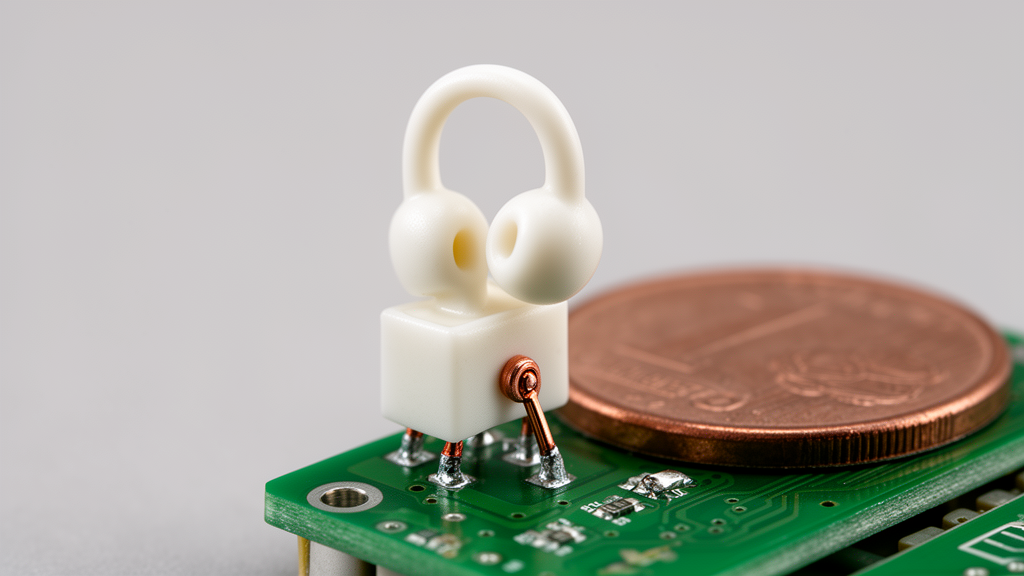
The resonator itself is a cylinder of Rogers RT Duroid 6010, a ceramic-loaded laminate with a moderate dielectric constant of 10.2, having a radius of 10 millimetres and a height of 2.5 millimetres. It is bonded to an FR4 substrate 1.6 millimetres thick with a dielectric constant of 4.4, over a ground plane measuring 35 by 24 millimetres. The decisive modification is the removal of a cylindrical volume of 18 by 6.75 by 2.5 millimetres from the centre of the disc. This central notch lowers the effective dielectric constant of the whole volume and reduces the Q-factor, which widens the bandwidth. It also transforms the outline of the resonator into a shape the author describes as resembling a pair of headphones. Without the notch, the same antenna on the same feed resonates only once, at 6.15 GHz with a narrow 6.5 percent bandwidth. With the notch in place, the structure resonates at three frequencies: 5.915 GHz, 10.76 GHz and 12.45 GHz, with fractional bandwidths of 18.57 percent, 9.9 percent and 15.8 percent respectively, and a return loss as deep as −32.7 dB, indicating strong impedance matching.
The dimensions of the notch proved critical. In a parametric study conducted with the HFSS 14 simulation software, the separation between the two arms of the headphone shape was varied between 5, 6.5 and 8 millimetres; the desired bands appeared only at 6.5 millimetres, with weaker bandwidth on either side. Similarly, notch lengths of 15, 18 and 19 millimetres were compared, and only the 18-millimetre version delivered both wide bandwidth and a good impedance match. The feed underwent its own evolution. A centre-fed microstrip line alone produced no resonance in the target bands. Adding a single stub yielded two bands, at 6.1 GHz and 13.1 GHz with bandwidths of 6 percent and 5.7 percent. Only when a second stub was added did the structure deliver three well-matched bands with the full bandwidths reported. The resulting flipped ‘F’-type feed, placed on the substrate beneath the resonator, acts as a frequency tuner: adjusting the lengths and widths of its two stubs optimises the coupling between feed and resonator and broadens each band. Microstrip feeding was chosen over alternatives because it is simple to fabricate, offers wider bandwidth than aperture coupling, and, unlike probe feeding, requires no drilling.
To confirm the simulations, the headphone-shaped antenna was fabricated from a slab of the Duroid material, machined into shape and bonded to the substrate with Araldite adhesive chosen for its very low dielectric constant, so that it would not perturb the results. Measurements were made with a PNA E8362B network analyser, and the simulated and measured return loss curves were found to be in very close agreement. The fabricated antenna resonated at 5.915 GHz, 10.76 GHz and 12.45 GHz, matching the predicted bands and covering WLAN frequencies along with the X and Ku bands. HEM modes were observed to be excited at all three resonances, confirming the mode analysis behind the design.
Radiation performance held up as well. Patterns measured in an anechoic chamber showed linear polarisation and stable broadside radiation across the entire operating range, with co-polarisation levels consistently above cross-polarisation in both the E-plane and the H-plane. Measured gain ranged from 4.5 dBi to a peak of 7.05 dBi at 10.88 GHz, with a horn antenna serving as the reference in the gain measurement. Radiation efficiency was evaluated using the Wheeler method, which compares the antenna’s reflection coefficient measured in free space with that measured in the chamber and requires no reference antenna. The theory predicted better than 87.5 percent efficiency, and the measurements confirmed more than 85 percent across all operating frequencies.
Compared with recently published multiband DRAs, the new design stands out for its profile. Earlier triple-band cylindrical designs reached 8, 9.6 or even 10 millimetres in height, and one rectangular DRA required 19.6 millimetres, whereas the proposed antenna achieves comparable or wider bandwidths in its lower and upper bands at only 2.5 millimetres thick, without stacking layers. Because it operates in both the C and X bands, the author notes it could serve as a satellite antenna and is well suited to air traffic control, weather monitoring, vehicle speed detection, defence tracking and radar applications. With a simple geometry, an easy feed mechanism, strong agreement between simulation and measurement, and good gain and efficiency throughout its bands, the headphone-shaped CDRA offers a compact route to the multiband operation that modern wireless systems increasingly demand.
Subject of Research: Multiband cylindrical dielectric resonator antenna design with modified microstrip feeding
Article Title: The multiband cylindrical dielectric resonator antenna with modified microstrip feeding
Article References: Vinodha, E. (2026). The multiband cylindrical dielectric resonator antenna with modified microstrip feeding. Frontiers in Antennas and Propagation, 4, Article 1850686. https://doi.org/10.3389/fanpr.2026.1850686
Image Credits: AI Generated
DOI: 10.3389/fanpr.2026.1850686
Keywords: dielectric resonator antenna, CDRA, multiband antenna, microstrip feed, HEM modes, WLAN, X band, Ku band, radiation efficiency, bandwidth enhancement, HFSS simulation, radar applications
Cite Scienmag News
Denise Maddox. (October 17, 2026). Headphone-Shaped Dielectric Resonator Antenna Delivers Three Bands on a 2.5 mm Footprint. Scienmag. https://scienmag.com/headphone-shaped-dielectric-resonator-antenna-delivers-three-bands-on-a-2-5-mm-footprint/
Denise Maddox. "Headphone-Shaped Dielectric Resonator Antenna Delivers Three Bands on a 2.5 mm Footprint." Scienmag, 17 October 2026, https://scienmag.com/headphone-shaped-dielectric-resonator-antenna-delivers-three-bands-on-a-2-5-mm-footprint/. Accessed 17 October 2026.
Denise Maddox. "Headphone-Shaped Dielectric Resonator Antenna Delivers Three Bands on a 2.5 mm Footprint." Scienmag. October 17, 2026. https://scienmag.com/headphone-shaped-dielectric-resonator-antenna-delivers-three-bands-on-a-2-5-mm-footprint/


