


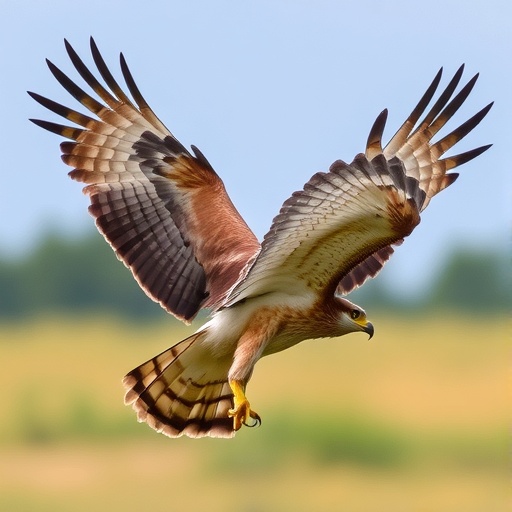
In the realm of aerodynamics and flight mechanics, nature continues to serve as an unparalleled muse and mentor. Recently, a groundbreaking study conducted by collaborative researchers from the University of Oxford and the University of California, Davis, has illuminated how a Harris’s hawk dynamically shifts its aerodynamic stability when navigating tight spaces mid-flight. Published in the prestigious Journal of the Royal Society Interface, this research unveils critical insights that not only deepen our understanding of avian flight but also pave the way for transformative advancements in uncrewed aerial vehicle (UAV) design.
Birds possess an extraordinary ability to modulate their wing and tail shapes in real-time, enabling them to fly gracefully through intricate environments filled with obstacles. Replicating this fluid adaptability in mechanical drones has long posed a formidable engineering challenge due to the complexities of morphing structures and stability control mechanisms. The team’s innovative approach involved synthesizing motion capture technology with meticulous wind tunnel testing to decode the biomechanics underlying the hawk’s flight adjustments.
At the core of the study is the Harris’s hawk, a predatory bird native to arid regions in the Southwestern United States, Mexico, and South America, known for its cooperative hunting strategies and remarkable maneuverability. By introducing narrow gaps formed by flexible poles within a controlled flighthall environment, the researchers induced the hawk to execute wing tucking maneuvers—an instinctive modification allowing the bird to traverse confined spaces.
Employing state-of-the-art motion capture imaging at Oxford’s dedicated flight hall, the team recorded high-fidelity data on the hawk’s wing and tail configurations throughout the gliding phase of flight. Subsequently, these biomechanical profiles were digitized and reproduced as precise 3D printed models. These models, rendered using resin and printed through the UC Davis Engineering Student Design Center, underwent rigorous aerodynamic testing inside a wind tunnel at the UC Davis College of Engineering to simulate the airflow conditions experienced during navigation of gaps.
The findings reveal a fascinating aerodynamic transition: the hawk shifts from an inherently unstable flight state to a stable one as it tucks its wings to pass through the narrow opening. Instability in aerodynamics, often a hallmark of fighter jets, enhances maneuverability by making the craft more responsive to control inputs. Conversely, stability favors steady cruising and energy-efficient flight paths but reduces agility. This ability to toggle between these states grants the hawk exceptional control, a strategy fundamentally different from the fixed stability designs of conventional human-engineered aircraft.
This research challenges longstanding paradigms in aeronautical engineering by demonstrating a biological model that negotiates the intrinsic trade-off between stability and maneuverability with a level of nuance engineers have yet to achieve in UAV technology. The morphing wing concept embodied by the hawk offers a blueprint for drones that can dynamically tailor their aerodynamic profiles in response to environmental challenges, greatly enhancing operational versatility and safety in complex, obstacle-rich settings.
Supporting these advances, UC Davis invested in constructing the Center for Animal Flight and Innovation, a cutting-edge research facility equipped with motion capture arrays and high-speed video systems designed specifically to observe and analyze biological flight phenomena. Financed partly by the U.S. Army Combat Capability Development Command Army Research Laboratory, this center stands poised to transform insights from biological flight into technological innovations.
The interdisciplinary collaboration between biomechanists, aerospace engineers, and roboticists reflects a burgeoning field at the nexus of biology and engineering—biomimicry applied to flight. The work by Kiran Weston and Professor Graham Taylor at Oxford, alongside Huanglun (Adam) Zhu and Assistant Professor Christina Harvey at UC Davis, exemplifies the caliber of integrative research required to dissect and replicate the complex flight control strategies birds inherently deploy.
Their meticulous experimental methodology—combining naturalistic observation via motion capture with empirical aerodynamic testing of precise physical models—sets a new standard for rigor in the study of animal flight. It offers a replicable framework for future research on other species and flight behaviors, further unraveling the sophisticated control systems that have evolved over millions of years.
Beyond the immediate scientific community, these findings hold profound implications for the future of UAVs employed in search and rescue, environmental monitoring, and urban package delivery, where navigating constrained spaces swiftly and safely is paramount. The ability to switch aerodynamic stability on demand could dramatically improve drone performances in cluttered environments, reduce collision risks, and expand operational envelopes.
The study was funded by the Air Force Office of Scientific Research and the David and Lucile Packard Foundation, marking a convergence of interest from both military and private philanthropic sectors in advancing this pioneering knowledge frontier. Importantly, the authors affirm there are no competing interests, underscoring the academic integrity driving this innovative endeavor.
With the continued evolution of such research, the day when drones emulate the fluid morphing flight of hawks may not be far off, signaling a paradigm shift in the design principles governing aerial robotics. By harnessing nature’s deeply refined flight mechanics, engineers are embarking on a path toward safer, more adaptable flying machines that will redefine air mobility across multiple domains.
Cite Scienmag News
Denise Maddox. (March 5, 2026). Hawk Research Reveals New Insights into the Mechanics of Bird Flight. Scienmag. https://scienmag.com/hawk-research-reveals-new-insights-into-the-mechanics-of-bird-flight/
Denise Maddox. "Hawk Research Reveals New Insights into the Mechanics of Bird Flight." Scienmag, 5 March 2026, https://scienmag.com/hawk-research-reveals-new-insights-into-the-mechanics-of-bird-flight/. Accessed 4 September 2026.
Denise Maddox. "Hawk Research Reveals New Insights into the Mechanics of Bird Flight." Scienmag. March 5, 2026. https://scienmag.com/hawk-research-reveals-new-insights-into-the-mechanics-of-bird-flight/


