

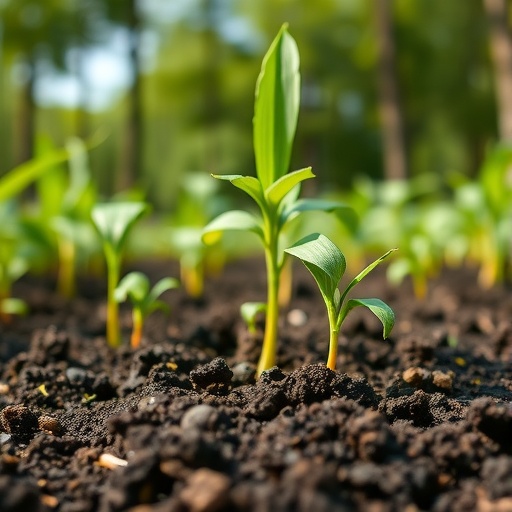
In an era marked by escalating climate concerns and an urgent need for sustainable agriculture, innovative solutions that reconcile food production with environmental stewardship are paramount. A groundbreaking study led by Dr. Bin Hu at the Center of Molecular Ecophysiology (CMEP), Southwest University, unveils the intricate biological and chemical processes underpinning the efficacy of biochar amendments in mitigating greenhouse gas emissions from soils. This comprehensive meta-analysis, synthesizing data from 78 independent global investigations and published in the journal Carbon Research, transcends conventional wisdom by mapping the soil’s molecular transformations in response to biochar, offering a transformative blueprint for climate-smart agriculture.
Biochar, a porous charcoal derivative generated via pyrolysis of organic biomass, has long intrigued researchers and farmers for its potential to sequester carbon. However, the mechanistic pathways through which it reduces greenhouse gases—chiefly carbon dioxide (CO₂), methane (CH₄), and nitrous oxide (N₂O)—have remained elusive, restricting optimized application in crop systems. Dr. Hu’s study reveals that biochar’s role extends well beyond passive carbon storage; it actively modulates soil physicochemical properties and microbial community functions, thereby orchestrating a reduction in emission fluxes through biological feedback loops and chemical pathway interruptions.
At the physicochemical level, the amendment of biochar substantially restructures soil architecture. By enhancing soil porosity and improving moisture retention capacity, biochar fosters microhabitats conducive to microbial colonization and enzyme activity modulation. The analysis shows a remarkable 24% increase in total soil organic carbon content post biochar amendment, signifying a shift toward a carbon-rich soil matrix that is both a reservoir and a regulator of nutrient cycling dynamics, thus influencing redox reactions pivotal to greenhouse gas generation.
Crucially, the study identifies a pronounced disruption of the soil nitrogen cycle, a central driver of N₂O emissions. Biochar was found to suppress key enzyme activities involved in nitrification and denitrification processes. These enzymatic pathways, typically responsible for transforming ammonium and nitrate into gaseous nitrogen forms, are slowed or altered, translating into lower emissions of N₂O, a greenhouse gas approximately 300 times more potent than CO₂ in terms of global warming potential. This enzyme activity modulation appears to derive from biochar’s surface chemistry and mineral composition, which selectively adsorb or inhibit microbial enzyme production.
Quantitatively, the research articulates the scale of emission reductions achievable through biochar amendments. On average, treated fields experienced a significant 24% drop in CO₂ emissions alongside striking decreases of 36% for methane and 39% for nitrous oxide. The research highlights that mitigating methane, particularly potent in rice paddy ecosystems, contributes substantially to lowering the overall greenhouse impact of cultivation, supporting the broader climate goals of reducing anaerobic microbial processes that produce methane under flooded soil conditions.
An important insight from the study is the identification of precise operational parameters that maximize these environmental benefits. It is not merely the presence of biochar that drives emission reductions, but the dosage and pyrolysis conditions employed in its production. Applying biochar at densities exceeding 40 tons per hectare, combined with high-temperature pyrolysis above 400 °C, results in the most profound declines in the global warming potential (GWP) of farmlands—up to 83%. This high-temperature pyrolysis likely enhances the stability and surface functionality of biochar, optimizing its interaction with soil microbes and nutrient cycles.
Moreover, the study delineates crop-specific responses to biochar amendment. Rice paddies emerged as the most responsive systems, showing a dramatic 53% reduction in greenhouse gas emission intensity. This is likely due to rice paddies’ characteristic waterlogged conditions, which exacerbate methane production—conditions that biochar evidently ameliorates through improved soil aeration and microbial community shifts. Conversely, maize cultivation systems exhibited a more resilient emission profile, necessitating higher management intensity and tailored biochar application strategies to realize comparable GWP reductions.
The intricate interplay between biochar-induced changes in soil enzyme profiles and microbial nitrogen cycling pathways unveils new frontiers for agronomic innovation. By targeting the biological regulators rather than merely altering physical soil attributes, biochar application emerges as a sophisticated lever to control microbial metabolic pathways that govern greenhouse gas fluxes. This insight propels the field beyond rudimentary amendments toward precision soil management aligned with climate mitigation ambitions.
This meta-analysis also underscores the scalability and practical applicability of biochar for global agronomy. By distilling results from a wide range of climatic zones, soil types, and cropping systems, the study offers a versatile and evidence-backed guide for policymakers and practitioners aiming to integrate biochar into sustainable agricultural frameworks. It aligns biochar deployment with global net-zero targets, highlighting soil management as an accessible and potent tool in the decarbonization toolbox.
In addition to its environmental benefits, biochar amendment contributes positively to soil health and productivity. Enhanced moisture retention alleviates drought stress, while increased soil organic carbon and modified nutrient dynamics foster fertility and crop resilience. These synergistic effects portend a dual dividend of environmental protection and agricultural sustainability, vital for ensuring food security in a warming world.
The research team’s findings challenge the prevailing notion of biochar being a static carbon store and position it instead as a dynamic agent of soil ecological regulation. By demonstrating how biochar reshapes soil microenvironments and biochemical cycles, the study enriches scientific understanding and expands the toolkit for confronting agricultural emissions with science-based interventions.
As climate models project rising temperatures and unpredictable precipitation patterns, solutions such as biochar that simultaneously enhance soil functionality and curb emissions will become indispensable. This study not only quantifies these benefits but furnishes a pathway forward—leveraging biochar’s multifaceted nature to reconcile agricultural productivity with planetary health.
Through this work, Dr. Bin Hu and colleagues have illuminated the biological and chemical choreography enabled by biochar amendments. Their insights provide a crucial scientific underpinning that empowers farmers, agronomists, and policymakers alike to harness the latent potential of soils—not only as foundation for crops but as frontline allies in the global struggle against climate change.
Subject of Research: Soil greenhouse gas emissions mitigation via biochar amendments and their impact on soil properties, enzyme activities, and nitrogen cycling processes.
Article Title: Biochar amendments mitigate soil greenhouse gas emissions by shifted soil properties, enzyme activities, and nitrogen cycling processes.
News Publication Date: February 18, 2026
Web References:
References:
Ngaba, M.J.Y., Mgelwa, A.S., Ibrahim, M.M. et al. Biochar amendments mitigate soil greenhouse gas emissions by shifted soil properties, enzyme activities, and nitrogen cycling processes. Carbon Res. 5, 14 (2026).
Image Credits: Mbezele Junior Yannick Ngaba, Abubakari Said Mgelwa, Muhammed Mustapha Ibrahim, Heinz Rennenberg & Bin Hu
Keywords: biochar, greenhouse gas emissions, soil carbon, nitrogen cycle, enzyme activity, carbon dioxide reduction, methane mitigation, nitrous oxide, soil microbiology, agricultural sustainability, climate-smart agriculture, pyrolysis


