

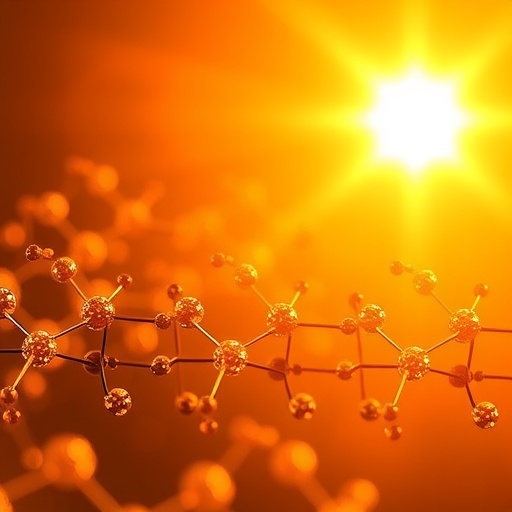
In the relentless pursuit of sustainable energy solutions, hydrogen stands out as a clean and efficient fuel with immense promise. A crucial step toward realizing a hydrogen-based economy is the efficient, scalable production of hydrogen fuel without harmful emissions. Among various methods, photocatalysis—a process where sunlight powerfully drives water-splitting reactions—is emerging as a front-runner. Central to this technology are photocatalyst materials that capture solar energy and convert it to chemical energy, ideally splitting water molecules into hydrogen and oxygen. Recently, tin oxides have garnered significant interest within the scientific community, attributed to their favorable stability, low toxicity, and affordability. In 2023, a remarkable advancement highlighted a novel polymorph of tin oxide, orthorhombic tri-tin tetraoxide (o-Sn₃O₄), which showed compelling photocatalytic properties, stimulating fresh excitement in this domain.
Despite the inherent potential demonstrated by o-Sn₃O₄, efforts to amplify its photocatalytic efficiency have faced considerable hurdles. Modifying photocatalysts via doping—a process that involves incorporating specific foreign ions into the material’s crystal lattice—has long been recognized as an effective way to enhance their behavior. Yet, systematically uncovering which dopants will harmonize with the structure and boost activity remains a time-consuming challenge. Experimental trial-and-error methods suffer from drawbacks such as high cost, extensive timelines, and the vast chemical space of possible dopant candidates, posing a bottleneck for progress.
To transcend these barriers, a cross-disciplinary team led by Professor Masahiro Miyauchi from the Institute of Science Tokyo embraced an innovative synergy of computational science and experimental validation. Harnessing the power of materials informatics, they leveraged machine learning interatomic potential (MLIP) calculations to predictively pinpoint promising metal ion dopants for o-Sn₃O₄. These advanced computational models enable rapid evaluation of the thermodynamic stability of doped structures with far greater efficiency compared to traditional quantum mechanical simulations. Their approach involved simulating the incorporation of various metal ions into the o-Sn₃O₄ lattice, thus forecasting stable doping configurations before any laboratory synthesis.
The outcome of this computational screening was a shortlist of dopants predicted to stably integrate into the host lattice, including trivalent ions such as aluminum (Al³⁺) and boron (B³⁺), as well as divalent strontium (Sr²⁺) and trivalent yttrium (Y³⁺). The research team meticulously synthesized these doped variants through a hydrothermal method, which is renowned for its controlled reaction environment conducive to high-quality crystal growth. Remarkably, the experimental results aligned impeccably with MLIP predictions. Only those dopants forecasted to be stable successfully matured into the desired orthorhombic structure, while others resulted in alternative crystal phases, underscoring the predictive power of the informatics-guided approach.
Among these candidates, aluminum emerged as a standout dopant. Aluminum-doped o-Sn₃O₄ exhibited photocatalytic performance that dwarfed its undoped counterpart—delivering a sixteen-fold increase in hydrogen production under visible light illumination. To unravel the underlying reasons for this significant enhancement, the researchers engineered thin-film samples with varying aluminum concentrations. Their findings indicated an optimal doping concentration around 5%, which critically improved the crystallinity and morphology of the material. Furthermore, aluminum doping facilitated the efficient separation of photogenerated charge carriers, a paramount factor in boosting catalytic activity by minimizing recombination losses.
This breakthrough demonstration cements MLIP calculations as a transformative tool in the rapid discovery and optimization of functional materials for energy applications. The ability to computationally triage dopant candidates not only conserves experimental resources but accelerates the timeline for identifying viable photocatalysts with superior characteristics. This study not only propels o-Sn₃O₄ into the spotlight as a compelling visible-light-active photocatalyst but also establishes a reproducible blueprint for future research endeavors aiming to marry computational insights with experimental innovation.
The implications extend beyond the confines of this particular material system. The methodology adopted by the Institute of Science Tokyo team exemplifies a scalable, data-driven paradigm to refine advanced materials systematically. As the global scientific community strives towards carbon-neutral energy technologies, approaches that optimize resource use while maximizing functional output gain paramount importance. Machine learning-driven interatomic potential calculations promise to underpin this next wave of discovery in materials science, enabling the swift tailoring of compounds with finely tuned properties.
This research was a concerted effort spanning academia and industry, incorporating expertise from multiple institutions across Japan. Aside from Professor Miyauchi’s leadership, contributions came from the graduate students Sho Uchida and Yuta Sekine, Assistant Professor Yohei Cho, and Associate Professor Akira Yamaguchi at the Institute of Science Tokyo’s Department of Materials Science and Engineering. The team also collaborated with Associate Professor Toyokazu Tanabe at the National Defense Academy and Dr. Kenji Yamaguchi from Mitsubishi Materials Corporation, showcasing the powerful synergy between fundamental and applied research.
Publishing their findings in the esteemed Journal of the American Chemical Society in February 2026, the team openly emphasized the utility of computational prediction in directing targeted experimental efforts. Their paper, titled Computational and Experimental Realization of Metal-Ion-Doped Orthorhombic Sn₃O₄ for Visible-Light-Active Photocatalysis, lays foundational work that could inspire analogous studies across a broad spectrum of functional materials.
In conclusion, the marriage of machine learning-enabled materials informatics with sophisticated chemical synthesis techniques marks a significant leap forward in photocatalytic material development. The exceptional enhancement achieved by aluminum doping of o-Sn₃O₄ pioneers a promising pathway to more efficient solar-driven hydrogen production, feeding directly into the vision of a sustainable, clean-energy future. As materials science continues to embrace data-centric methodologies, this study stands as a compelling testament to the transformative potential of integrating computational foresight with experimental rigor.
Subject of Research: Not applicable
Article Title: Computational and Experimental Realization of Metal-Ion-Doped Orthorhombic Sn₃O₄ for Visible-Light-Active Photocatalysis
News Publication Date: 18-Feb-2026
Web References:
Journal of the American Chemical Society article
Image Credits: Institute of Science Tokyo
Keywords
Photocatalysis, Tin Oxide, Orthorhombic Sn₃O₄, Doping, Machine Learning, Materials Informatics, Interatomic Potential, Clean Energy, Hydrogen Production, Visible-Light Photocatalyst, Computational Screening, Sustainable Energy


