

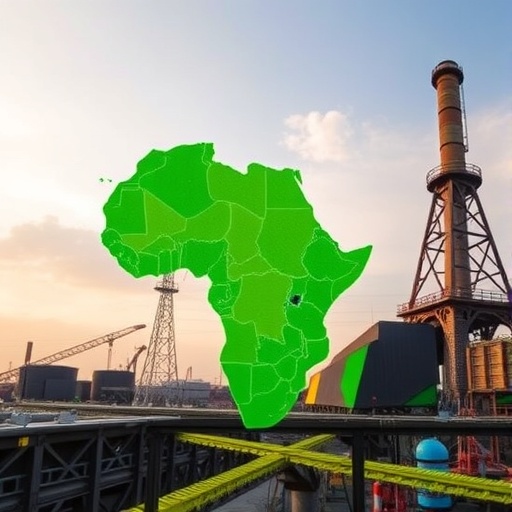
As the world urgently confronts the climate crisis, decarbonizing the steel industry emerges as a pivotal challenge with global implications. Steel production today accounts for approximately 7% to 9% of worldwide carbon emissions, ranking as the single largest source of industrial CO2 output. Transforming this sector is not merely an environmental imperative but a socio-economic necessity, deeply entwined with infrastructure development and economic growth, particularly in the Global South. A new paradigm must reconcile the dual demands of green technology adoption in Europe and burgeoning steel infrastructure needs across developing regions, especially Africa.
Most African nations grapple with steel consumption rates below one tonne per capita, a stark contrast to the far higher levels in industrialized countries. This gap is a significant bottleneck hindering vital infrastructure expansion. Nearly 600 million Africans still lack access to electricity, and more than 400 million are without clean water—shortfalls directly linked to insufficient steel-dependent facilities for power generation and water distribution. Meeting the Sustainable Development Goals and fostering broad-based economic development requires sustained, local steel production capacity that can underpin decades of infrastructure build-out.
Traditional steelmaking practices, heavily reliant on coal-fueled blast furnaces and integrated production systems, present formidable obstacles to decarbonization. These integrated facilities must be collocated with resources, constraining location flexibility and limiting comparative advantages. The emergence of hydrogen-based direct reduced iron (H2-DRI) technology disrupts this paradigm by allowing the production of solid iron—specifically Hot Briquetted Iron (HBI)—which can be transported globally and utilized at separate steelmaking sites equipped with electric arc furnaces. This disaggregation opens unprecedented pathways to scale green steel globally.
For European steelmakers, the H2-DRI technology crystallizes a critical strategic choice. Should they produce green iron domestically by importing iron ore and hydrogen separately and performing reduction onsite (Route B), or should they import HBI from geographically advantageous “sweetspot” locations, where renewable energy and iron ore are abundant, shipping the solid iron to Europe for finishing (Route A)? This dichotomy cuts to the heart of efforts to balance economic viability with environmental ambition.
Route B, while maintaining complete production within Europe, confronts severe economic and logistical hurdles. Hydrogen’s physical properties challenge its transport; conversion to carriers like ammonia, combined with shipping and reconversion logistics or pipeline infrastructures, imposes high costs and geopolitical dependencies. Importing hydrogen at high cost only to combine it with iron ore onsite at high-cost European facilities renders green steel production potentially uncompetitive and stymies investment incentives.
Conversely, Route A leverages the inherent advantages of HBI’s stability and transportability. Producing green iron in locations such as South Africa, North Africa, and Brazil—regions with unparalleled access to renewable energy and iron ore reserves—ensures lower production costs and enhanced supply security. Solid HBI can be shipped affordably using established maritime logistics without the infrastructural and security vulnerabilities linked to hydrogen transport. Recent quantitative analyses estimate a 27% cost advantage for German steelmakers sourcing HBI from these “sweetspot” areas, compared to crafting green iron domestically.
Moreover, the employment concern often posited against Route A—that outsourcing iron production bleeds critical jobs from Europe—does not withstand analytical scrutiny. Ironmaking constitutes only about 10% of steel sector employment, with over 90% employed in steel refining, product manufacturing, and downstream industries, all of which remain anchored in Europe regardless of iron feedstock origin. By lowering iron input costs, Route A can invigorate the entire value chain, preserving and potentially enhancing European steel jobs through amplified competitiveness.
Industrialized nations themselves are shifting their steel production frameworks towards secondary steelmaking routes that rely increasingly on scrap metal recycling rather than primary iron. For instance, the United States now recycles steel through electric arc furnaces for 70% of production, with the European Union close behind at 43%. This transition is gradually contracting domestic demand for primary iron production, creating risks that newly built green iron facilities could become stranded assets in shrinking markets.
Yet, current subsidy mechanisms complicate the scaling of overseas green iron production. Policies are often biased towards domestic production, rendering export-oriented green iron projects financially unfeasible. This barrier arises not from cost competitiveness—new producing regions hold clear cost advantages—but due to the absence of accessible policy instruments capable of underwriting early project financing through mechanisms like carbon contracts for difference centered on imported intermediates such as HBI.
The implications extend beyond economics to encompass a profound developmental dynamic. Developing countries possess the natural resources and renewable energy capacity necessary for green iron production but lack bankable long-term offtake agreements to secure investment. Without such foundational commercial partnerships, these nations are caught between untenable choices: enduring the “green premium” of costly imports or persisting with carbon-intensive steelmaking that jeopardizes climate goals and community health.
The new conceptual framework proposed involves adaptation of consumption-based Carbon Contracts for Difference (CCfDs) to support green steel producers exporting HBI from sweetspot regions. Under this model, European steelmakers commit to purchasing competitively priced, decarbonized iron inputs, receiving financial support linked to decarbonization outcomes. This arrangement facilitates long-term offtake agreements that de-risk investments in developing country production, thus unlocking crucial capital flows.
Crucially, this export-orientated production does not preclude domestic industrial advancement. Rather, the scale and bankability arising from export markets create the critical mass for developing country producers to simultaneously build domestic green steel capacity aimed at local infrastructure demands. Accordingly, the export partnership becomes the linchpin—the “anchor investment”—that unlocks sustainable industrial development trajectories that would otherwise remain inaccessible.
From a policy standpoint, no wholesale reinvention is necessary. Many European jurisdictions, such as Germany, already permit imported hydrogen as feedstock eligible for CCfD support. Extending this logic to encompass imported HBI constitutes a pragmatic, low-barrier adjustment to existing frameworks. Technology readiness is proven, cost advantages are quantitatively validated, and infrastructural pathways for scaling are established. Adoption hinges primarily on political will and coordinated industrial strategy.
Time is of the essence. Steel infrastructure projects inherently involve multi-decade timelines, underscoring the imperative for immediate action. Delays in establishing green iron production capacities push back decarbonization pathways across Europe and defer critical infrastructure development in the Global South, perpetuating energy poverty and inadequate water access. Mobilizing the proposed cross-continental production and trade model today can accelerate emission reductions and simultaneously spearhead sustainable industrial growth where it is most needed.
In conclusion, the decarbonization of steel presents interconnected challenges and opportunities spanning the developed and developing worlds. Embracing hydrogen-based direct reduced iron technology and unlocking new economic models built on cross-border collaboration can yield a win-win: Europe achieves cost-effective green steel production supporting its industrial legacy, while developing nations secure the foundational industries needed for inclusive, low-carbon development. This future demands integrating industrial policy with climate ambition, transcending protectionist subsidies, and embodying a shared global responsibility to green one of humanity’s most essential materials.
Subject of Research: Decarbonization strategies for the steel industry and their implications for both European steelmakers and developing countries.
Article Title: How could steel industry decarbonisation benefit the global south?
News Publication Date: 30-Dec-2025
Web References: 10.26599/TRCN.2025.9550016
Image Credits: Design and Graphics: Ivan Pharabod. Concept: Author.
Keywords: Green steel, hydrogen direct reduced iron, Hot Briquetted Iron, steel decarbonization, European steel industry, developing countries, renewable hydrogen, carbon contracts for difference, industrial development, infrastructure, sustainable steel production, global carbon emissions.


