


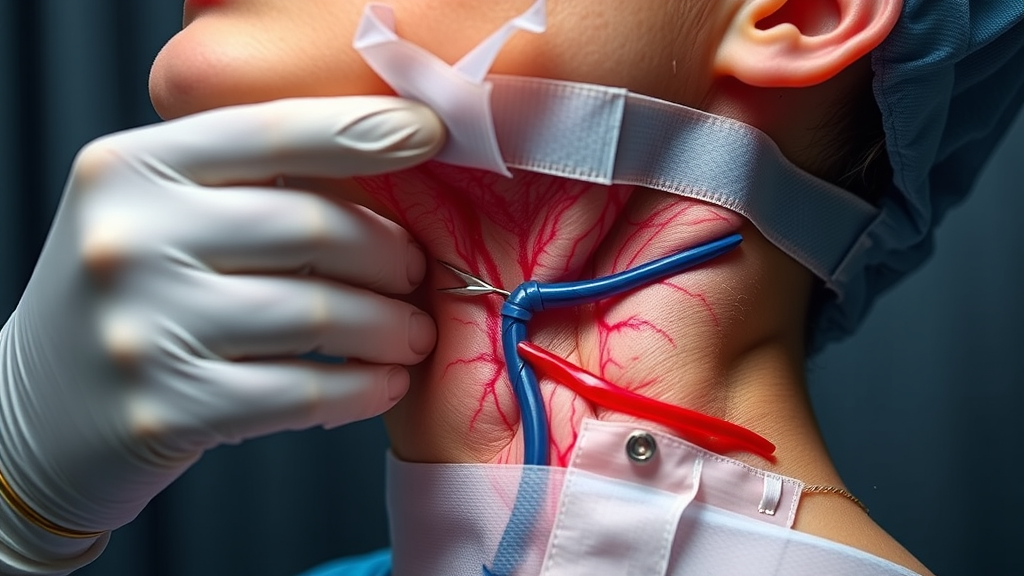
Surgeons in Japan have developed a refined hand-sewing method for connecting blood vessels that they say delivers the safety benefits of a mechanical device without its drawbacks, and their early results in one of the most demanding fields of reconstructive surgery are striking. In a retrospective study published in BMC Plastic and Reconstructive Surgery, a team led by Chihiro Matsui of Juntendo University School of Medicine describes the Evert Style Vessel Anastomosis, or ESVA, a standardized technique designed to bring the delicate inner linings of two vessels into direct, circumferential contact using nothing more than a needle, thread, and an operating microscope. Across 58 anastomoses performed in 32 patients undergoing head and neck free flap reconstruction between 2020 and 2024, the technique was completed without a single vascular complication or flap failure.
The problem the technique addresses is one of the most stubborn in microsurgery. When surgeons rebuild faces, jaws, and throats after cancer removal, they routinely transfer living tissue from elsewhere in the body and hook it into blood vessels in the neck. Those recipient vessels are often poor-quality real estate. Tumor extension triggers inflammation, radiation therapy damages vessel walls, and repeat operations leave behind dense scar tissue. As prior research cited by the team has shown, previous surgery and radiation frequently produce scarring that makes identifying usable vessels exceedingly difficult in what specialists call the vessel-depleted neck.
Why does this matter at the microscopic level? The innermost layer of a blood vessel, the intima, is lined by endothelial cells that normally resist clot formation. When that layer is injured, particularly by vertical defects, the risk of thrombotic occlusion rises sharply. Earlier histological work has documented endothelial damage, intimal hyperplasia, and medial necrosis at failed anastomotic sites, underscoring that preserving intimal integrity is the difference between a thriving flap and a dead one. In a conventional hand-sewn connection, the intimal surface between suture knots can be exposed to high-velocity blood flow, raising the risk of intimal dissection and clot formation at precisely the junction where the flap’s survival is decided.
The hemodynamics of the neck make matters worse. Recipient vessels there sit near the carotid artery, which delivers blood at high flow velocity and pressure. Studies have documented a progressive increase in arterial pedicle flow velocity after free tissue transfer, and the external carotid artery, with its large diameter, moves substantially more blood than its distal branches. That torrent is good news for perfusing a flap but bad news for any rough edges inside the anastomosis. Any technique that leaves thrombogenic surfaces exposed to that flow is playing with fire.
Mechanical coupling devices emerged as one answer. These ring-based couplers evert the vessel ends circumferentially over the device, producing reliable intima-to-intima contact and keeping foreign material out of the vessel lumen. They have been widely adopted, particularly for veins. But couplers come with constraints: they only work within certain vessel diameter ranges, mismatches in vessel size can render them unsuitable, they add cost, and they are not always available in every operating room, especially in resource-limited settings. The Japanese team set out to reproduce the coupler’s geometric advantage purely by hand.
The ESVA technique is elegantly mechanical in its logic. The surgeon everts the outer vessel wall outward while inserting the needle at a perpendicular, 90-degree angle through the everted tissue. After everting the opposing vessel wall, the needle is positioned on the intimal side, ensuring that the two intimal surfaces face each other before penetration. The wall is then pushed from the outside to allow needle passage, and because the tissue remains everted after the needle goes through, the suture can be tied directly in that configuration. Repeated around the circumference, the sequence yields a finished connection in which the endothelial surfaces are closely apposed, mimicking the coupler’s result with no intraluminal foreign body.
To make the method reproducible, the team classified vessel quality into four intraoperative categories: Type 1 vessels that evert easily without atherosclerosis, Type 2 vessels that evert despite atherosclerosis or inflammatory hardening, Type 3 vessels that can be everted only with technical difficulty due to atherosclerosis, calcification, or scarring, and Type 4 vessels that cannot be everted at all. The classification matters because eversion is the anatomical prerequisite of the entire technique. Of 61 end-to-end anastomoses, only three, roughly 4.9 percent, involved Type 4 vessels and required conventional non-everting sewing; the remaining 95.1 percent were successfully completed with ESVA, a remarkable adoption rate in a patient population defined by hostile vessels.
The timing results add a second layer of interest. All anastomoses were performed by a single surgeon with more than a decade of microsurgical experience, working at approximately 10 to 20 times magnification. The team compared two suture materials: standard nylon monofilament with 6-millimeter micro-taper needles, and ACRI+Asflex, a polyvinylidene fluoride monofilament carrying ultra-sharp needles of the same size, used in 9-0 and 8-0 gauges. Arterial anastomosis time fell from 23.4 to 20.8 minutes with the sharper suture, and venous time dropped from 21.4 to 19.2 minutes, differences that reached statistical significance. The advantage grew as vessel quality worsened: in Type 3 cases, venous anastomosis time fell from 24.8 to 19.5 minutes, one of the largest gaps in the study.
Those minute-or-two savings may sound trivial, but in complex head and neck reconstruction they compound meaningfully. Shorter anastomosis time translates into reduced flap ischemia duration, smoother operative workflow, and less surgeon fatigue during procedures that demand sustained precision. In vessels already compromised by calcification or scarring, improved needle penetrability also means fewer passes and less unnecessary manipulation of fragile walls. The authors note that while the suture’s properties complement the technique, ESVA itself defines the anastomotic geometry; the ultra-sharp needle maintains penetrability in hardened tissue while the material provides secure knots with minimal loosening.
The study’s own limitations temper the enthusiasm, and the authors are candid about them. The design was retrospective, the cohort small, and the experience single-surgeon, so the results speak to one expert’s hands rather than the broad surgical community. The sharper suture was introduced partway through the study period, meaning growing procedural familiarity may partly explain the speed gains. There was no concurrent control group using couplers, long-term patency was not assessed, and because some patients contributed more than one anastomosis, the observations are not fully independent. Still, the safety record is unambiguous in this series: no macroscopic intimal damage was visible under the operating microscope, and every flap survived. The team suggests ESVA may also suit small-caliber vessels of roughly 1 to 1.5 millimeters and venous size mismatches where couplers falter, though dedicated studies are needed. If larger, multicenter trials confirm these findings, a technique that requires only thread, skill, and a microscope could bring coupler-grade vascular reliability to operating rooms that have never had access to the devices at all.
Subject of Research: A hand-sewn evert-style microvascular anastomosis technique for head and neck free flap reconstruction
Article Title: Evert style vessel anastomosis: a standardized hand-sewn technique for intima-to-intima contact in microvascular reconstruction
Article References: Matsui, C., Tanaka, T., Arai, G., Arai, T., Sasaki, M., Escandón, J. M., Tachibana, K., & Mizuno, H. (2026). Evert style vessel anastomosis: a standardized hand-sewn technique for intima-to-intima contact in microvascular reconstruction. BMC Plastic and Reconstructive Surgery, 2(1), Article 10. https://doi.org/10.1186/s44452-026-00022-y
Image Credits: AI Generated
DOI: 10.1186/s44452-026-00022-y
Keywords: microsurgery, vessel anastomosis, free flap reconstruction, head and neck cancer, microvascular coupler, intima-to-intima contact, thrombosis, suture technique, reconstructive surgery, vascular complications, ACRI+Asflex suture, Evert
Cite Scienmag News
Ophelia Keating. (September 24, 2026). Hand-Sewn Suture Technique Achieves Coupler-Level Vessel Results in Head and Neck Rebuilds. Scienmag. https://scienmag.com/hand-sewn-suture-technique-achieves-coupler-level-vessel-results-in-head-and-neck-rebuilds/
Ophelia Keating. "Hand-Sewn Suture Technique Achieves Coupler-Level Vessel Results in Head and Neck Rebuilds." Scienmag, 24 September 2026, https://scienmag.com/hand-sewn-suture-technique-achieves-coupler-level-vessel-results-in-head-and-neck-rebuilds/. Accessed 4 October 2026.
Ophelia Keating. "Hand-Sewn Suture Technique Achieves Coupler-Level Vessel Results in Head and Neck Rebuilds." Scienmag. September 24, 2026. https://scienmag.com/hand-sewn-suture-technique-achieves-coupler-level-vessel-results-in-head-and-neck-rebuilds/


