


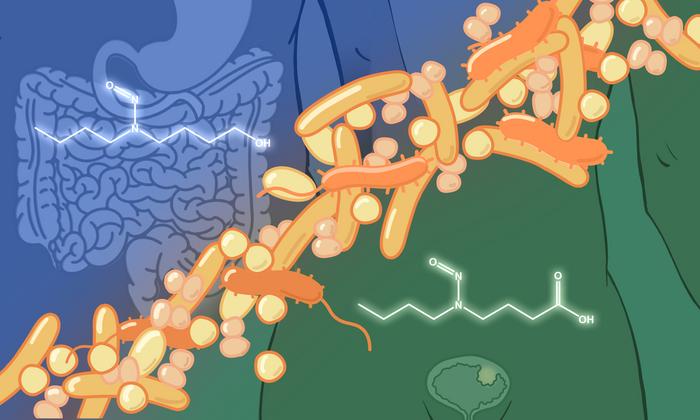
At any given time, over 10 trillion microbes call our guts their home. From breaking down nutrients in our food to strengthening our immunity against pathogens, these microbes play an essential role in how we interact with the world. This includes – as shown in a new study by EMBL researchers and collaborators at the University of Split, Croatia – the way the body responds to carcinogens and develops cancer.

Credit: Isabel Romero Calvo/EMBL
At any given time, over 10 trillion microbes call our guts their home. From breaking down nutrients in our food to strengthening our immunity against pathogens, these microbes play an essential role in how we interact with the world. This includes – as shown in a new study by EMBL researchers and collaborators at the University of Split, Croatia – the way the body responds to carcinogens and develops cancer.
Carcinogens are chemicals that can cause ordinary cells to transform into cancer cells, giving rise to tumours and cancer. They can be found in a number of places, tobacco smoke being one of the most well-known sources. Researchers have previously found that if mice are exposed to the nitrosamine BBN, one of the chemicals found in tobacco smoke, they reliably develop an aggressive form of bladder cancer. This is therefore used as a common laboratory model of carcinogen-induced cancer.
Janoš Terzić’s lab at the University of Split, Croatia, was studying this model when they made a curious observation. If the mice were fed antibiotics, at a dose that kills 99.9% of their gut bacteria, at the same time as they were exposed to BBN the chances of them forming tumours were much lower.
“While 90% of mice exposed to BBN went on to develop bladder tumours, only 10% of those that also received antibiotics did so. This led us to hypothesise that the gut bacteria might be involved in regulating the way BBN is processed in the body,” said Blanka Roje, co-first author of the study and PhD student at the Laboratory for Cancer Research, University of Split School of Medicine in Croatia. “I’ll never forget seeing BBN and BCPN bands on thin layer chromatography plates following overnight incubation of bacteria and BBN.”
“The decrease in tumour incidence was so dramatic that at first I doubted the results, thinking we must have made a mistake somewhere in the experiment. Consequently, we repeated the experiment five times before we finally became ‘believers’,” Terzić said. “It was fantastic to realise that with a treatment – in this case, antibiotics – we were able to abolish cancer development.”
While attending a conference at EMBL Heidelberg, Terzić met with Michael Zimmermann, a group leader at EMBL Heidelberg. The Zimmermann group specialises in using high-throughput methods to study gut microbiome functions, focusing mainly on a process called biotransformation. Biotransformation is the ability microorganisms have to alter or break down chemicals in their environment.
The initial meeting gave rise to a fruitful collaboration. The two groups decided to combine their expertise to understand whether and how gut bacteria affected the way the mice responded to the carcinogen. Using a variety of microbiology and molecular biology methods, the researchers discovered that bacteria living in the mouse gut could convert BBN into BCPN. Like BBN, BCPN belongs to a class of compounds called nitrosamines. However, the team found that, unlike BBN, BCPN concentrates in the urinary bladder and triggers tumour formation in a microbiome-dependent manner.
The researchers next studied over 500 isolated and cultured bacteria to identify the specific bacterial species involved in converting BBN to BCPN. “We found 12 species that can carry out this carcinogen biotransformation,” said Boyao Zhang, co-first author of the study and former PhD student in the Zimmermann group. “We sequenced them and were surprised to find that many of those species were skin-associated and found at relatively low abundance in the gut. We speculated that there might be some transient transfer of such bacteria from the skin to the gut as a consequence of the animals’ grooming. But it was important to figure out whether these findings would also be true for humans.”
Following these initial studies in mice, the scientists used human faecal samples to show that human gut bacteria can also convert BBN to BCPN. As a proof of concept, they showed that if human stool was transplanted into the intestine of a mouse that had no gut microbiome of its own, they could also convert BBN to BCPN.
However, the researchers also observed large individual differences in the ability of the human gut microbiome to metabolise BBN, as well as in the bacterial species involved in the biotransformation. “We think this lays the foundation for further research to see whether a person’s gut microbiome represents a predisposition for chemically induced carcinogenesis and could hence be used to predict the individual risk and potentially prevent cancer development,” said Zimmermann.
“This difference in interindividual microbiota could explain why some people, despite being exposed to potential carcinogens, do not develop cancers while others do,” Terzić added.
Do these findings mean antibiotics can universally prevent cancer? No, of course not, says Zimmermann. “This calls for more studies, including some that we are doing currently, to understand how the microbiome influences the metabolism of different types of carcinogens. It is also important to remember that cancer is a multifactorial disease – there is rarely a single cause.”
The study aligns with EMBL’s Microbial Ecosystems and Human Ecosystems transversal themes, which were introduced in its 2022-26 Programme, ‘Molecules to Ecosystems’. The Microbial Ecosystems theme aims to explore microorganisms and their interactions with each other and with their environments, while the Human Ecosystems theme plans to take advantage of rapidly expanding human datasets to explore the gene–environment interplay and its effects on human phenotypes. Learn more about these research plans here.
Journal
Nature
Method of Research
Experimental study
Article Title
Gut microbiota carcinogen metabolism causes distal tissue tumours.
Article Publication Date
31-Jul-2024
Cite Scienmag News
Nathaniel Bowman. (July 31, 2024). Gut microbes implicated in bladder cancer. Scienmag. https://scienmag.com/gut-microbes-implicated-in-bladder-cancer/
Nathaniel Bowman. "Gut microbes implicated in bladder cancer." Scienmag, 31 July 2024, https://scienmag.com/gut-microbes-implicated-in-bladder-cancer/. Accessed 3 September 2026.
Nathaniel Bowman. "Gut microbes implicated in bladder cancer." Scienmag. July 31, 2024. https://scienmag.com/gut-microbes-implicated-in-bladder-cancer/

