

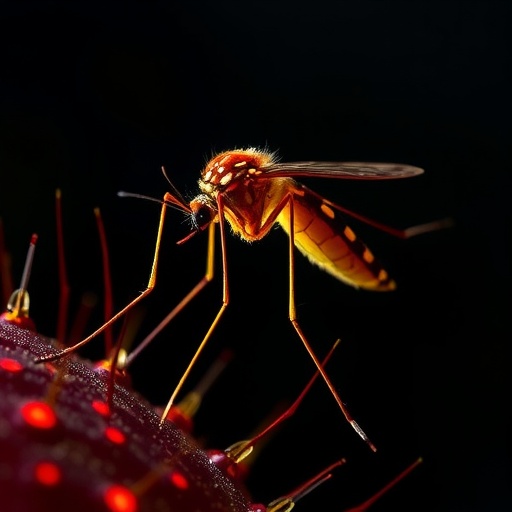
In a groundbreaking study published recently in Current Biology, researchers have uncovered an unexpected signaling hub in the mosquito rectum that plays a pivotal role in coordinating reproductive investment and feeding behavior following blood meals. This discovery not only deepens our understanding of mosquito physiology but also opens up innovative avenues for disrupting the biting behavior of these disease vectors. The research was spearheaded by Laura Duvall, a professor in the Department of Biological Sciences at Columbia University, whose work has fundamentally shifted how scientists think about gut signaling in insects.
For years, the mosquito rectum has remained an understudied organ, largely overlooked by entomologists and neurobiologists alike. Conventional wisdom framed the gut primarily as a system for nutrient absorption and waste elimination. However, Duvall’s team has revealed that this perception is incomplete, demonstrating that the mosquito rectum operates as more than just a digestive endpoint—it acts as a communication center that intricately modulates behavior after blood feeding.
Female mosquitoes, the only sex that bites and transmits pathogens, undergo a notable period of appetite suppression after consuming a blood meal. This interlude, which lasts several days, is essential for the mosquito to digest its meal and convert ingested nutrients into yolk proteins for egg production. Researchers have long puzzled over the molecular and physiological underpinnings of this temporary satiety, which essentially silences the mosquito’s drive to bite new hosts. Crucially, Duvall’s earlier research had identified a receptor—Neuropeptide Y-like Receptor 7 (NPYLR7)—as a molecular switch that mediates this newly discovered satiety state.
The current study takes this finding several steps further by investigating where and how NPYLR7 functions within the mosquito’s body. The team hypothesized that the receptor would be widely distributed and, notably, present in the brain, mirroring known patterns in other animal species where this receptor family regulates feeding. Surprisingly, their investigations pointed not to the brain but rather to the rectum as the primary site of NPYLR7 activity. This shift in focus to the rectum challenges traditional views on neuroendocrine control of feeding and demonstrates that peripheral tissues can play integral roles in behavioral regulation.
Using sophisticated calcium imaging techniques, Duvall and colleagues tracked cellular activity within the rectum after mosquitoes fed on blood. They employed a calcium-sensitive fluorescent protein that “glows” in response to increased intracellular calcium—this signal being a proxy for cellular activation. Their experiments revealed that nerve terminals adjacent to the rectal cells release a peptide known as RYamide upon blood feeding, which binds to and activates NPYLR7. In response, the rectal cells exhibited robust calcium influxes akin to neuronal responses seen in nervous tissue.
Intriguingly, the rectal cells did not merely respond passively; they appeared to engage in bidirectional communication. After activation of NPYLR7 by RYamide peptides, the rectal cells likely release their own signaling packets, functioning as neurosecretory-like cells. This behavior suggests that these rectal cells could be considered ‘semi-neuronal’—forming a novel type of sensor and effector in the gut that directly channels information back to the mosquito’s central nervous system.
The functional significance of this gut-brain communication hub becomes clearer when considering the nutritional context. Duvall proposes that these rectal cells may directly sense the composition and presence of nutrients within the gut lumen, effectively providing a continuous readout of the mosquito’s satiety status. This feedback loop would then regulate feeding drive and reproductive strategies by informing the brain whether the mosquito should seek out more blood or focus on egg development.
This discovery aligns with a growing consensus in biology that the gut is a dynamic signaling organ influencing a wide range of behaviors across taxa. Parallels can be drawn to mammals, where gut-derived peptides such as glucagon-like peptide-1 (GLP-1) exert potent appetite-suppressing effects. These molecules have recently become targets for pharmacological interventions in weight management, underscoring the fundamental role of gut-nervous system interactions in energy homeostasis. The mosquito model now offers a unique comparative system to study neuropeptide signaling in invertebrates, potentially leading to novel biocontrol strategies.
One of the most promising practical implications of Duvall’s work is the identification of the rectum and its associated NPYLR7 receptor as accessible targets for disrupting mosquito blood-feeding behavior. Unlike receptors buried deep within the central nervous system, those located in the gut are more amenable to pharmacological intervention via ingestion. This means that it might be possible to develop compounds that mosquitoes consume, which would activate or block NPYLR7, thus altering their feeding preferences and reducing disease transmission.
Additionally, understanding the cellular and molecular machinery underpinning mosquito satiety could facilitate the design of innovative repellents or attractants that manipulate mosquito behaviors with unprecedented precision. Such strategies have the advantage of being highly species-specific, potentially minimizing ecological disruption and resistance development compared to traditional insecticides.
This research also illustrates the power of combining molecular genetics with advanced imaging and neuroethological approaches. By visualizing neural and semi-neural activity in situ, the study provides a real-time window into how peripheral tissue communicates with neural circuits. It is a vivid example of how integrative biology can shed light on complex behaviors crucial to public health outcomes.
In sum, Duvall’s findings reshape our understanding of feeding regulation in mosquitoes, revealing a sophisticated gut-brain axis that balances nutrient sensing with reproductive needs. This signaling nexus in the rectum represents a critical control point that could be leveraged to reduce mosquito biting and the spread of vector-borne diseases. As researchers continue to dissect the molecular dialogues within the mosquito gut, new doors may open for thwarting some of the world’s deadliest pests, potentially saving millions of lives.
The study highlights the broader biological principle that tissues traditionally considered peripheral can have profound neurophysiological roles. It suggests that multidisciplinary approaches exploring gut-brain communication across organisms will yield rich insights into the evolution and modulation of feeding behaviors. For scientists and public health advocates alike, this work signals a paradigm shift with exciting translational potential.
As technology advances, further research will likely focus on identifying the full repertoire of peptides and signaling molecules involved, as well as how environmental factors influence this gut-based control system. Understanding how these pathways integrate with the mosquito’s broader neuroendocrine network will be essential for developing robust and sustainable interventions. Duvall’s study thus stands as a landmark in both entomology and neurobiology, emphasizing the mosquito rectum not just as a biological curiosity but as a target rich with promise.
Subject of Research: Animals
Article Title: A Signaling Hub in the Mosquito Rectum Coordinates Reproductive Investment After Blood Feeding
News Publication Date: 20-Mar-2026
Web References: Current Biology Journal, DOI: 10.1016/j.cub.2026.02.042
Keywords: mosquito physiology, neuropeptide Y-like receptor 7, gut-brain axis, feeding behavior, RYamide, calcium imaging, reproductive investment, vector control, GLP-1 analogs, neuroendocrine signaling, mosquito rectum, entomology


