


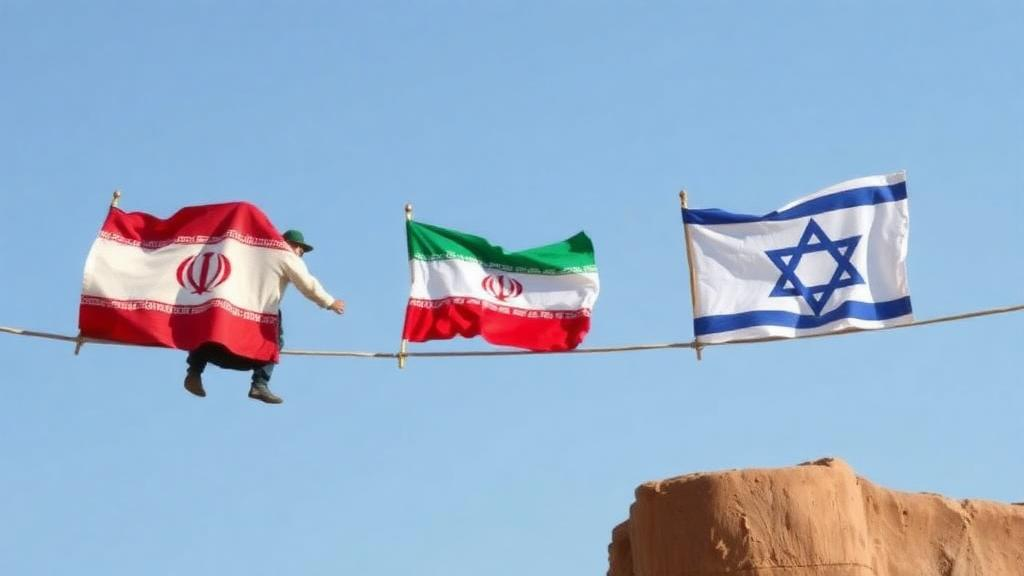
When Hamas launched its attack on Israel on 7 October 2023, few expected the shockwaves to travel as far as the Persian Gulf as quickly as they did. Within months, every state along the Gulf’s western and southern shores found itself navigating a conflict that touched its domestic politics, its economic security and its carefully constructed web of international partnerships. A new study published in SN Social Sciences by Sumant Kumar of Alliance University in Bangalore argues that the Iran–Israel rivalry has intensified strategic pressure on all Gulf countries, and that their responses to the war in Gaza reveal a consistent underlying logic: nation-state interests prevail. According to the research, Gulf governments calibrated their reactions not primarily in response to geopolitical pressure from Tehran or Jerusalem, but according to domestic priorities, regime security and the demands of regional and global partnerships.
The analytical framework behind the study draws on regional security complex theory, first developed by Barry Buzan and Ole Wæver, which treats security as socially constructed within geographically clustered groups of states whose fates are interlocked. The Gulf is one of the world’s most tightly coupled security complexes: energy exports funnel through the Strait of Hormuz, United States military bases dot the coastline of the Gulf Cooperation Council states, and the ideological contest between Riyadh and Tehran has shaped proxy conflicts from Yemen to Lebanon for more than a decade. Kumar’s study situates the Gaza war within this structure, arguing that Gulf countries’ historical support for Palestinian rights against Israeli occupation helped start the Arab–Israeli conflict in the first place, and that this legacy still constrains their freedom of manoeuvre today, even as several of them have normalised or explored normalisation of ties with Israel.
The study’s central finding is that the Gulf states never adopted a unified stance on the Israel–Hamas war. Instead, each government pursued a calibrated balance-of-power approach shaped by three considerations: regime security, regional and global partnerships, and a carefully managed public position on Palestine. This fragmentation is significant because the Gulf Cooperation Council has often been treated in Western analysis as a bloc. In practice, Saudi Arabia, the United Arab Emirates, Qatar, Kuwait, Bahrain and Oman each weighed the war through distinct domestic lenses. Bahrain, which normalised relations with Israel under the Abraham Accords in 2020, faced a different domestic environment from Qatar, which hosts Hamas’s political office and has served as a key mediator. Kuwait’s parliament historically constrains its foreign policy in ways the more centralised Emirati system does not. The result was a spectrum of responses rather than a single Gulf position.
A crucial variable in the study is Iran’s so-called forward defence strategy. Rather than confronting Israel or the United States directly, Iran projects power through allied non-state actors, most prominently Hamas in Gaza and Hezbollah in Lebanon. The war in Gaza, Kumar argues, gained regional salience for this strategy and strengthened Iran’s axis of resistance, the network of Iran-backed militias that stretches across Lebanon, Syria, Iraq, Yemen and the Palestinian territories. Technically, forward defence functions as a form of asymmetric deterrence: by positioning armed partners on Israel’s borders, Iran raises the costs of any strike against its own territory without ever firing a shot from Iranian soil. The study finds that Iran does not seek direct escalation but prefers to calibrate its support to avoid direct interstate war, a pattern visible in the carefully limited exchanges between Iran and Israel that have punctuated the wider conflict.
The Gulf states’ perception of Iran’s ideological ambitions remains negative, yet the war produced an unexpected alignment dynamic. Because every single Gulf country has been affected by both Israel’s and Iran’s stances, the conflict pushed them toward pragmatic convergence with one another and, in some respects, toward shared positions with Israel on questions of regional stability. Saudi Arabia and Iran, in a striking development, restored diplomatic relations in a Chinese-brokered agreement, a rapprochement that scholars have interpreted as an attempt to insulate the Gulf security complex from the worst effects of great-power competition and regional proxy warfare. At the same time, Gulf states warned that their airspace must not be used in military exchanges between Israel and Iran, signalling that their tolerance for being drawn into the confrontation was strictly limited.
Energy economics provides a technical backbone to these calculations. Research cited in the study shows that air and drone strikes in the Middle East measurably affect global energy stocks, and that geopolitical turbulence in the region reshapes the global energy landscape. The Gulf states sit atop a substantial share of the world’s proven oil and gas reserves, and their economic diversification agendas, from Saudi Vision 2030 to the Emirates’ investment in technology and tourism, depend on stable shipping lanes and predictable risk premiums. The 2012 opening of a pipeline bypassing the Strait of Hormuz was an early acknowledgment of this vulnerability. Naval procurement strategies across the Gulf have similarly followed a three-level logic, balancing constabulary duties, deterrence against Iran and partnership with external navies. Every escalation in the Levant therefore carries a direct fiscal and logistical cost for Gulf capitals, whatever their political sympathies.
Humanitarian policy has emerged as one of the few arenas where Gulf states could act visibly and relatively uncontroversially. The study documents fluctuating solidarity and what one cited analysis calls humanitarian exceptionalism in Gulf aid to Gaza, with the United Arab Emirates dispatching its largest humanitarian aid ship to the territory amid the deepening crisis. The urgency of these efforts grew as famine was confirmed in Gaza for the first time, with United Nations agencies and the World Health Organization issuing irrefutable assessments of acute food insecurity in 2025. Aid diplomacy allowed Gulf governments to demonstrate commitment to Palestinian welfare, satisfying domestic and wider Arab public opinion, while avoiding the military and ideological entanglements that direct confrontation with Israel would entail.
The Abraham Accords loom over the entire analysis. Signed in 2020, the accords reshaped the pattern of friendship and enmity in the Middle East regional security complex, reclassifying Israel from an existential other to a potential regional partner in the eyes of several Gulf governments. Yet the Gaza war tested this transformation severely. Scholarly work cited in the study examines whether normalisation dynamics between the Gulf Cooperation Council and Israel survived the conflict, and Saudi–Israeli normalisation has followed what one analysis describes as a rocky road, with Riyadh linking any formal agreement to progress on Palestinian statehood. The Israeli strike on Hamas negotiators in Qatar in 2025, which the United Nations Security Council warned risked opening a new and perilous chapter in the conflict, further complicated the security partnerships that the accords were meant to cement.
Kumar’s findings also speak to a broader theoretical debate in international relations about alignment in the developing world. Classic scholarship on third-world alignment, from Steven David’s work on omnibalancing to Cheng-Chwee Kuik’s analysis of hedging, suggests that smaller and middle powers rarely choose sides outright; instead, they pursue contradictory policies simultaneously to offset multiple risks. The Gulf states’ Gaza responses fit this pattern precisely. They condemned Israeli military actions rhetorically while maintaining security and intelligence cooperation with Israel; they distrusted Iran’s regional ambitions while coordinating with Tehran on de-escalation; they hosted American forces while courting Chinese investment and mediation. Hedging, in this reading, is not indecision but a deliberate strategy for states whose regime survival depends on managing multiple external patrons and threats at once.
The study’s conclusion, that nation-state interests prevail, carries implications well beyond the Gulf. It suggests that predictions of a unified Arab or Islamic bloc response to the Gaza war misread the region’s underlying political economy. Gulf monarchies are increasingly governed by the calculus of economic transformation, sovereign wealth and great-power hedging, and their policies toward Palestine will continue to be filtered through those priorities. As the Iran–Israel rivalry grinds on, the Gulf states are likely to remain what the study implicitly describes them as: pivotal but cautious actors, seeking stability above all, calibrating every statement and shipment of aid against the twin risks of domestic unrest and regional conflagration. For a region whose security is so densely interdependent, the war in Gaza has demonstrated that no Gulf capital can fully opt out, but none is willing to be consumed by it either.
Subject of Research: Gulf states' foreign policy responses to the Gaza war within the Iran–Israel rivalry
Article Title: The Iran–Israel rivalry and its implications: Gulf states’ responses to the war in Gaza
Article References: Kumar, S. (2026). The Iran–Israel rivalry and its implications: Gulf states’ responses to the war in Gaza. SN Social Sciences, 6(9), Article 432. https://doi.org/10.1007/s43545-026-01710-3
Image Credits: AI Generated
DOI: 10.1007/s43545-026-01710-3
Keywords: Iran–Israel rivalry, Gulf states, Gaza war, Hamas, Hezbollah, axis of resistance, Abraham Accords, regional security complex theory, hedging, Saudi Arabia, Iran, regime security
Cite Scienmag News
Courtney Benton. (October 10, 2026). Gulf States Walk a Tightrope as the Iran–Israel Rivalry Reshapes Regional Order. Scienmag. https://scienmag.com/gulf-states-walk-a-tightrope-as-the-iran-israel-rivalry-reshapes-regional-order/
Courtney Benton. "Gulf States Walk a Tightrope as the Iran–Israel Rivalry Reshapes Regional Order." Scienmag, 10 October 2026, https://scienmag.com/gulf-states-walk-a-tightrope-as-the-iran-israel-rivalry-reshapes-regional-order/. Accessed 10 October 2026.
Courtney Benton. "Gulf States Walk a Tightrope as the Iran–Israel Rivalry Reshapes Regional Order." Scienmag. October 10, 2026. https://scienmag.com/gulf-states-walk-a-tightrope-as-the-iran-israel-rivalry-reshapes-regional-order/


