

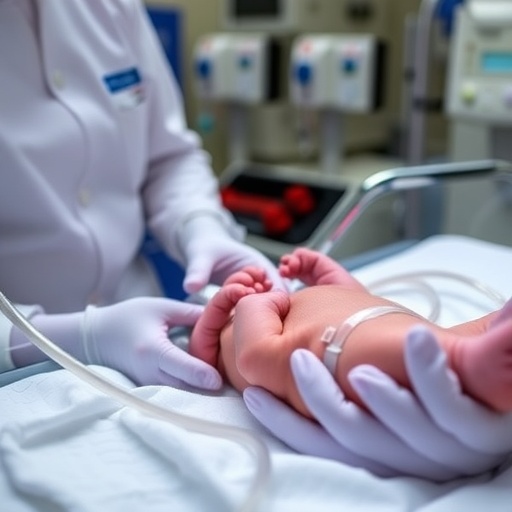
The intricate transition from fetal to neonatal life is an extraordinary physiological event, demanding precise coordination between cardiopulmonary systems. For newborns diagnosed with critical congenital heart disease (CCHD) prior to birth, this transition is compounded by atypical heart anatomies and altered circulatory dynamics that defy conventional neonatal resuscitation protocols. Addressing this challenge, a multidisciplinary team has pioneered lesion-specific clinical practice guidelines (CPGs) tailored for delivery room management of six profoundly high-risk CCHD subtypes. These guidelines represent a landmark advancement aiming to revolutionize care delivery during one of the most vulnerable phases of life.
Critical congenital heart disease, a collective term for life-threatening structural heart defects present at birth, necessitates specialized management strategies immediately after delivery. Standard neonatal resuscitation frameworks, while effective for the majority, often fall short in addressing the idiosyncratic physiology of CCHD patients. The newly formulated clinical guidelines encompass six distinct diagnoses: hypoplastic left heart syndrome (HLHS), dextro-transposition of the great arteries (d-TGA), Ebstein anomaly, congenital complete heart block, total anomalous pulmonary venous return (TAPVR), and tetralogy of Fallot with absent pulmonary valve. Each condition entails unique cardiopulmonary challenges that the guidelines meticulously address.
The formulation of these guidelines was a collaborative effort involving neonatologists, cardiologists, and cardiac intensivists, underscoring the multidisciplinary nature of managing CCHD in the delivery room (DR). This integrated approach fosters a shared mental model among healthcare professionals, a critical factor in emergent settings where rapid decisions are lifesaving. The guidelines do not merely standardize care but create a cognitive framework enabling teams to anticipate patient-specific needs and respond with precision.
Integral to these guidelines is the establishment of structured escalation thresholds concerning oxygen supplementation, respiratory support modes, intubation timing, and pharmacological interventions. These parameters recognize the delicate balance required in oxygen delivery, as hyperoxia can be as detrimental as hypoxia in patients with unique shunt physiology. The protocols advocate for titrated oxygen administration leveraging real-time monitoring tools to minimize oxidative stress while ensuring adequate tissue perfusion.
Advanced respiratory support modalities are delineated with lesion-specific nuances that account for pulmonary blood flow dynamics altered by the underlying cardiac defect. For instance, infants with HLHS require careful modulation of ventilation pressures to avoid disrupting the balance between systemic and pulmonary circulations. Meanwhile, infants with d-TGA benefit from early prostaglandin administration to maintain ductal patency, a pharmacological cornerstone woven seamlessly into the guidelines.
Intubation protocols within these CPGs emphasize timing and technique adaptive to the hemodynamic status unique to each lesion. The guidelines accommodate scenarios where immediate intubation may either stabilize or destabilize the neonate, providing clear criteria based on oxygen saturation trends, respiratory effort, and circulatory markers. This level of specificity is unprecedented, reducing the risk of inadvertent harm in complex physiological states.
Beyond the acute management focus, the guidelines underscore the importance of robust provider education. Training modules grounded in these protocols aim to enhance team preparedness and procedural competence, fostering confidence in managing rare but critical scenarios. By codifying knowledge into actionable steps, the guidelines elevate the standard of care attainable across both cardiac specialty centers and non-specialized birthing facilities.
Another transformative impact of these guidelines lies in the enhancement of family counseling. Prenatal diagnosis of CCHD invariably introduces significant parental anxiety and necessitates sensitive communication about expected interventions. These standardized protocols offer a clear roadmap clinicians can share with families, elucidating the immediate postnatal plan and potential outcomes. Such transparency supports informed decision-making and emotional preparedness.
The framework’s scalability is notable, designed to be adaptable to diverse healthcare settings regardless of on-site cardiac surgery availability. This inclusivity ensures equitable care delivery, as smaller or resource-limited institutions can implement a structured, evidence-informed approach rather than relying solely on referral or transfer. Consequently, neonatal outcomes may improve through widespread adoption and localization of these guidelines.
From a physiological standpoint, the guidelines elegantly bridge theoretical cardiovascular principles with clinical pragmatism. The nuanced understanding of shunt physiology, ventricular interdependence, and oxygen delivery is translated into clear bedside directives. This integration represents a synthesis of contemporary cardiac science with frontline neonatal resuscitation practice, setting new benchmarks for evidence-based care.
The development process itself reflects an evolving paradigm whereby interdisciplinary collaboration and consensus-building yield superior clinical tools. By leveraging collective expertise, the guidelines counter the historic fragmentation in CCHD management between obstetric, neonatal, and cardiology teams. The resulting documents serve as a unifying script to coordinate care efforts seamlessly in high-pressure environments.
Looking ahead, these guidelines may catalyze further innovations, including digital decision support tools harnessing artificial intelligence to tailor real-time interventions based on individual patient parameters. Such evolution would deepen personalization of care, combining technological advances with the foundational structure these protocols establish.
In sum, the introduction of lesion-specific delivery room CPGs for newborns with prenatally diagnosed critical congenital heart disease constitutes a paradigm shift. By honoring the complexity and heterogeneity of CCHD physiology, these guidelines not only standardize care but elevate it, promising improved neonatal survival and long-term outcomes. Their adoption marks a crucial stride toward optimizing the earliest moments in the lives of the most fragile infants.
As the medical community assimilates these guidelines, ongoing data collection and outcome analysis will be vital to refine recommendations and address emerging clinical scenarios. This iterative process will ensure guidelines remain responsive to advances in neonatal cardiology and resuscitation science. Ultimately, the collaborative spirit and clinical rigor embodied in this initiative represent a beacon of progress in perinatal medicine.
The significance of these clinical practice guidelines extends beyond their immediate application, embodying an educational and operational ethos. They demonstrate how complex congenital conditions can be approached systematically, transforming uncertainty into actionable knowledge. This blueprint may inspire analogous efforts across other domains of perinatal care marked by high complexity and low frequency.
In an era where precision medicine is increasingly prioritized, these lesion-specific protocols exemplify its principles applied at the critical threshold of life. By delivering tailored interventions grounded in robust physiological insight, the guidelines align with broader goals of personalized neonatal care. Their impact will be measured not only in survival rates but in the quality of life afforded to survivors.
These advances underscore the imperative for continual innovation at the interface of cardiology and neonatology. As prenatal diagnosis capabilities improve and the spectrum of CCHD expands, evolving clinical tools such as these guidelines will be indispensable. They crystallize a forward-looking approach that harnesses expertise, technology, and compassion in the high-stakes environment of neonatal resuscitation.
Ultimately, this work underscores that in the delicate dance of perinatal transition, mastery over pathophysiological nuance translates into saved lives and brighter futures. The development and dissemination of these specialized clinical practice guidelines herald a new era of hope and excellence in caring for newborns facing critical congenital heart disease.
Subject of Research: Delivery room resuscitation and management protocols for newborns with prenatally diagnosed critical congenital heart disease (CCHD).
Article Title: Importance of clinical practice guidelines for specialized delivery room resuscitation of newborns with prenatally diagnosed critical congenital heart disease.
Article References:
Thomas, A.R., Geisser, D., Kaza, E. et al. Importance of clinical practice guidelines for specialized delivery room resuscitation of newborns with prenatally diagnosed critical congenital heart disease. J Perinatol (2026). https://doi.org/10.1038/s41372-025-02552-2
Image Credits: AI Generated
DOI: 05 January 2026


