


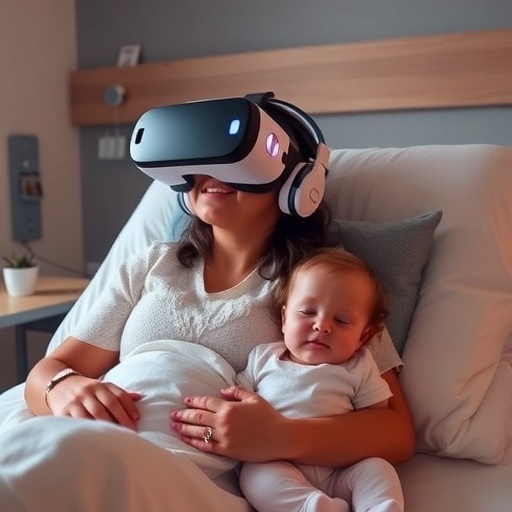
Parenting during a child’s hospitalization is an inherently stressful experience, placing immense psychological burdens on caregivers who often prioritize their child’s health over their own well-being. Recognizing this challenge, researchers from Stanford Medicine have pioneered an innovative intervention using virtual reality (VR) technology to address caregiver anxiety in a clinical setting. This approach, which leverages immersive VR-guided meditation, represents a breakthrough in scalable mental health support tailored specifically for parents navigating the hospital environment.
Hospital stays often exacerbate parental stress and anxiety, disrupting emotional equilibrium and complicating caregiving roles. Traditional in-person mental health support, while effective, is resource-intensive and difficult to offer consistently to every parent. The Stanford team sought a pragmatic alternative by utilizing VR headsets delivering a succinct, six-minute guided meditation. This intervention immerses the user in a calming virtual nature scene, designed to facilitate relaxation and promote resilience through focused breathing and visual engagement.
The study, recently published in the Journal of Patient Experience, employed a randomized controlled design involving 200 parents of pediatric inpatients at Lucile Packard Children’s Hospital Stanford. Participants were stratified by language preference, receiving the meditation either in English or Spanish, allowing for an analysis of culturally sensitive delivery. Those assigned to the VR meditation group experienced a statistically significant reduction in self-reported anxiety—approximately 30% lower post-intervention—compared to a control cohort employing their usual anxiety-management strategies such as social interaction, reading, or music listening.
What distinguishes this research is not only its efficacy but its adaptability. The VR experience simulates a tranquil mountainous landscape featuring dynamic natural elements—a gently flowing creek, a subtle waterfall, and an expansive twilight sky. The guided meditation is carefully scripted to synchronize breath pacing with evolving visual cues: the gradual emergence of stars, the aurora borealis, and rhythmic pulses of clouded breath—elements designed to engage multiple sensory pathways and deepen relaxation. This multisensory approach leverages neurological mechanisms of attention and respiration regulation, which are pivotal in stress modulation.
An intriguing finding from the study spotlighted greater anxiety alleviation among Spanish-speaking participants. This suggests that VR interventions may help bridge gaps in mental health resources often encountered by non-English-speaking populations. Language barriers frequently pose secondary stressors in hospital settings, complicating communication with medical staff and undermining caregivers’ sense of control. The availability of culturally and linguistically tailored VR content thus addresses a crucial unmet need, fostering inclusivity in supportive care.
Lead author Ricardo Jimenez, a medical student with a personal background in healthcare navigation for Spanish-speaking families, emphasized that the intervention’s impact extended beyond anxiety measurements. Many parents expressed emotional vulnerability during post-meditation discussions, revealing that the novel experience facilitated openness about their mental health struggles. This underscores the potential of VR not only as a therapeutic modality but also as a gateway for engagement and dialogue in clinical environments.
From a technical standpoint, deploying VR-guided meditation in busy hospital wards involved addressing practical challenges such as device sanitization, user training, and integration into existing care workflows. The research team developed protocols to maximize ease of use by clinical staff and parents, ensuring consistent delivery. This pragmatic model enhances scalability, suggesting VR may become a standard adjunct in family-centered pediatric care without imposing substantial operational burdens.
The psychological mechanisms underlying the intervention’s success relate to attentional redirection and autonomic nervous system regulation. The immersive nature scene serves as an attentional anchor, distracting from ruminative thoughts related to the child’s illness. Simultaneously, breath pacing guided by visual cues stabilizes heart rate variability—a biomarker of stress resilience. These convergent effects culminate in measurable anxiety reduction, highlighting VR’s capacity to modulate neurophysiological stress responses in real time.
Moreover, the study marks an important step in the transition from patient-focused to family-centered therapeutic technologies. While prior VR applications in pediatric settings primarily targeted pain and procedural anxiety in children, this initiative broadens VR’s utility to caregivers who indirectly experience substantial distress. Recognizing and mitigating caregiver anxiety can also indirectly improve pediatric outcomes, as calmer, more supported parents are better equipped to engage with clinical teams and advocate for their children.
The Stanford Medicine Chariot Program, which spearheads this research, continues to expand its VR content library, exploring additional languages and mental health scenarios relevant to diverse caregiver populations. Future directions include longitudinal studies to assess sustained benefits and investigations into how VR experiences may interact with other psychosocial supports. This continued innovation taps into a growing body of evidence supporting technology-assisted mindfulness and cognitive-behavioral strategies.
Equally noteworthy is the feedback loop between pediatric patient VR tools and caregiver interventions. The hospital’s existing VR applications for children’s surgical anxiety inspired the current study after staff noted parents often wished for similar resources. This cross-pollination of ideas exemplifies how patient-centered innovations can stimulate improvements in holistic care models, addressing the psychological ecosystem surrounding hospitalized children.
In sum, VR-guided meditation emerges from this research as a promising, scalable method to alleviate caregiver anxiety in pediatric hospital contexts. Its capacity to deliver culturally sensitive, multisensory therapeutic interactions offers a model for integrating cutting-edge technology into psychosocial care. By providing parents with accessible tools to manage their mental health amidst the intense pressures of hospitalization, this approach stands to transform family-centered pediatric healthcare practices in meaningful and lasting ways.
- https://journals.sagepub.com/doi/full/10.1177/23743735251326671
- https://www.stanfordchildrens.org/
- https://chariot.stanford.edu/
- http://dx.doi.org/10.1177/23743735251326671
References: Journal of Patient Experience
Keywords: Anxiety, Pediatrics
Cite Scienmag News
Glenn Wilkins. (May 1, 2025). Guided VR Meditations Alleviate Anxiety in Parents of Hospitalized Children, Study Finds. Scienmag. https://scienmag.com/guided-vr-meditations-alleviate-anxiety-in-parents-of-hospitalized-children-study-finds/
Glenn Wilkins. "Guided VR Meditations Alleviate Anxiety in Parents of Hospitalized Children, Study Finds." Scienmag, 1 May 2025, https://scienmag.com/guided-vr-meditations-alleviate-anxiety-in-parents-of-hospitalized-children-study-finds/. Accessed 3 September 2026.
Glenn Wilkins. "Guided VR Meditations Alleviate Anxiety in Parents of Hospitalized Children, Study Finds." Scienmag. May 1, 2025. https://scienmag.com/guided-vr-meditations-alleviate-anxiety-in-parents-of-hospitalized-children-study-finds/


