

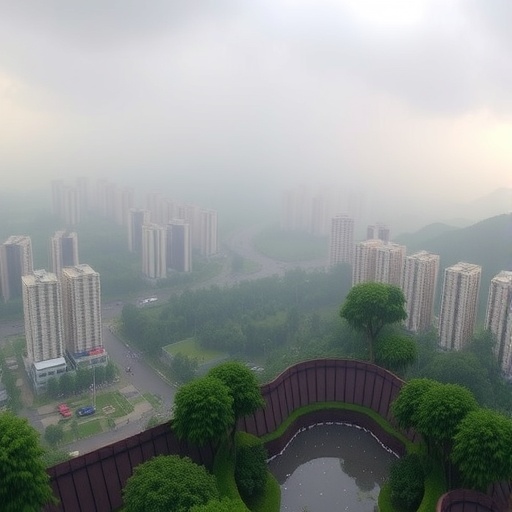
Japan’s geographical and climatic complexity places it at the forefront of nations vulnerable to severe hydrometeorological disasters. This island nation, characterized by varied climate zones and intricate topography, confronts the persistent threat of intense rainfall and flooding. These natural hazards are exacerbated by the advancing impacts of global warming, which escalate both the frequency and severity of extreme precipitation events. As climate change continues to disrupt historical weather patterns, accurately predicting these events becomes indispensable for safeguarding critical infrastructure and rural communities that are particularly susceptible to flood risks.
Despite advances in meteorological observation, Japan faces a substantial challenge: weather stations are densely clustered in urban centers, leaving vast rural regions under-monitored. This uneven distribution results in significant statistical voids, complicating efforts to accurately map and predict extreme rainfall across the entire country. Conventional methodologies such as kriging have been the mainstay for spatial interpolation of weather data; however, these approaches frequently underestimate extreme values, diminishing their utility for disaster preparedness. Furthermore, Bayesian hierarchical models employing Markov Chain Monte Carlo (MCMC) techniques offer potential solutions but at the cost of prohibitive computational demands that limit practical deployment at large scales.
Addressing these challenges, a team of researchers from Osaka Metropolitan University, including Associate Professor Jihui Yuan, Emeritus Professor Kazuo Emura, and Professor Craig Farnham, together with Visiting Researcher Zhichao Jiao from Yantai University, embarked on a comprehensive study designed to enhance the spatial prediction of extreme precipitation. Leveraging an unprecedented dataset comprising hourly rainfall measurements from 752 meteorological stations spanning 1981 to 2020, their inquiry sought to advance forecasting models applicable to Japan’s diverse climatic regions, segmented into four distinct areas across the nation’s major islands.
Central to the study was the application of the Generalized Extreme Value (GEV) distribution, employed to estimate the statistical behavior of extreme precipitation at each observation point using the MCMC method. This statistical framework allowed the researchers to compute return periods for rainfall events occurring over intervals of 2, 5, 10, 25, 50, and 100 years, thereby quantifying the probability and intensity of future extreme rainfall episodes. Building upon these foundational statistics, the team undertook a comparative assessment of spatial modeling techniques—specifically the Integrated Nested Laplace Approximation coupled with Stochastic Partial Differential Equation modeling (INLA-SPDE), ordinary kriging (OK), and kriging with external drift (KED).
The INLA-SPDE method, increasingly recognized for its efficiency in handling large-scale environmental datasets, successfully mitigated the computational intensity characteristic of MCMC-based models. By integrating spatial covariates such as annual precipitation totals, proximity to coastlines, and population density, the researchers were able to refine predictive accuracy and provide nuanced spatial forecasts for unmonitored regions. The robustness of each model was rigorously evaluated using Leave-One-Out Cross-Validation (LOOCV), a resampling technique that validates predictive performance while minimizing bias due to data omission.
Analysis revealed that the INLA-SPDE model, particularly the variant incorporating annual precipitation as a covariate (SPDE1), outperformed traditional kriging methods by delivering higher prediction stability and reducing underestimation of extreme rainfall values. Notably, the SPDE1 model exhibited lower standard deviations during extended return periods, indicating improved confidence in forecasting rare, high-impact rainfall events. This enhanced precision uncovered a northward expansion of high-risk zones across Japan’s main islands, signaling a shifting landscape of vulnerability in response to climatic changes.
Professor Jihui Yuan emphasized the transformative potential of this research, noting its critical role in elevating the quality and reliability of disaster prevention plans. By highlighting the limitations inherent in conventional hazard mapping and introducing a scientifically rigorous framework for flood risk assessment under evolving climate scenarios, the study paves the way for more responsive and adaptive disaster management strategies. The implications extend beyond national borders, offering a methodological blueprint for other regions grappling with similar spatial forecasting challenges.
Looking ahead, the research team plans to incorporate dynamic meteorological variables, such as typhoon trajectories and evolving atmospheric conditions, into the spatiotemporal modeling framework. This advancement aims to capture the temporal progression of extreme rainfall events with greater fidelity, moving toward real-time high-resolution forecasting capabilities. Such innovations promise to revolutionize early warning systems, enabling preemptive action and potentially mitigating the human and economic toll of flooding disasters.
The study also underscores the strategic importance of refining spatial statistical models to handle complex topographies like Japan’s. The success of the INLA-SPDE approach within this context suggests widespread applicability in comparable geographic settings worldwide, where topography and climate heterogeneity similarly complicate environmental prediction. By achieving computational efficiency without sacrificing predictive quality, this methodology holds promise for expanding scientific understanding and practical forecasting of climate extremes globally.
Published in the Journal of Hydrology: Regional Studies, this investigation contributes a vital chapter to the evolving discourse on climate resilience. It bridges theoretical advancements in spatial statistics with urgent applied needs, representing a confluence of environmental science, data modeling, and public policy. As climate change accelerates, such interdisciplinary work becomes ever more critical for building societies capable of withstanding and adapting to unprecedented natural hazards.
The research not only sets a new benchmark for extreme precipitation modeling but also serves as a clarion call for expanded observational infrastructure in rural regions. Enhanced real-time data collection, coupled with sophisticated spatial analytics, will markedly improve the granularity and reliability of predictions. Together, these elements foster a proactive approach to sustainable infrastructure planning and disaster risk reduction, essential for safeguarding communities in an era dominated by climatic uncertainty.
In sum, this study charts a promising path forward in the scientific quest to predict and manage extreme rainfall events, melding advanced statistical techniques with practical imperatives. Its findings resonate with a broad audience—from climate scientists and engineers to policymakers and emergency responders—illuminating the challenges ahead and the tools now in hand to confront them with rigor and resilience.
Subject of Research: Not applicable
Article Title: Assessing the risk of extreme precipitation in Japan through GEV distribution and spatial modeling
News Publication Date: 6-Jan-2026
Web References: Osaka Metropolitan University
References: Journal of Hydrology: Regional Studies, DOI: 10.1016/j.ejrh.2026.103107
Image Credits: Osaka Metropolitan University
Keywords: Extreme precipitation, climate change, spatial modeling, INLA-SPDE, kriging, Generalized Extreme Value distribution, Markov Chain Monte Carlo, flood risk, Japan, disaster preparedness, climate resilience, statistical analysis


