


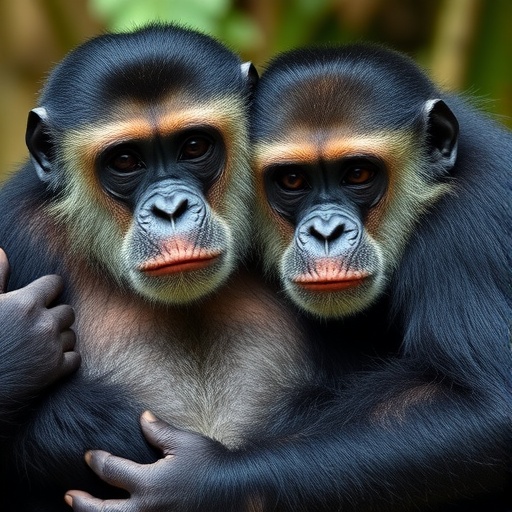
For decades, the scientific community has been deeply invested in unraveling the cognitive mysteries of great apes, seeking insights that might illuminate the evolutionary pathway of human cognition. The prevailing paradigm hinges on the belief that certain cognitive traits—such as the use of gestures for communication—are markers of evolutionary proximity to humans. Traditionally, if these complex abilities surfaced only in species closely related to us, it suggests these traits emerged relatively late in our evolutionary timeline. This perspective, however, poses a simplistic, static view of cognition that does not fully capture the dynamic nature of cognitive development.
Emerging research challenges this static perspective by acknowledging that cognitive abilities in great apes are neither fixed nor uniform within species. Much like in humans, ape cognition fluctuates throughout an individual’s lifetime, shaped profoundly by unique experiences, developmental stages, and underlying personality traits. The framework of cognitive capacities as stable, universal traits within species fails to account for the rich variability that individual differences and environmental factors introduce over time.
In a groundbreaking study recently published in Psychological Science, Manuel Bohn and his colleagues from Leuphana University of Lüneburg expand on this dynamic viewpoint. Their research dives into the complexities of cognitive variability in great apes, revealing not only significant individual differences that persist over time but also unexpected structural divergences from human cognition. This research embraces a developmental and individualized lens, arguing that ape cognition cannot be comprehensively understood without considering the trajectories and diversity of cognitive growth within individuals.
The researchers examined 48 great apes across four species: bonobos, chimpanzees, gorillas, and orangutans. These subjects, differing in age and sex, were tested longitudinally over eighteen months using a battery of six cognitive assessments. These tasks aimed to probe various domains, including the apes’ ability to follow human attentional cues, comprehend communicative gestures, and recall locations associated with food acquisition. These tasks are rooted in previously validated experimental paradigms for assessing social cognition, reasoning, and executive functions in great apes and other primates.
One of the most striking findings was the pronounced cognitive heterogeneity within species. It became clear that factors such as social group membership, prior research exposure, sex, and rearing history significantly influenced cognitive performance. Furthermore, these individual differences demonstrated notable stability across the study period, suggesting a trait-like consistency akin to the individual cognitive profiles observed in humans. Such results imply that cognitive abilities in great apes are not merely situationally dependent but may represent stable characteristics nurtured throughout development.
This finding brings great apes’ cognitive structures into sharper contrast with humans, especially when considering how different cognitive domains relate to each other. For example, the study found that performance on tasks involving social cues—such as tracking the attention of a human experimenter—did not correlate strongly with one another. In stark contrast, tasks probing nonsocial reasoning abilities showed robust positive correlations. This challenges the assumption that cognitive skills in social contexts form cohesive clusters, a pattern well established in human cognitive research.
The fragmented and uncorrelated nature of social-cue-based tasks in apes highlights a critical divergence in how their cognition is organized compared to humans. In human cognitive architecture, social cognition often intertwines with other executive functions, suggesting integrated neural and psychological mechanisms. The decoupling seen in great apes compels researchers to rethink cognitive frameworks that have been primarily human-centric, inviting exploration into alternative models that better capture ape cognitive realities.
Despite the study’s relatively small cohort, the implications are far-reaching. This research questions the adequacy of current assessment tools used in comparative cognition, highlighting their potential limitations in capturing the full spectrum of ape cognitive abilities. Many existing tests were originally designed with human cognition in mind and may overlook nuanced cognitive features unique to apes. Developing tailored, species-specific evaluation methodologies is essential for advancing our understanding of apes’ mental lives.
Moreover, the research underscores the urgent need for longitudinal studies in ape cognition. Although logistically challenging, tracking cognitive development across extended periods offers invaluable insights into how cognitive capacities emerge, stabilize, or decay over time. Such long-term data could unveil the developmental mechanisms underlying individual differences and enable comparisons with human cognitive maturation, shedding light on evolutionary trajectories.
At the heart of these findings is an invitation to scientists to widen their conceptual toolkit. Manuel Bohn prompts the research community to “think about these alternative structures of cognition,” urging us to envision cognitive organization beyond human-centric models. By embracing this inclusive and dynamic approach, researchers may chart novel pathways that illuminate not only the minds of great apes but also deepen our understanding of the evolutionary origins of cognition itself.
This research stands at the frontier of comparative psychology and evolutionary biology, bridging developmental psychology with primate cognition in a way that enriches both fields. It paves the way for future investigations that could map cognitive facets previously uncharted, ultimately contributing to a more comprehensive understanding of intelligence across species boundaries.
The implications stretch beyond academic spheres, resonating with conservationists, zoo managers, and policymakers who work with great apes. Recognizing the individuality and developmental trajectories of ape cognition can refine enrichment programs, welfare assessments, and conservation strategies, enhancing the quality of life for these remarkable animals in human care.
As research continues to unravel the tapestry of great ape cognition, it becomes increasingly evident that cognitive abilities are not monolithic entities but are deeply interwoven with life history, environmental contexts, and individual temperament. This paradigm shift elevates the scientific conversation, encouraging a nuanced appreciation of apes as sentient beings with richly varied cognitive lives that challenge and expand our understanding of intelligence.
News Publication Date: 15-Apr-2026
Web References: http://dx.doi.org/10.1177/09567976261434817
References:
Bohn, M., Völter, C. J., Hanus. D., Eisbrenner, N., Eckert, J., Holtmann, J., & Haun, D. (2026). Individual differences in great ape cognition across time and domains: stability, structure, and predictability. Psychological Science, 37(5), 331–346. https://doi.org/10.1177/09567976261434817
Bohn, M., Eckert, J., Hanus, D., Lugauer, B., Holtmann, J., & Haun, D. B. M. (2023). Great ape cognition is structured by stable cognitive abilities and predicted by developmental conditions. Nature Ecology & Evolution, 7, 927–938. https://doi.org/10.1038/s41559-023-02050-8
Cite Scienmag News
Glenn Wilkins. (June 17, 2026). Great Apes Display Individual Thinking Styles Similar to Humans, Study Finds. Scienmag. https://scienmag.com/great-apes-display-individual-thinking-styles-similar-to-humans-study-finds/
Glenn Wilkins. "Great Apes Display Individual Thinking Styles Similar to Humans, Study Finds." Scienmag, 17 June 2026, https://scienmag.com/great-apes-display-individual-thinking-styles-similar-to-humans-study-finds/. Accessed 4 September 2026.
Glenn Wilkins. "Great Apes Display Individual Thinking Styles Similar to Humans, Study Finds." Scienmag. June 17, 2026. https://scienmag.com/great-apes-display-individual-thinking-styles-similar-to-humans-study-finds/


