


In the grassy margins of Tsukuba, Japan, one of the country’s most conspicuous but least studied insects has finally received a full biological workup. The large grasshopper Patanga japonica, which can overwinter as an adult and is the only grasshopper in temperate Japan known to do so, has now been the subject of a detailed field census and a series of laboratory experiments covering nearly every stage of its life. The results, gathered over multiple seasons in Ibaraki Prefecture, document a univoltine life cycle, a surprisingly broad diet, distinctive mating behavior, and a striking example of coordinated hatching in which embryos appear to talk to one another through physical contact.
The weekly census, conducted from July to November 2021 in a grassy strip roughly two meters wide and two hundred meters long, showed that nymphs of many different sizes were already present by late July, indicating that hatching had begun earlier that month. This was confirmed the following year, when nearly nine in ten nymphs observed on July 7 were first-stadium individuals. Nymphs grew steadily through the summer, and the first adults appeared on September 16; by November 24, only adults remained at the site. When the city cut the grasses on October 30, most grasshoppers either moved into adjacent bushes or were killed, illustrating how vulnerable the late-season population is to vegetation management.
Rearing nymphs that hatched on July 5 in an outdoor cage revealed the precise timing of adult emergence. Males took an average of 76.0 days to reach adulthood and females 81.6 days, meaning males emerged on average 5.6 days earlier than females, a pattern known as protandry. Because this species does not reproduce before winter, the researchers suggest this early emergence may simply reflect the sex difference in body size and development time rather than a mating advantage. Interestingly, female body size increased significantly with later emergence dates, while male size did not, a difference that may partly reflect the fact that only females were observed passing through an extra nymphal stadium.
The study also clarified which plants this grasshopper uses. In the field census, nymphs were overwhelmingly found on kudzu, Pueraria montana var. lobata, which accounted for 66.3 percent of nymphal observations, followed by Japanese silvergrass and cogon grass. Adults showed a somewhat different pattern, with 56.2 percent on kudzu and a larger share, about a quarter, resting on various other plants, a difference the author attributes to adults frequently perching on non-food plants rather than to a different diet. Both stages were often seen chewing holes in the middle of kudzu leaves rather than feeding from the edges, an unusual feeding style for a grasshopper.
To test how wide the dietary range really is, newly hatched nymphs were offered leaves from 51 plant species collected in and around the study habitat. Thirty-seven species, or about 73 percent, allowed at least one nymph to molt to the second stadium, and on seven species every nymph succeeded. Nymphs given only a moist cotton ball died on the third day without molting, and no cannibalism was observed. The author cautions that the feeding test was stopped at the second stadium and offered only one plant species at a time, so the number of plants that could support full development to adulthood remains unknown, and in nature the grasshopper likely relies on a narrower set of preferred hosts that varies with habitat and season.
Mating behavior proved equally distinctive. Overwintered adults began copulating in mid-March in outdoor enclosures, with mating frequent in April and May and continuing until late July. The number of copulating pairs increased through the day and correlated with mean daily temperature, and pairs often remained coupled for many hours, with some apparently continuing for two or three days. Males mount the female and curve their abdomen around either her right or left side to reach her genitalia, and the two directions occurred in nearly equal numbers. When a male was moved to a second female, he consistently approached from the same side as before, suggesting the preference lies with the male rather than the female.
Perhaps the most curious discovery concerns stridulation during copulation. Males rubbed a hind tarsus against their forewing or abdomen three or four times in succession, almost exclusively during mating rather than beforehand, leading the author to interpret it as a copulation song that may calm the partner. The behavior followed a strict rule: a male reaching the female from one side used the hindleg on the opposite side to stridulate, a pattern followed by 93.9 percent of observed males. Most strikingly, males missing an entire hindleg copulated from the side of the missing leg in all but one of twenty cases, apparently because they needed the remaining leg to balance while stridulating. One male lacking only a tarsus behaved as if the whole leg were gone, reaching the female from that side and stridulating with the other leg.
Oviposition began in late April and continued until early August under outdoor conditions, with females laying an average of 5.4 egg pods at intervals of about 10.4 days. Egg pods averaged 72.1 eggs, and females possessed an average of 123.5 ovarioles, meaning they used only about 58 percent of their potential egg-producing capacity, a figure similar to that reported for solitarious migratory locusts. Larger females laid more eggs per pod, and a clear trade-off emerged between egg number and egg size, with pods containing more eggs producing shorter eggs. Notably, females kept in groups of five pairs laid pods with significantly fewer eggs than females housed with a single male, although egg size was unaffected.
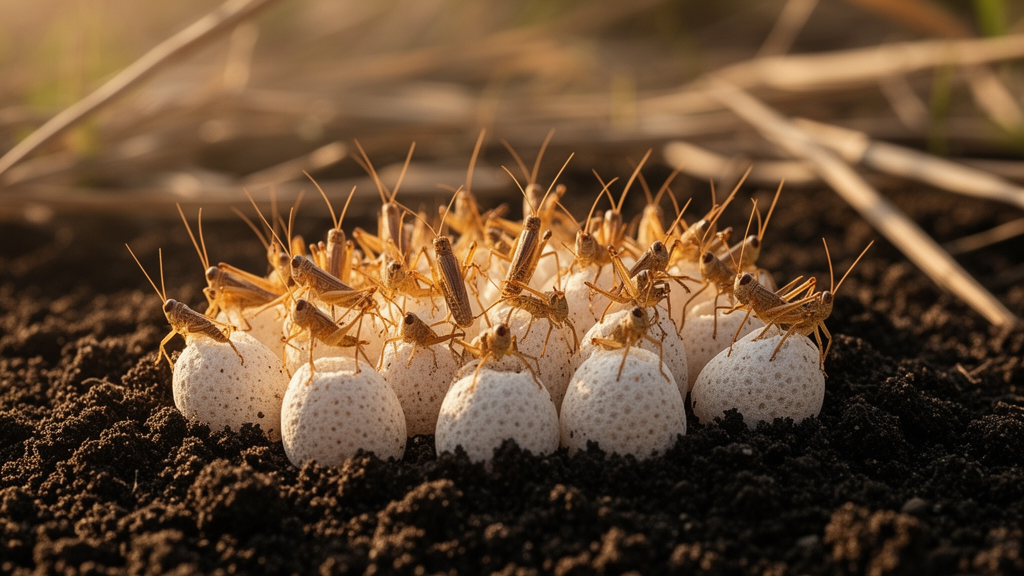
The hatching experiments produced the study’s most dramatic findings. Under semi-outdoor conditions, once hatching began from an egg pod, most nymphs emerged within the same 30-minute window, and no eggs hatched during the night. Under controlled conditions at a constant 30 degrees Celsius, eggs buried in groups of 10 or 20 hatched within roughly an hour of one another, while eggs buried individually hatched sporadically over a much wider span, with standard deviations of 15 to 19 hours. Group-buried eggs also hatched at a significantly higher rate, 97.1 percent versus 78.1 percent, suggesting that grouping benefits survival as well as timing.
Experiments with pairs of eggs revealed the mechanism behind this coordination. Eggs kept in contact hatched far more synchronously than eggs separated by a few millimeters, but when separated eggs were connected by a thin steel wire, synchrony was restored, indicating that physical stimuli, likely vibrations, transmitted between eggs. In a decisive test, eggs from the same pod were developmentally staggered by chilling one batch and then paired with eggs from the other. The hatching times adjusted in both directions: early eggs delayed their hatching by an average of 13.4 hours and late eggs advanced theirs by 18.2 hours to match their partners, even when their developmental difference exceeded 18 hours. This two-way adjustment resembles the pattern seen in the migratory locust and the Bombay locust, in contrast to the desert locust, where only advancement occurs. In the field, newly hatched nymphs quickly climbed kudzu leaves and formed small aggregations of three to seven individuals, scattering at the slightest disturbance, behaviors consistent with the idea that synchronous hatching helps hatchlings form defensive groups and limits the window during which predators can detect emerging nymphs.
The study also examined whether crowding induces the morphometric changes characteristic of locust phase polyphenism. Adults reared at high density showed some shifts in the ratios of hind femur length to head width and forewing length to femur length, but the directions of these changes were opposite to those documented in classic locust species, and pronotum shape showed no consistent density-dependent pattern. Nymphs of P. japonica do become heavily melanized when crowded, as previously reported, yet they remain relatively inactive even in groups, and no swarming has been recorded in temperate populations. The author notes that temperate females average a head width of 6.5 millimeters compared with 9.0 millimeters in an Okinawa population, and that eggs from the subtropical population take about seven days longer to incubate, raising open questions about the species status of the two populations. Taken together, the findings paint a picture of a common insect whose quiet biology, from hole-chewed kudzu leaves to whispering embryos, rewards the kind of patient, multi-season observation that this species had long gone without.
Subject of Research: Biology, seasonal life cycle, and hatching synchrony of the grasshopper Patanga japonica in central Japan
Article Title: Biology of Patanga japonica ( Orthoptera , Acrididae ): Nymphal growth, host plants, reproductive activity, hatching behavior, and adult morphology
Article References: Tanaka, S. (2023). Biology of Patanga japonica (Orthoptera, Acrididae): Nymphal growth, host plants, reproductive activity, hatching behavior, and adult morphology. Journal of Orthoptera Research, 32(1), 93-108. https://doi.org/10.3897/jor.32.95753
Image Credits: AI Generated
DOI: 10.3897/jor.32.95753
Keywords: Patanga japonica, grasshopper, hatching synchrony, embryo communication, host plants, oviposition, mating behavior, protandry, phase polyphenism, Japan, Orthoptera, life cycle
Cite Scienmag News
Gavin Prescott. (October 27, 2026). Grasshopper study reveals synchronized hatching driven by embryo-to-embryo communication. Scienmag. https://scienmag.com/grasshopper-study-reveals-synchronized-hatching-driven-by-embryo-to-embryo-communication/
Gavin Prescott. "Grasshopper study reveals synchronized hatching driven by embryo-to-embryo communication." Scienmag, 27 October 2026, https://scienmag.com/grasshopper-study-reveals-synchronized-hatching-driven-by-embryo-to-embryo-communication/. Accessed 27 October 2026.
Gavin Prescott. "Grasshopper study reveals synchronized hatching driven by embryo-to-embryo communication." Scienmag. October 27, 2026. https://scienmag.com/grasshopper-study-reveals-synchronized-hatching-driven-by-embryo-to-embryo-communication/


