


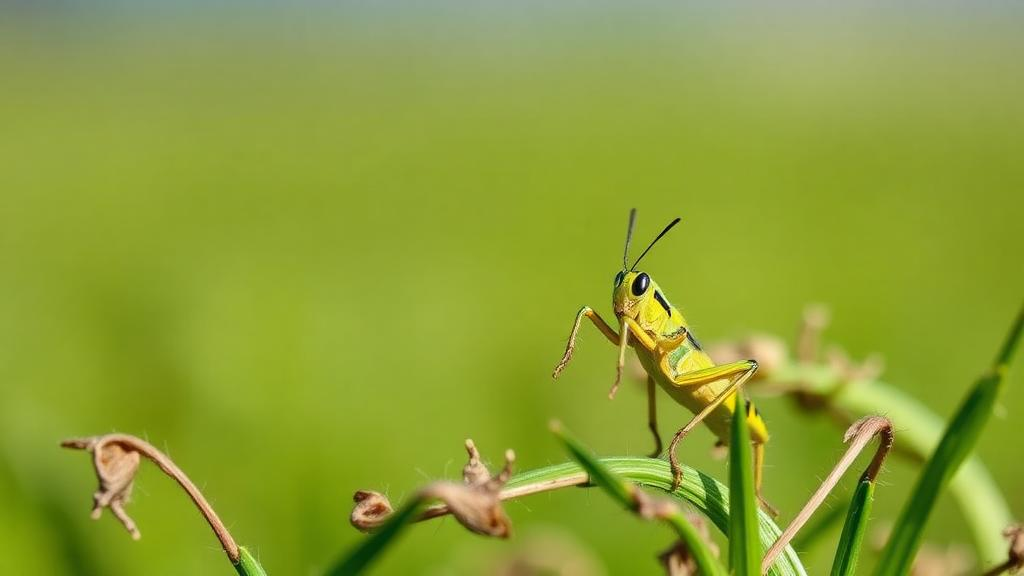
In the vast grasslands of Xinjiang, a region that holds the third-largest grassland area in China, seven dominant grasshopper species have been quietly shaping one of the most important ecosystems on Earth. A new study published in the Journal of Orthoptera Research has now revealed that these insects’ feeding habits are far more complex than previously assumed, with males and females of the same species often choosing entirely different plants to eat. The findings, based on microscopic analysis of the insects’ crop contents under natural conditions, could reshape how scientists and land managers approach grasshopper control in one of China’s most ecologically and economically significant regions.
Grasshoppers are not merely background players in grassland ecosystems. In China, they compete with domestic livestock for forage and are ranked alongside droughts and floods as major natural disasters affecting agricultural and livestock production. Understanding what these insects actually eat in the wild, and how their diets vary between sexes and individuals, is therefore a matter of practical urgency. The research team, led by scientists working in the Bozhou region of Xinjiang, set out to fill a conspicuous gap: although similar studies had been conducted in Inner Mongolia, Gansu, and Zhejiang, Xinjiang, home to roughly one-sixth of all known grasshopper species in China, remained largely unstudied.
The researchers focused on seven dominant species spanning two families and three subfamilies: Oedaleus decorus, Oedipoda caerulescens, and Bryodema gebleri from the Oedipodinae; Calliptamus coelesyriensis and Calliptamus barbarus from the Calliptaminae; Notostaurus albicornis from the Gomphocerinae; and Dericorys annulata from the family Dericorythidae. In July 2018, the team collected adult grasshoppers from six natural, unmanaged grassland sites, swinging a net 100 times in each of the four cardinal directions at each plot. Ten females and ten males of each species were randomly selected for dietary analysis, ensuring a balanced sample across the sexes.
The method at the heart of the study, microscopic analysis of crop contents, or MACC, is prized for its precision, efficiency, low cost, and simplicity. Each grasshopper was killed in 75 percent ethanol immediately after collection, and the plant fragments inside its crop, the storage organ of the digestive tract, were compared microscopically with voucher specimens of plants gathered from the same study area. This approach captures what the insects actually chose to eat in their natural environment, avoiding a key weakness of earlier caging studies, which can record artificial forced feeding rather than independent food selection. The researchers calculated a relative feeding frequency for each plant, classifying feeding as high-preference, preference, seldom, or occasional, and then applied Levin’s measure of niche breadth and Schoene’s measure of niche overlap to quantify dietary specialization and potential competition.
Across the seven species, the team identified 33 distinct plant species in the grasshoppers’ diets. Notostaurus albicornis proved to be the most adventurous eater, consuming 15 plant species, while Dericorys annulata was the pickiest, feeding on only five. Plant families such as Poaceae, Fabaceae, Asteraceae, and Amaranthaceae appeared in the diets of nearly all the grasshoppers, whereas Nitrariaceae, Caprifoliaceae, and Tamaricaceae were consumed by only one or two species. Among the three grasshoppers that fed primarily on grasses, each showed a distinct favorite: Oedaleus decorus showed high-preference feeding on Poa annua, Bryodema gebleri on Stipa capillata, and Calliptamus barbarus on Setaria viridis. Dericorys annulata fed almost exclusively on Amaranthaceae, Oedipoda caerulescens favored Asteraceae, and Notostaurus albicornis combined Poaceae and Amaranthaceae in its diet.
The most striking discovery concerned sex differences. For three species, Oedaleus decorus, Bryodema gebleri, and Calliptamus coelesyriensis, whether a grasshopper was polyphagous or oligophagous depended entirely on its sex: females behaved as generalists, feeding broadly across many plant species, while males behaved as specialists. Bryodema gebleri females consumed plants from 11 species across five families, whereas males took only seven species from three families. Calliptamus coelesyriensis females ate plants from eight species in five families, while males restricted themselves to just two species in two families. Even their primary food sources diverged: Bryodema gebleri females fed mainly on Amaranthaceae at 46.50 percent of their diet, while males consumed Poaceae at 93.12 percent. Multivariate analysis of variance confirmed that these sex-based differences were statistically significant for multiple plant species across all seven grasshoppers.
The researchers propose that these dietary splits reflect fundamental physiological needs. Female grasshoppers, which are heavier and must produce eggs, require protein-rich food to support ovarian development, and their larger bodies demand greater overall food intake. Males, by contrast, need high-fat foods to fuel flight. Females also tend to move along the lower parts of plants or along the ground surface more frequently than males, partly because they lay their eggs in the soil, which changes the plants they encounter. Similar sex-based dietary differences have been documented elsewhere: female Romalea microptera prefer Spartina alterniflora while males favor Sesbania macrocarpa, and female Oedaleus decorus in earlier studies preferred Leymus chinensis over Artemisia frigida, the reverse of male preference.
Individual grasshoppers within the same species also differed in their diets, and the pattern followed a clear rule: the narrower a species’ feeding range, the more consistent its individuals. The oligophagous grasshoppers, including male Oedaleus decorus, male Bryodema gebleri, and Dericorys annulata, showed small individual dietary variance, with Kendall’s coefficient of concordance values between 0.116 and 0.175. The polyphagous species, particularly Calliptamus coelesyriensis and Notostaurus albicornis, showed the greatest individual variation, with Kendall values as low as 0.037 and 0.047. Intriguingly, the results challenge a long-standing hypothesis in insect ecology, that population-level polyphagy arises from each individual specializing on a different resource. Instead, most individuals within the polyphagous species were themselves polyphagous, with only a minority of specialists: Oedaleus decorus had the highest proportion of oligophagous individuals at 50 percent, while other polyphagous species ranged from 0 to 30 percent.
The niche analysis added another layer of insight. Notostaurus albicornis and Oedaleus decorus had the widest ecological niches, measured at 5.22 and 4.02 respectively, while Oedipoda caerulescens and Dericorys annulata had the narrowest, at 2.49 and 1.22. Overall, food niche overlap among the seven species was low, ranging from 0 to 0.31, suggesting limited potential for competition at the population level. However, when the analysis was broken down by sex, a different picture emerged: male Bryodema gebleri and male Oedaleus decorus showed an overlap of 0.76, well above the 0.6 threshold generally considered biologically significant, indicating a potential competitive relationship between these two groups. Calliptamus barbarus showed the strongest overall potential for competition with the other six species, while Dericorys annulata had almost none, with overlaps of just 0.00 to 0.09.
The study’s authors emphasize that grasshoppers did not simply eat whatever was most abundant in their habitats, which is indirect evidence that these insects actively select their food. Plant characteristics such as leaf toughness, epidermal hairs, nutrient content, and secondary compounds all influence feeding decisions, and grasshoppers are known to balance their intake of carbohydrates, proteins, and water with remarkable precision. The researchers suggest that some choices, such as Calliptamus coelesyriensis feeding on the water-rich Peganum harmala, may even reflect the need to stay hydrated during dry periods. Because the study covered only one habitat and season, the team calls for future work across different altitudes, latitudes, and habitats, with careful attention to sex differences. The practical implications are considerable: knowing which plants each species and sex prefers could enable ecological management strategies, such as planting less-preferred species in areas prone to grasshound plagues, offering a more targeted alternative to broad-spectrum chemical control in a region where grasshoppers remain one of the greatest threats to grassland productivity.
Subject of Research: Food-plant choice, sex-specific feeding, and interspecific competition among seven dominant grasshopper species in the Xinjiang grasslands of China
Article Title: Food-plant choice of seven dominant grasshopper species in the Xinjiang grasslands
Article References: Ren, J.-L., Kang, W.-J., Li, J.-X., Jin, X., Li, K.-X., & Zhao, L. (2024). Food-plant choice of seven dominant grasshopper species in the Xinjiang grasslands. Journal of Orthoptera Research, 33(1), 157-168. https://doi.org/10.3897/jor.33.110690
Image Credits: AI Generated
Keywords: grasshoppers, Xinjiang grasslands, feeding ecology, sex differences, diet analysis, ecological niche, interspecific competition, polyphagy, oligophagy, Orthoptera, crop content analysis, host-plant preference
Cite Scienmag News
Gavin Prescott. (October 19, 2026). Grasshopper Diets in Xinjiang Grasslands Reveal Surprising Sex-Based Feeding Differences. Scienmag. https://scienmag.com/grasshopper-diets-in-xinjiang-grasslands-reveal-surprising-sex-based-feeding-differences/
Gavin Prescott. "Grasshopper Diets in Xinjiang Grasslands Reveal Surprising Sex-Based Feeding Differences." Scienmag, 19 October 2026, https://scienmag.com/grasshopper-diets-in-xinjiang-grasslands-reveal-surprising-sex-based-feeding-differences/. Accessed 19 October 2026.
Gavin Prescott. "Grasshopper Diets in Xinjiang Grasslands Reveal Surprising Sex-Based Feeding Differences." Scienmag. October 19, 2026. https://scienmag.com/grasshopper-diets-in-xinjiang-grasslands-reveal-surprising-sex-based-feeding-differences/


