

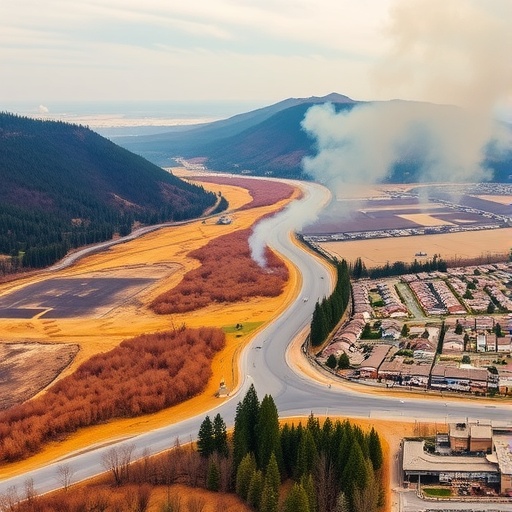
In an age where wildfires are increasingly shaping landscapes and human lives, a groundbreaking study has introduced a transformative framework for managing the complex interface between urban environments and wildlands. The newly proposed tridimensional model innovatively integrates pyro-ecological dynamics with social and governance elements, marking a significant leap in how society can address wildfire risks in rapidly changing terrains. This integration is essential as wildfire behavior and their societal impacts grow more unpredictable and devastating due to climate change and urban expansion.
Traditionally, approaches to wildfire governance have had to contend with the complicated intersections of ecological processes and human activities. Previous frameworks often segmented ecological factors from social and political considerations, which limited their effectiveness. The new study, however, envisions the wildland-urban interface (WUI) through a triadic lens that concurrently examines fire behavior patterns, ecosystem responses, and human governance structures. This three-dimensional view articulates a more dynamic and interconnected understanding of wildfire risk management that can lead to more resilient communities.
The researchers introduced the concept of Pyro-Socio-Ecological Zones (PSEZs), a novel spatial framework that overlays fire regimes with social vulnerability and governance capacity in specific landscapes. This multidimensional zoning accounts not only for the physical properties of terrain and vegetation but also integrates social variables such as population density, cultural attitudes towards fire, and institutional frameworks for risk mitigation. By comprehensively mapping these layers, authorities and land managers can better tailor interventions to local conditions, enhancing both preparedness and response.
A key technical advancement lies in the use of high-resolution geospatial data combined with socio-economic datasets to define and map PSEZs with unprecedented precision. The study leverages remote sensing technologies, including satellite imagery and LiDAR, to characterize pyro-ecological properties, such as fuel loads and topography, driving fire spread and intensity. Simultaneously, advanced social science methodologies are employed to assess governance structures and community resilience indicators. This interdisciplinary fusion enables an actionable and scalable classification system for wildfire-prone regions.
Governance, often the weakest link in wildfire risk reduction, gains renewed focus within the framework. The PSEZs highlight critical gaps and strengths in local and regional governance that impact fire management effectiveness. This includes evaluating institutional coordination, policy enforcement, resource allocation, and community participation. By embedding governance metrics into spatial zones, decision-makers can identify areas requiring enhanced regulatory oversight or community engagement efforts, thereby fostering more adaptive and responsive wildfire policies.
Importantly, the tridimensional framework offers a dynamic lens that accounts for changes over time, calling for continuous monitoring and adaptive management strategies. Wildfire risk is not static; it evolves with changing climatic conditions, human settlement patterns, and ecological transformations. The PSEZ classification can be regularly updated with new data inputs, enabling authorities to anticipate emerging hotspots and prioritize interventions accordingly. This forward-looking capacity distinguishes the model from static zoning practices that may soon become obsolete.
The study also emphasizes the role of technological innovation and participatory governance mechanisms in managing PSEZs. Incorporating community knowledge alongside scientific data fosters inclusivity and builds trust between stakeholders. Furthermore, the framework suggests integrating early warning systems, real-time fire behavior modeling, and digital communication platforms to enhance situational awareness. These tools empower residents and land managers with timely information, promoting proactive rather than reactive fire management.
The implications of this tridimensional governance framework extend beyond wildfire management alone. It exemplifies a broader trend in environmental governance towards multidimensional, data-driven, and community-engaged approaches. Given the increasing frequency and severity of natural disasters globally, the study sets a precedent for how complex socio-ecological challenges can be understood through integrated spatial models that balance scientific rigor with human realities. The Pyro-Socio-Ecological Zones concept is positioned to become a vital reference for climate adaptation strategies worldwide.
One of the striking elements of the framework is its potential to harmonize competing land-use interests by providing a common spatial language for diverse stakeholders. Ecosystem restoration specialists, urban planners, fire managers, and policy-makers can converge around PSEZ maps to negotiate risk mitigation actions that simultaneously address ecological integrity, public safety and economic viability. This convergence is vital in WUI areas where land tenure and usage can be fragmented, and conflicting objectives often undermine cohesive wildfire governance.
Moreover, the tridimensional model sensitizes governance to socio-economic disparities that influence wildfire vulnerability. Marginalized communities frequently reside in the most fire-prone zones yet lack sufficient resources and institutional support to cope with disasters. By rigorously incorporating social vulnerability indices into PSEZ delineation, the framework foregrounds equity considerations in fire management planning. This ensures that interventions not only minimize ecological damage but also do so in a manner that is just and inclusive.
From a technical perspective, the study’s methodological sophistication opens new frontiers in landscape fire modeling. The use of machine learning algorithms to integrate diverse datasets allows identification of nuanced patterns and correlations that static models miss. These computational techniques enable predictive insights, such as forecasting shifts in fire regimes under future climate scenarios and demographic changes. Such projections are invaluable for long-term strategic planning and resource mobilization.
In practice, pilot applications of the framework have demonstrated its utility in diverse geographic contexts, from Mediterranean-type ecosystems to North American coniferous forests. Across these varied biomes, PSEZ analysis illuminated unique combinations of fire risk and social governance characteristics, enabling tailored management recommendations. Successful cross-site implementation underscores the framework’s adaptability and robustness, promising broad applicability across wildfire-prone regions worldwide.
The integration of pyro-ecological data with governance metrics encourages a paradigm shift from reactive firefighting to proactive wildfire resilience building. Instead of relying solely on suppression tactics, land and community managers can deploy a portfolio of measures including fuel treatments, land-use planning, community preparedness training, and policy reform. This holistic approach aligns with evolving best practices recognizing that wildfire governance must encompass prevention, mitigation, preparedness, and response in an interconnected cycle.
The study also calls for strengthening institutional frameworks at multiple scales, advocating for enhanced coordination between federal, regional, and local agencies involved in wildfire governance. PSEZs can serve as a harmonizing mechanism that aligns jurisdictional responsibilities, fosters information sharing, and catalyzes joint initiatives. Such multi-scalar governance integration is critical given that wildfire impacts and ecological processes transcend administrative boundaries, demanding a synchronized approach.
Looking forward, the research team envisions further enhancements by incorporating real-time environmental monitoring sensors and expanding socio-political data layers, such as cultural fire knowledge and community social networks. Future iterations of the PSEZ framework could thus evolve into comprehensive wildfire governance platforms supported by AI-driven decision support systems. These advancements would not only improve situational awareness but also enable predictive and prescriptive analytics for wildfire risk reduction.
As wildfires continue to pose existential threats to thousands of communities and ecosystems globally, this tridimensional framework offers a timely, innovative, and scientifically robust tool for governance transformation. By merging pyro-ecological realities with social complexities and governance capacities, it transcends traditional siloes, enabling more effective and just wildfire management in the wildland-urban interface. This study sets a new standard for research and practice at the nexus of fire science, social science, and public policy.
In sum, the development of Pyro-Socio-Ecological Zones heralds a new chapter in wildfire governance, one that embraces complexity rather than shying away from it. Its technical sophistication, interdisciplinary integration, and emphasis on equity and adaptivity constitute a paradigm shift in managing wildfire risks. As climate change exacerbates fire threats and urban expansion pushes human settlements deeper into fire-prone landscapes, this innovative framework equips societies with the tools to safeguard lives, property, and ecological integrity more effectively than ever before.
Subject of Research: Wildfire governance and risk management in the wildland-urban interface using an integrated pyro-socio-ecological framework.
Article Title: A tridimensional framework for governance in the wildland-urban interface using Pyro-Socio-Ecological Zones.
Article References:
Cappelluti, O., Escobedo, F.J., Sanesi, G. et al. A tridimensional framework for governance in the wildland-urban interface using Pyro-Socio-Ecological Zones. Nat Commun 16, 11232 (2025). https://doi.org/10.1038/s41467-025-66452-x
Image Credits: AI Generated


