


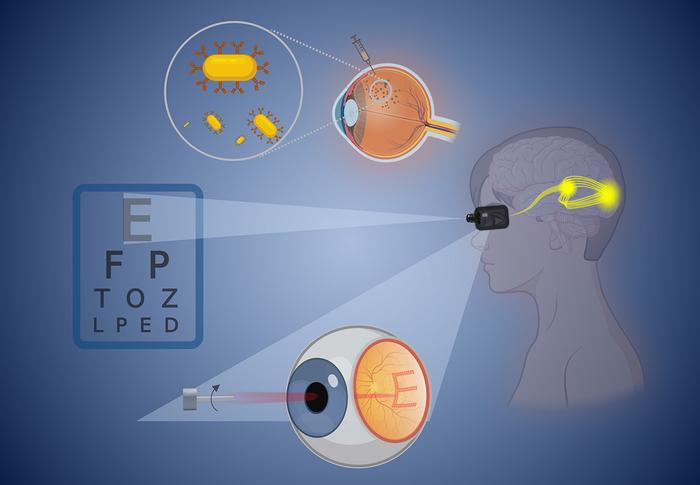
A revolutionary breakthrough in vision restoration has emerged from Brown University, where researchers have unveiled the potential of gold nanoparticles to remedy vision loss caused by retinal disorders like macular degeneration. This innovative approach, which operates without the need for complicated surgeries or genetic modifications, could mark a significant shift in how such conditions are treated. The foundation of the research is built on the application of nanoparticles—microscopic particles of gold that are thousands of times thinner than a human hair—in conjunction with laser technology.
As detailed in a recent study published in the esteemed journal, ACS Nano, this team of researchers set out to explore alternatives to traditional visual prosthetic systems. Their investigations revealed that by injecting these nanoparticles directly into the retina, they could successfully stimulate the visual system of mice afflicted with various retinal disorders. The key lies in the ability of these nanoparticles to activate bipolar and ganglion cells directly, bypassing the damaged photoreceptors that are characteristic of conditions such as macular degeneration.
The implications of this research extend far beyond mere academic interest. Current treatment paradigms for retinal degeneration often involve invasive surgical techniques that come with significant risks and complications. The nanoparticle approach, as articulated by Jiarui Nie, a postdoctoral researcher and lead author of the study, offers a far less invasive alternative. An intravitreal injection is a straightforward procedure among ophthalmology practices, presenting a feasible strategy for future patient applications.
The method harnesses the power of near-infrared laser light, which is directed onto the nanoparticles once they are injected into the retina. This results in the generation of localized heat that excites the bipolar and ganglion cells. As these cells play a pivotal role in transmitting visual signals from photoreceptors to the brain, the nanoparticle approach effectively reinstates a form of vision by restoring the communication pathway that was interrupted due to the degeneration of photoreceptors.
In the course of their experiments, the research team utilized patterned near-infrared laser light to project simple shapes onto the retinas of the treated mice. They measured the resultant cellular activity using calcium signals, confirming that the nanoparticles successfully activated the targeted cells consistent with the patterns presented by the laser. The results were promising: the stimulation yielded no observable adverse effects, suggesting that the procedure could be safely translatable to human patients in the near future.
Additionally, the researchers observed increased activity in the visual cortices of treated mice, reinforcing the potential for partial vision restoration. This is a pivotal finding, indicating that the synthetic stimulation of the visual system could lead to the processing of visual information much like that which occurs in healthy eyes. For individuals suffering from retinal conditions, this could represent a new dawn of hope, offering possible restoration of a vital sensory function.
The envisioned system for human applications would comprise nanoparticles combined with a sophisticated laser apparatus embedded within glasses or goggles. Cameras integrated into these goggles would gather real-time data from the environment, converting imagery into a format that the laser system could manipulate, thereby stimulating the nanoparticles in the retina. This technological integration signifies a substantial evolution in assistive technologies for vision impairments and could radically redefine patient experiences in everyday life.
Compared to conventional systems, which involve surgical implantation of electrode arrays to process visual information, the nanoparticle technique holds several advantages that could make it more appealing. Its non-invasive nature, coupled with a potentially higher resolution due to the widespread distribution of nanoparticles across the retina—unlike the restrictive pixel count of implantable devices—further highlights its promise.
Moreover, this technology is adaptive, as it utilizes near-infrared light, which means it could be employed without interfering with whatever residual vision a patient may possess. This is particularly advantageous for individuals whose vision loss has not been complete, allowing them to retain some functional vision while still benefiting from the enhanced capabilities provided by the nanoparticle system.
Future research is set to delve deeper into optimizing this promising avenue. While the initial findings are encouraging, extensive studies will be necessary to ensure the long-term safety and efficacy of this approach before it can transition into clinical trials. Notably, Nie’s ongoing work offers a glimpse into what could be an incredibly transformative period for ocular medicine.
The research team demonstrated that the nanoparticles exhibited stability within the retina for months, posing no major toxicity risks. This is crucial, as any therapeutic that aims to be effective must also be safely integrable into biological systems over prolonged periods. Their findings open the door to further exploration and refinement of this technique, making it a focal point of significant scientific interest moving forward.
As this groundbreaking work continues to garner attention, it will undoubtedly spur discussions about broader applications of nanoparticle technology across various medical fields, particularly in the realm of regenerative medicine. The intersection of nanotechnology and biomedical applications holds vast potential that researchers are only beginning to tap into.
In conclusion, the development of this nanoparticle-based retinal restoration technique marks a significant milestone in the quest for innovative treatments for blindness caused by retinal degeneration. The fusion of nanotechnology with optical stimulation provides an exciting glimpse into future therapeutic strategies that could alter the landscape of vision restoration and rehabilitation once and for all.
Keywords
Nanoparticles, vision restoration, retinal disorders, plasmonic nanorods, macular degeneration, near-infrared laser, ophthalmology, biocompatibility.
Cite Scienmag News
Denise Maddox. (April 16, 2025). Golden Horizons: The Potential of Gold Nanoparticles in Vision Restoration. Scienmag. https://scienmag.com/golden-horizons-the-potential-of-gold-nanoparticles-in-vision-restoration/
Denise Maddox. "Golden Horizons: The Potential of Gold Nanoparticles in Vision Restoration." Scienmag, 16 April 2025, https://scienmag.com/golden-horizons-the-potential-of-gold-nanoparticles-in-vision-restoration/. Accessed 4 September 2026.
Denise Maddox. "Golden Horizons: The Potential of Gold Nanoparticles in Vision Restoration." Scienmag. April 16, 2025. https://scienmag.com/golden-horizons-the-potential-of-gold-nanoparticles-in-vision-restoration/


