

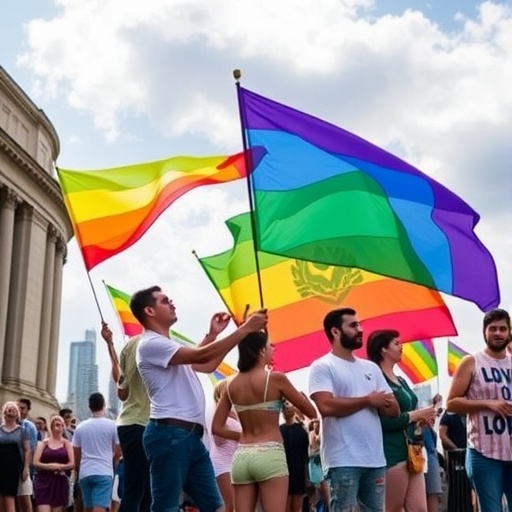
In a groundbreaking study that has drawn attention from scholars and advocates alike, researchers have investigated the well-being of sexual and gender diverse individuals across a vast demographic landscape. The survey encompasses a staggering 82,324 participants from 153 countries, delving into the intricate relationship between socioecological dimensions of homophobia, familial dynamics, community levels of acceptance, and broader national sentiments. These elements are assessed alongside socioeconomic status, illustrating how these intersecting factors shape the lived experiences of LGBTQ+ individuals.
The findings reveal stark disparities in subjective well-being, revealing that participants from the Middle East and North Africa reported the lowest mean well-being scores at 4.78, with a standard deviation of 2.70. This alarming statistic raises pressing questions about the mental health and social conditions of LGBTQ+ individuals in these regions, where conservative cultural norms often exert a significant influence on personal identity and social acceptance.
Following closely behind are participants from Eastern Europe and Central Asia, who reported a mean well-being score of 5.22 with a standard deviation of 2.13. These figures highlight a troubling trend within these populations, where societal prejudices and overarching political climates continue to marginalize sexual and gender diverse individuals. The study underscores the urgent need for policies and community programs that foster acceptance and support for these marginalized groups.
The research identifies two critical factors that correlate negatively with the well-being of LGBTQ+ individuals: structural homophobic climate and family-level homophobia. The Structural Homophobic Climate Index emerged as a particularly strong predictor, with a beta coefficient of -1.68, indicating that higher levels of societal homophobia are strongly associated with lower well-being scores. This link reveals the pervasive impact of legal, social, and cultural attitudes towards LGBTQ+ individuals, shaping not only public perceptions but also personal experiences.
Family dynamics emerge as another focal point of the study. Family-level homophobia, with a beta coefficient of -0.84, illustrates how familial attitudes and beliefs can hinder an individual’s mental health and overall well-being. Living in a homophobic family environment can lead to feelings of isolation, low self-esteem, and a lack of support, emphasizing the need for family education and awareness programs that promote inclusivity and acceptance.
Another layer of complexity is added when considering economic precarity, which was found to significantly interact with the negative effects of homophobia on well-being. The study indicates that economically secure participants experienced a lesser impact from their country’s homophobic climate, with the weight of these societal factors nearly halved compared to those facing economic deprivation. This finding suggests that financial stability can act as a protective layer, allowing individuals to navigate discriminatory environments more effectively.
The research also highlights a concerning trend among participants who are unaware of their human immunodeficiency virus (HIV) status. This group reported the lowest well-being scores, with a beta coefficient of -0.20, signaling an urgent public health concern. Lack of awareness surrounding HIV not only jeopardizes individual health outcomes but also reveals societal stigmas that may prevent effective health education and support services. Addressing these issues is crucial for improving health outcomes and overall well-being within the LGBTQ+ community.
The implications of this study are far-reaching, prompting public health officials and policymakers to reconsider their approaches to health care and community support for sexual and gender diverse individuals. Public health measures should prioritize combating homophobic stigma and discrimination, particularly for those in the lowest socioeconomic strata. Targeted interventions at both the public health and community levels can help mitigate the negative impacts of homophobia and economic instability on mental health.
This research serves as a call to action for advocates and community leaders to collaborate in creating supportive environments for LGBTQ+ individuals. Building social support systems and fostering inclusive communities can significantly enhance well-being by reducing the stresses associated with homophobia and economic hardship. This means not only advocating for legislative changes but also implementing community programs that promote acceptance and understanding.
As the global landscape continues to evolve, so does the necessity for comprehensive research that highlights the challenges faced by marginalized communities. This study is a crucial contribution to this body of work, underscoring the intersectionality of sexual and gender diversity, socioeconomic status, and well-being. It emphasizes the importance of creating holistic approaches that address these interconnected issues, ensuring that LGBTQ+ individuals have the opportunity to thrive.
In conclusion, the insights gained from this extensive survey reveal the urgent need for systemic change in how societies view and treat sexual and gender diverse individuals. By recognizing the disabling effects of homophobia and the amplifying role of economic insecurity, stakeholders can work towards more inclusive policies and community practices. Only through sustained effort and collaboration can we hope to create a world where all individuals, regardless of sexual orientation or gender identity, can enjoy the dignity and respect they deserve.
The findings from this novel study will undoubtedly stimulate further research and discussion. As society grapples with evolving norms around gender and sexuality, understanding the multifaceted experiences of LGBTQ+ individuals remains paramount. Addressing their unique challenges is not only a matter of equity but also fundamental to fostering healthier societies at large.
Overall, as public awareness grows, so does the responsibility of both individuals and institutions to champion the cause for LGBTQ+ rights and well-being. With empirical data to guide these efforts, stakeholders can develop more effective strategies to combat stigma, enhance support networks, and ultimately improve the quality of life for sexual and gender diverse individuals everywhere.
In the face of adversity, the resilience of the LGBTQ+ community shines through. It is imperative for society to stand in solidarity with these individuals, advocating for their dignity and ensuring that their voices are heard. By doing so, we take significant steps toward a more just and equitable world.
Subject of Research: The well-being of sexual and gender diverse (LGBTQ+) individuals in relation to homophobia and socioeconomic status.
Article Title: Homophobia, economic precarity, and the well-being of sexual and gender diverse people in a 153-country survey
Article References:
Lamontagne, E., Leroy, V., Howell, S. et al. Homophobia, economic precarity and the well-being of sexual and gender diverse people in a 153-country survey.
Nat Hum Behav (2025). https://doi.org/10.1038/s41562-025-02361-9
Image Credits: AI Generated
DOI: https://doi.org/10.1038/s41562-025-02361-9
Keywords: LGBTQ+, well-being, homophobia, socioeconomic status, public health, discrimination


