


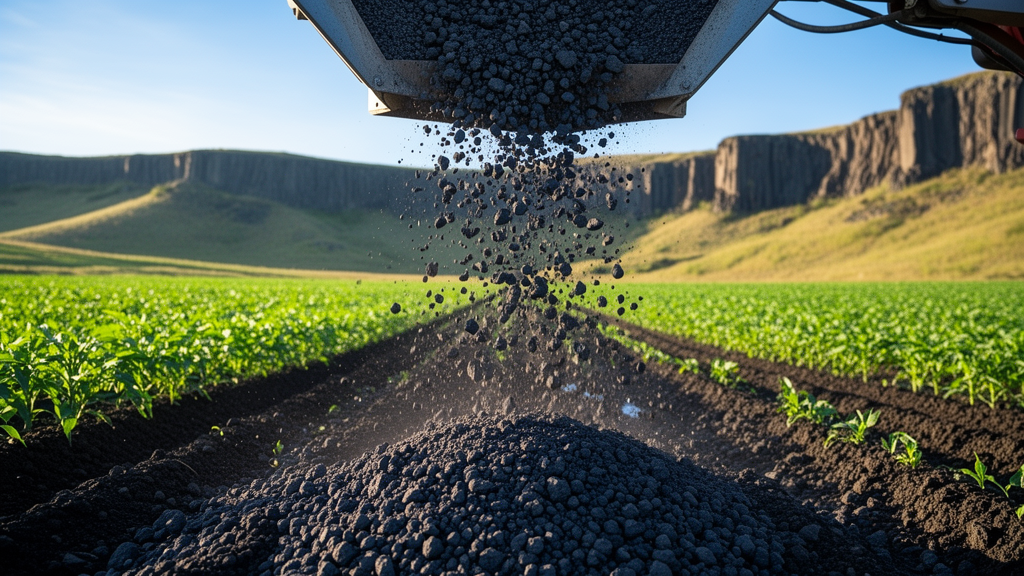
Researchers have completed a global assessment of the theoretical potential for enhanced weathering, a carbon removal approach that involves applying finely ground silicate rock to agricultural soils. The study, published in the journal Carbon Research, analyzed 9,088 silicate-rock records to estimate how much carbon dioxide could be removed from the atmosphere under various conditions. By combining data on rock chemistry, life-cycle emissions, and cropland conditions, the team identified specific particle sizes, sourcing regions, and environmental constraints that influence the effectiveness of this method. The work provides a detailed framework for understanding how this rock-based approach could contribute to global climate goals, while also highlighting the significant limitations and uncertainties inherent in its deployment.
Enhanced weathering operates by increasing the surface area of minerals available to react with atmospheric carbon dioxide. When silicate rocks are ground into fine particles and spread on soil, they undergo chemical reactions that form dissolved carbon compounds, effectively locking away carbon over long timescales. This process is considered necessary alongside emissions reductions, but it differs from other removal approaches in its storage duration, energy requirements, and potential scale. The performance of the method is not uniform; it depends heavily on the specific rock chemistry, local weather patterns, soil conditions, and the carbon emissions generated by the mining, grinding, transport, and spreading of the material.
The research team, led by authors from the Zhejiang Academy of Agricultural Sciences, Zhejiang A & F University, and Tianjin University, utilized a comprehensive global dataset to compare three types of silicate materials: basalt, peridotite, and granitoid. They evaluated these materials using theoretical carbon-sequestration potential and weathering indices, specifically the chemical index of alteration, or CIA. The study also assessed the distribution of these rocks and their life-cycle carbon footprints. By modeling 50-year outcomes for particles of varying sizes, the researchers incorporated estimates of process energy and emissions to provide a more realistic picture of the net carbon removal potential.
Among the materials tested, peridotite exhibited the highest estimated maximum carbon-sequestration potential, at 0.72 ± 0.16 tonnes of CO₂ per tonne of rock. Basalt followed with a potential of 0.30 ± 0.08 tonnes of CO₂ per tonne, while granitoid showed the lowest capacity at 0.09 ± 0.05 tonnes of CO₂ per tonne. The researchers also compared the chemical weathering intensity of these materials. Average basalt CIA values were 61.48 ± 13.16, spanning weak, moderate, and strong weathering categories. Peridotite generally displayed higher CIA values than basalt, whereas granitoid values were mostly below 60, indicating lower reactivity in this specific metric.
Despite peridotite’s higher theoretical capacity, the authors identify basalt as the more suitable material for cropland applications. This recommendation is driven by environmental concerns associated with peridotite, which can contain substantial amounts of nickel and chromium. In contrast, the main metal components of basalt are described as relatively harmless. The study notes that basalt covers approximately 5.2% of the world’s land area, making it a geographically accessible option for large-scale deployment in agricultural regions.
A critical aspect of the assessment was the life-cycle analysis of the carbon dioxide emissions associated with processing basalt. The study estimated emissions from mining, crushing, grinding, transport, and spreading. For particles of 10 μm, estimated process emissions ranged from 81.18 to 182.95 kg CO₂ per tonne of basalt. For 37 μm particles, the range was 27.48 to 63.68 kg CO₂ per tonne. Estimates were lower for larger particles: 21.40–50.16 kg CO₂ per tonne for 100 μm particles and 16.40–39.07 kg CO₂ per tonne for 1,000 μm particles. These ranges reflect the study’s assessment of different energy sources, with grinding and transportation identified as major contributors to the overall process emissions.
The modeling of 50-year outcomes revealed that soil pH significantly impacts the efficiency of carbon sequestration. Lower soil pH increased basalt dissolution and, consequently, the modeled carbon-sequestration efficiency. At a pH of 4, particles of 10, 37, and 100 μm sequestered enough carbon within the assessment period to offset the emissions from the application process. However, 1,000 μm particles did not offset those emissions within 50 years. The study cautions that coarse particles may continue weathering beyond this period, so their longer-term effects should not be dismissed. The authors identify the 10–100 μm range as an optimal grain size, balancing improved weathering against increased energy use and emissions.
Global mapping efforts combined temperature, precipitation, and soil pH data with cropland cover to identify where basalt weathering may be most favorable. At an application rate of 40 tonnes per hectare, the study estimates that applying basalt across 1.57 billion hectares of suitable cropland could yield approximately 18.84 Gt CO₂ of theoretical sequestration after complete weathering. This scenario would require approximately 62.8 Gt of basalt. The analysis identified stronger potential in Southern Asia, Southeast Asia, Latin America, and West-Central Africa, with particularly favorable modeled conditions in parts of Brazil and Myanmar. India, Ethiopia, Russia, Iceland, and Brazil were also noted for their extensive basalt distribution.
The authors emphasize that the 18.84 Gt CO₂ estimate is theoretical and conditional on complete weathering, rather than a prediction of realized removal. The theoretical rock-capacity figures assume that all released cations result in permanent carbon storage and do not account for downstream carbon dioxide outgassing. Therefore, these estimates represent an upper bound before such losses are considered. Deployment would need to carefully account for material availability, transport distances, grinding requirements, energy sources, and local environmental conditions to achieve meaningful net carbon removal.
The study concludes that careful selection of basalt, local sourcing, suitable particle sizes, and locations with favorable weathering conditions can help balance carbon uptake against implementation emissions. It also states that potential adverse effects and safety concerns require further interdisciplinary research. The assessment provides a theoretical basis for considering enhanced weathering as one possible contribution to global net-zero targets by 2050, but it explicitly states that this approach cannot replace emissions reductions.
The study relied on computational simulation and modeling to evaluate the enhanced weathering potential, rather than conducting field trials or direct atmospheric measurements. The modeling process incorporated estimates of process energy and emissions, enabling a more comprehensive assessment of the net carbon removal potential under various simulated conditions.
The assessment specifically evaluated the life-cycle carbon footprint of basalt, focusing on the emissions generated during mining, crushing, grinding, transport, and spreading. The study identified grinding and transportation as major contributors to these process emissions. The estimated ranges for carbon dioxide emissions varied significantly based on particle size, reflecting the assessment of different energy sources used in the processing chain.
The global mapping component of the study combined temperature, precipitation, and soil pH data with cropland cover to identify regions where basalt weathering may be most favorable. The analysis highlighted specific geographic areas with stronger potential, including Southern Asia, Southeast Asia, Latin America, and West-Central Africa. Parts of Brazil and Myanmar were noted for particularly favorable modeled conditions, while India, Ethiopia, Russia, Iceland, and Brazil were identified for their extensive basalt distribution.
The authors emphasize that the theoretical rock-capacity figures assume that all released cations result in permanent carbon storage. This assumption means that the estimates do not account for downstream carbon dioxide outgassing, which could reduce the net carbon removal. Consequently, the reported figures represent an upper bound before such losses are considered. The study concludes that enhanced weathering cannot replace emissions reductions but may serve as one possible contribution to global net-zero targets by 2050. The findings underscore the need for interdisciplinary research to address potential adverse effects and safety concerns.
Subject of Research: Assessing global potential for enhanced weathering
Article Title: Assessing global potential for enhanced weathering
Article References: Assessing global potential for enhanced weathering. Original publication (Bibliographic details unavailable.)
Image Credits: AI Generated
DOI: Not provided
Keywords: Assessing, global, potential, enhanced, weathering, scientific research
Cite Scienmag News
Violet Maxwell. (November 9, 2026). Global Study Maps Basalt Potential for Carbon Removal. Scienmag. https://scienmag.com/global-study-maps-basalt-potential-for-carbon-removal/
Violet Maxwell. "Global Study Maps Basalt Potential for Carbon Removal." Scienmag, 9 November 2026, https://scienmag.com/global-study-maps-basalt-potential-for-carbon-removal/. Accessed 9 November 2026.
Violet Maxwell. "Global Study Maps Basalt Potential for Carbon Removal." Scienmag. November 9, 2026. https://scienmag.com/global-study-maps-basalt-potential-for-carbon-removal/




