

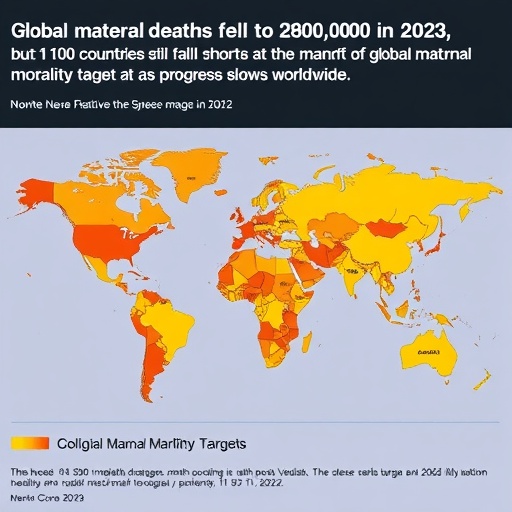
Global maternal mortality rates have witnessed a significant decline over the past three decades; however, recent data reveals a worrying deceleration in this progress. The latest research published in The Lancet Obstetrics, Gynaecology, & Women’s Health, synthesizing findings from the Global Burden of Disease (GBD) 2023 study, highlights that while maternal deaths have dropped to approximately 240,000 in 2023, the pace of reduction has faltered alarmingly. This stagnation poses critical challenges for achieving the United Nations Sustainable Development Goal (SDG) target 3.1, which aims for a global maternal mortality ratio below 70 per 100,000 live births by 2030. Presently, the global maternal mortality ratio remains nearly threefold higher, underscoring urgent needs for strategic health interventions worldwide.
The study, meticulously compiled by the Institute for Health Metrics and Evaluation (IHME) at the University of Washington alongside a broad network of international collaborators, integrates data from over a thousand novel sources and applies advanced modeling methodologies. This comprehensive approach allows for granular insights into maternal mortality trends across 204 countries and territories, including detailed subnational analysis for twenty nations. The robustness of the dataset reveals stark regional disparities, with maternal deaths disproportionately concentrated in sub-Saharan Africa, parts of Oceania, South Asia, and regions of the Caribbean. Countries such as Nigeria, India, the Democratic Republic of the Congo, Ethiopia, and Pakistan emerge as epicenters for maternal mortality, each contributing substantially to the global burden.
Analyzing progress from 1990 to 2023 shows encouraging historical reductions, with the maternal mortality ratio falling from 321 to 191 per 100,000 live births. Notably, the period from 2000 to 2015 experienced rapid annual declines of nearly 3%, attributed largely to international health initiatives and expanded access to maternal healthcare. However, the trajectory sharply diverges post-2015, as the decline has slowed to an anemic average of 0.5% per year. Alarmingly, certain nations have even witnessed increases in maternal mortality ratios during this latter period, a trend that threatens global progress and raises questions surrounding healthcare system resilience and equity.
The regional distribution of maternal mortality ratios remains uneven. Sub-Saharan Africa continues to bear the heaviest burden, with countries such as Liberia, the Central African Republic, Haiti, Eritrea, and Sierra Leone recording maternal mortality ratios exceeding 700 deaths per 100,000 live births. These figures starkly illustrate persistent systemic challenges, including under-resourced health infrastructure, shortages of skilled birth attendants, and limited emergency obstetric care. The Caribbean and Oceania regions also register high maternal mortality rates, highlighting the need for targeted regional health policy interventions.
Examining the underlying causes of maternal mortality reveals that the majority are attributable to preventable conditions. Maternal hemorrhage and hypertensive disorders during pregnancy account for more than 40% of these deaths globally. These findings emphasize the critical importance of improving access to quality antenatal care, skilled delivery services, emergency obstetric treatment, and postnatal follow-up. Health systems must prioritize the continuum of care before, during, and after pregnancy to mitigate avoidable complications and avert maternal fatalities.
The study underscores that data quality and availability remain substantial barriers to effective maternal health interventions, particularly in high-burden, low-resource regions. Many countries lack comprehensive vital registration systems and maternal death surveillance mechanisms, which diminishes the accuracy of maternal mortality estimates and hampers timely policy responses. Strengthening health information systems and expanding high-quality data collection frameworks are indispensable for enabling tailored and dynamic health policies that can adapt to evolving maternal health challenges.
Socioeconomic factors profoundly influence maternal mortality outcomes, intertwining health system capacity with broader social determinants of health. Economic growth and expansion of healthcare resources have correlated with reduced maternal deaths in several contexts. Nevertheless, countries like Ethiopia, Bangladesh, Nepal, and Cambodia have demonstrated that marked improvements can occur even in resource-constrained settings through strategic investments in facility-based deliveries and maternal health service scaling. These case studies provide valuable lessons in leveraging limited resources for maximal health impact.
The COVID-19 pandemic introduced an unprecedented disruption to maternal health progress. Early in the pandemic, before widespread vaccine availability, increased infection rates led to a spike in maternal deaths in select regions. Latin America, parts of the Caribbean, Central and Eastern Europe, and high-income North America experienced temporary reversals in maternal mortality reduction, driven by both direct effects of COVID-19 infection in pregnant women and indirect consequences of healthcare system strain. This wave of adversity highlighted vulnerabilities within maternal health programs and underscored the interconnectedness of pandemic preparedness and maternal health resilience.
Despite the transient setbacks engendered by the pandemic, many countries with robust health systems demonstrated resilience, returning maternal mortality trends towards pre-pandemic trajectories by 2022 and 2023. However, this recovery is uneven and fragile. The persisting rates of maternal death remain unacceptably high in numerous parts of the world, signaling that the global community still faces profound challenges in achieving the SDG maternal mortality target within the next five years.
Addressing this complex challenge demands renewed international commitment and investment. Policymakers and global health stakeholders must adopt a multipronged strategy prioritizing health system strengthening, equitable access to maternal healthcare, and enhanced surveillance infrastructures. Emphasizing quality of care, especially in the most affected countries, is vital to accelerate reductions in maternal mortality. Additionally, integrating social equity considerations by addressing disparities in gender, socioeconomic status, and geography will be imperative to ensure no woman is left behind.
In conclusion, while global maternal mortality has witnessed historic advances, the current slowdown in progress coupled with persistent high rates in vulnerable regions signals an urgent call to action. Combating maternal mortality necessitates an integrated approach encompassing clinical excellence, robust data infrastructures, health equity, and pandemic preparedness. Meeting the SDG 3.1 target is within reach only through decisive, well-coordinated global efforts that address both the medical and social determinants of maternal health. The window for transformative progress is rapidly narrowing, making immediate and sustained interventions indispensable for saving the lives of hundreds of thousands of women worldwide.
Subject of Research: People
Article Title: Global, regional, and national levels and trends in maternal mortality, progress towards the Sustainable Development Goals, and mortality from COVID-19 infection in pregnant women, 1990–2023: a systematic analysis for the Global Burden of Disease Study 2023
News Publication Date: 26-Mar-2026
Web References: Not provided
References: DOI 10.1016/S3050-5038(26)00047-6
Image Credits: Not provided
Keywords: maternal mortality, global health, Sustainable Development Goals, SDG 3.1, sub-Saharan Africa, maternal hemorrhage, hypertensive disorders, COVID-19, pandemic impact, health systems, maternal care quality, vital registration


