

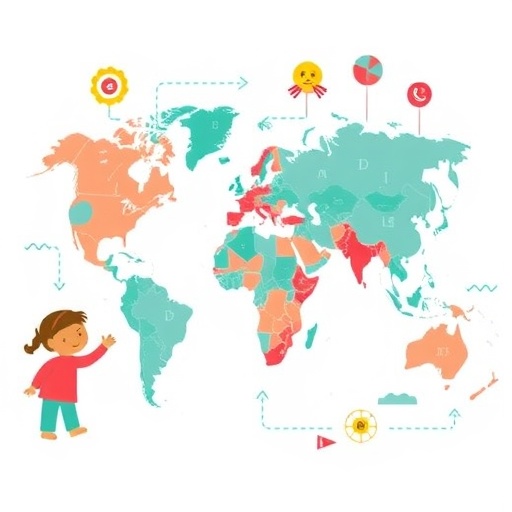
In the ever-evolving landscape of early childhood education, the critical examination of curriculum frameworks across different regions has become paramount. A recent study titled “Semantic Network Analysis of Early Childhood Curriculum Document from the NYS (U.S.), British Columbia (Canada), and South Korea” delves into this significant field, analyzing the semantic structures of early childhood educational documents from three distinct educational authorities. The authors, Lee, Lee, and Ghim, endeavor to illuminate how varying cultural contexts shape educational priorities and methods in their respective curricula, which is crucial for educators and policymakers alike.
The study employs semantic network analysis, a methodological approach that allows researchers to map and visualize relationships between concepts within texts. By utilizing this method, the authors compare the underlying themes, concepts, and structural nuances embedded within early childhood curricula from the New York State, British Columbia, and South Korea. This comparison is essential for understanding how early educational frameworks cater to their specific societal contexts while maintaining a shared goal of fostering developmental growth in children.
In the curriculum documents analyzed, each region presents unique emphases that reflect their cultural values and educational priorities. For instance, New York’s curriculum often promotes diversity and inclusion, showcasing a commitment to social justice and equity. This emphasis on inclusivity mirrors the multicultural tapestry of New York City, catering to a wide array of backgrounds and learning needs. Conversely, British Columbia’s curriculum is more tailored towards holistic child development, emphasizing connections with nature and community. This reflects the region’s rich natural environment and strong community ties, demonstrating how geography influences educational priorities.
South Korea’s approach to early childhood education, as articulated in its curriculum document, stresses academic achievement and discipline, with a structured framework aimed at fostering cognitive skills from a young age. This focus aligns closely with the country’s competitive educational culture, which has long prioritized academic rigor. The stress on discipline and educational outcomes in Korea reveals societal expectations that may differ significantly from the approaches taken in North America, where social-emotional learning holds substantial importance.
Furthermore, by mapping the semantic networks of these curriculum documents, the authors reveal the interconnectedness of key educational concepts across the three regions. They identify core themes such as play-based learning, community engagement, and developmental appropriateness that resonate in varying degrees within each curriculum. Through this lens, the study suggests that, despite apparent differences, there is an underlying recognition of the crucial role of early education in child development, which serves as a common ground for further discussion and research.
The implications of the study are manifold. For educators, understanding these differences provides critical insights into how cultural contexts shape pedagogical practices. This awareness can lead to more informed teaching strategies that are sensitive to the diverse backgrounds of children within the classroom. For policymakers, the analysis of these curriculum documents can guide the formulation of educational policies that are not only effective but also culturally responsive, ultimately enhancing the educational experiences of young learners.
Moreover, the research highlights the importance of semantic network analysis as a valid tool for educational research. The ability to visualize relationships among concepts allows educators, researchers, and administrators to better grasp the complexities of educational frameworks. This methodological framework enables an in-depth understanding of how narratives within curricula are constructed and how they can be aligned to meet emerging educational challenges.
As the world becomes increasingly interconnected, the necessity of comparative educational studies grows. The insights drawn from analyses such as this one contribute to a global dialogue about best practices in early childhood education. By studying curricula across borders, educators can draw lessons from one another, adapting successful strategies to fit local contexts, thus enhancing educational outcomes on a larger scale.
Ultimately, the study by Lee, Lee, and Ghim serves not only as a comparative analysis but also as a call to action for ongoing examination of childhood education. As educational systems grapple with the challenges and changes posed by globalization, technology, and evolving societal norms, the need for well-rounded, culturally aware curricula becomes ever more pressing. It is through comprehensive studies like this that stakeholders can gain the insights necessary to construct educational experiences that are both nurturing and academically enriching.
As we move forward into a new era of educational exploration, peer-reviewed studies like this pave the way for understanding the critical elements that help shape young minds. It illuminates the pathways that connect various educational philosophies and practices, emphasizing that while methodologies may vary, the underlying intent to promote holistic development in children remains universally shared.
In conclusion, the semantic network analysis conducted by Lee and colleagues not only sheds light on the intricacies of early childhood curricula across different cultural landscapes but also inspires further inquiry into how education systems can collaboratively enhance the learning experience for children. It is a testament to the powerful role that early education plays in shaping societies and underscores the necessity of continual research to adapt and improve educational practices worldwide.
Subject of Research: Semantic network analysis of early childhood curriculum documents in New York State, British Columbia, and South Korea.
Article Title: Semantic Network Analysis of Early Childhood Curriculum Document from the NYS (U.S.), British Columbia (Canada), and South Korea.
Article References:
Lee, H., Lee, YS., Ghim, H. et al. Semantic Network Analysis of Early Childhood Curriculum Document from the NYS (U.S.), British Columbia (Canada), and South Korea.
IJEC (2026). https://doi.org/10.1007/s13158-025-00457-x
Image Credits: AI Generated
DOI: https://doi.org/10.1007/s13158-025-00457-x
Keywords: Early childhood education, curriculum analysis, semantic network analysis, educational frameworks, comparative education, cultural context.


