

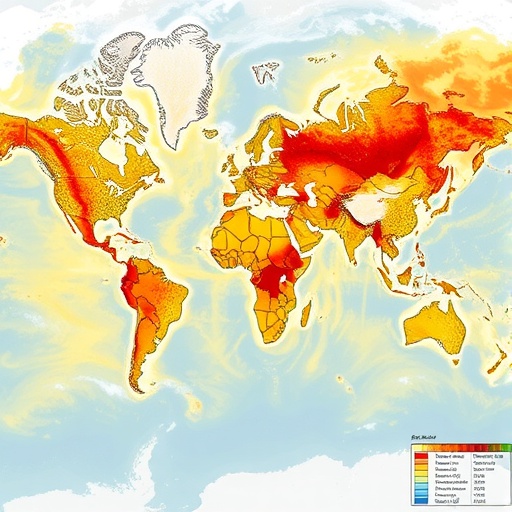
As the planet confronts escalating climate challenges, new research uncovered by Huang, Luo, Wu, and their colleagues has illuminated the alarming emergence of global hotspots characterized by compound extreme heat and pollution. This groundbreaking study evaluates intricate interactions between local surface features and atmospheric conditions, revealing synergistic effects that exacerbate human and environmental risks far beyond what isolated heatwaves or pollution events would suggest. Their findings, soon to be published in Communications Earth & Environment, offer a sobering glimpse into future climate dynamics and underscore an urgent need to reconsider urban planning, environmental policy, and public health strategies worldwide.
The core of the research centers on “compound extreme events,” which describe the concurrence or rapid succession of multiple environmental stressors—in this case, extreme heat coupled with severe pollution episodes. While previous studies have separately tracked heatwaves and air quality deterioration, this investigation uniquely integrates both phenomena, using advanced climate and atmospheric models to pinpoint geographical regions where these hazards align, amplifying their effects. This compound perspective is vital, as it directly correlates with intensified health impacts, infrastructure strain, and ecological disruption.
Methodologically, the team applied a sophisticated combination of remote sensing data, in-situ measurements, and high-resolution atmospheric simulations to dissect the localized factors driving these compound extremes. Of particular importance were land surface characteristics, such as urban density, albedo changes, vegetation cover, and topographical influences. These local surface variables modulate not only ground temperatures but also influence pollutant dispersion, chemical transformation in the air, and atmospheric stability, creating feedback loops that worsen heat-pollution events.
Their analysis highlights how urban areas, especially megacities, become disproportionate epicenters of compound risk due to the urban heat island effect and high-emission activities. The study meticulously documents several hotspots across continents—including parts of South Asia, East Asia, sub-Saharan Africa, and regions within North and South America—where extreme heat coinciding with elevated pollutants such as ozone and particulate matter scarcely fluctuate independently but rather conflate, creating sustained exposure threats.
One surprising revelation was the role of atmospheric boundary layer dynamics in sustaining these compound extremes. Typically, during intense heat days, a shallow boundary layer traps pollutants close to the surface, preventing vertical mixing and dispersion. This condition stalls contaminants near human breathing zones, compounding health risks such as respiratory stress and cardiovascular strain. By quantifying this phenomenon with enhanced vertical atmospheric profiling, the study contributes new mechanistic understanding of how heat intensifies pollution’s hazardous footprint.
Moreover, the research delineates how diurnal and seasonal cycles influence compound event probabilities, underscoring that certain seasons exacerbate these threats far more than others. For example, late summer and early autumn often combine ground-level ozone precursors AND hotter days, maximizing ozone formation. Meanwhile, winter inversions coupled with sporadic cold fronts may heighten particulate matter accumulation. This intricate temporal variability challenges the notion of static seasonal risk assessments and calls for dynamic monitoring regimes.
Intriguingly, their findings suggest that local surface interventions could substantially mediate these compound impacts. Initiatives such as increased urban green spaces, reflective roofing materials, and improved street ventilation may lower surface temperatures and enhance pollutant dispersal. Likewise, reducing emissions via cleaner transportation and industrial processes directly dovetails to mitigate compound extremes—yet the paper stresses that isolated measures are insufficient without coordinated urban-atmospheric system approaches.
A key technological advancement in this study lies in the integration of machine learning algorithms with physical climate models to detect patterns and predict compound risk zones with unprecedented precision. The synergy between data-driven techniques and process-based modeling offers a replicable framework for other climate risk assessments. This breakthrough paves the way for near-real-time hazard mapping and proactive risk management at scales from neighborhoods to nations.
The implications for public health and infrastructure resilience are profound. Vulnerable populations—particularly children, the elderly, and those with preexisting health issues—face magnified threats from concurrent exposure to heat stress and toxic air. The study argues for urgent reform in warning systems and emergency response protocols, advocating for compound event advisories that differ from traditional heatwave or pollution alerts to better prepare communities.
Ecological systems are not immune either. The overlapping impact of intense heat and atmospheric pollutants undermines plant photosynthetic efficiency, soil microbial activity, and freshwater quality, thereby threatening biodiversity and ecosystem services. The research highlights the cascading consequences of these compound extremes on food security and natural carbon sinks, elevating the urgency of addressing underlying climatic and environmental drivers.
Global inequities stand out starkly in this research. Many identified hotspots fall within developing regions where adaptive capacity is limited due to socio-economic constraints and weak governance structures. The authors emphasize the ethical imperative to channel global support, technology transfer, and funding to bolster resilience in these disproportionately affected areas, aligning efforts with climate justice.
Further compounding the challenge is the trajectory of climate change itself, which the study uses advanced scenario modeling to project will amplify the frequency, intensity, and duration of compound heat-pollution events throughout the 21st century. This intensification could push many urban centers beyond critical thresholds, triggering irreversible damage to human health and urban systems unless swift mitigation and adaptation actions are undertaken.
The paper closes by advocating for an integrated paradigm shift in climate research, policy, and practice. Recognizing compound extremes as opposed to isolated hazards enables more holistic vulnerability assessments and targeted interventions. It calls for interdisciplinary collaboration among climatologists, environmental engineers, urban planners, public health experts, and policymakers to translate findings into tangible protections for people and planet.
Ultimately, Huang and colleagues’ study serves as both an urgent warning and a roadmap. It reveals the complex machinery behind some of the planet’s most intense environmental health risks and illustrates actionable pathways to reduce those risks. Their pioneering work lays the foundation for the next generation of climate resilience science—one that acknowledges the interwoven nature of heat, pollution, surface processes, and atmospheric behavior in shaping our shared future.
Subject of Research: Compound extreme heat and pollution events and their links to local surface and atmospheric conditions globally.
Article Title: Global hotspots of compound extreme heat-pollution linked to local surface and atmospheric conditions.
Article References:
Huang, Z., Luo, M., Wu, S. et al. Global hotspots of compound extreme heat-pollution linked to local surface and atmospheric conditions. Commun Earth Environ (2026). https://doi.org/10.1038/s43247-026-03460-9
Image Credits: AI Generated


