

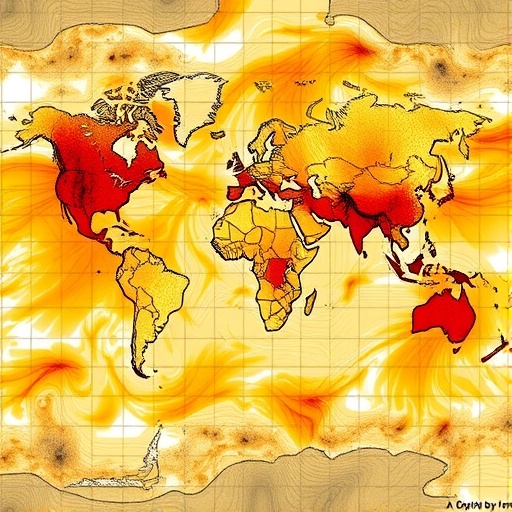
In recent years, the growing vulnerability of global food systems has captured the attention of researchers and policymakers alike. A groundbreaking new study published in Nature Communications projects a worrying trend: record-shattering droughts impacting the world’s major agricultural regions—or “breadbaskets”—may arise not solely from traditionally understood meteorological extremes but from the compounded effects of multiple moderately extreme regional events. The implications of this insight are profound, reframing how we evaluate drought risk in a warming and increasingly interconnected planet.
Drought is a complex climate hazard defined by a significant and persistent deficiency in precipitation, leading to water scarcity and adverse impacts on agriculture, ecosystems, and societies. Historically, the most catastrophic droughts have been associated with severe anomalies in weather patterns localized to major crop-producing areas. However, the novel research by Li, Zscheischler, and Bevacqua challenges this paradigm by demonstrating that devastating global agricultural droughts may emerge from the confluence of several regional droughts, each individually moderate but collectively unprecedented in scale and severity.
This shift in understanding originates from the authors’ use of sophisticated statistical modeling and climate data analysis across multiple breadbasket zones globally, including regions such as the U.S. Midwest, the European Plain, the Indo-Gangetic Plain, and parts of South America. These areas collectively contribute to a significant portion of the world’s cereal production. The study’s models account not only for localized meteorological conditions but also for the spatial interdependencies among regional droughts, providing a comprehensive framework that captures the potential for synchronous or cascading climate extremes.
The researchers employed a novel approach using multivariate extreme value theory, which is particularly suited to analyzing the joint occurrence of multiple moderately extreme but distinct events. While univariate drought assessments focus on parameters such as precipitation deficits or soil moisture anomalies within individual regions, this method allows for the integration of regional events across space and time, revealing compound hazards with surprisingly high global impact. Such compound droughts could disrupt global grain markets, destabilize economic systems, and exacerbate food insecurity on an unprecedented scale.
Importantly, the study identifies that moderately extreme droughts, which have historically been managed or mitigated with relative success, could synchronize across regions due to evolving climate teleconnections and anthropogenic influences. Teleconnections—large-scale climate patterns such as El Niño-Southern Oscillation (ENSO) or the North Atlantic Oscillation (NAO)—create atmospheric linkages that can simultaneously influence weather conditions thousands of kilometers apart. The intensification of such teleconnections under climate change may increase the probability of these synchronizations, effectively turning individually manageable droughts into globally catastrophic events.
The consequences of such global-scale breadbasket droughts are dire. Agricultural systems functioning under the assumption of spatial independence between drought-impacted regions may find themselves ill-prepared when multiple regions experience simultaneous production shortfalls. The result would not only be a collapse in local yields but an exacerbation of global food price volatility, leading to heightened risk for political instability, nutrition deficits, and humanitarian crises, particularly in vulnerable regions dependent on food imports.
From a technical standpoint, the findings underscore the need for multidimensional hazard assessment frameworks in climate risk analysis. Traditional risk metrics based solely on single-region extremes or annual average losses do not capture the complex interplay among regions. These insights may prompt policymakers to reconsider adaptation planning, integrating cross-regional drought risk assessments and coordinated international response strategies to mitigate the repercussions of such compound events.
Furthermore, the study pioneers the concept that record-breaking global droughts need not always be driven by the most severe local extremes. Instead, the aggregation of moderately extreme events can produce unprecedented systemic shocks. This revelation propels a shift from focusing exclusively on the severity of isolated events to understanding systemic vulnerabilities arising from spatial correlations in climate stressors.
The modeling framework developed by Li and colleagues leverages enormous climate datasets spanning multiple decades, applying cutting-edge computational techniques to simulate drought likelihoods under varying emissions scenarios and climate variability assumptions. These simulations suggest an increase in the frequency and spatial extent of compound drought events through the mid-21st century, reinforcing concerns over climate change’s role in intensifying hydrological risks.
Given the inherent complexity of forecasting compound droughts, early warning systems and drought management protocols must evolve. Incorporation of real-time climate teleconnection indicators and integrated modeling that considers simultaneous stressors can improve anticipation of these large-scale drought events, allowing for preemptive mitigation steps such as strategic grain reserves, diversified crop selection, and water resource management optimizations.
On the research frontier, this work calls for enhanced interdisciplinary collaborations between climatologists, agronomists, economists, and social scientists to holistically address systemic drought risks. A systems approach that integrates climate science, food security modeling, and socio-economic vulnerability assessments will be crucial in comprehensively understanding and preparing for the cascading impacts of compound droughts.
Moreover, the authors highlight the urgent need for global cooperation in food production and trade policies. Given that breadbaskets are geographically dispersed but economically interlinked, international mechanisms for resource sharing, trade stabilization, and climate resilience financing will be essential to counterbalance regional shortfalls and avoid exacerbation of inequalities.
This study also encourages a reassessment of current climate risk communication. Often, drought risk is portrayed through the lens of event magnitude and frequency within isolated locales. Instead, an emphasis on systemic exposure—the likelihood that multiple regions face simultaneous stress—should be communicated to policymakers and the public. Fostering awareness of interconnected risks can galvanize more robust, coordinated responses across borders.
In conclusion, by reframing record-breaking global breadbasket droughts as emergent phenomena from moderately extreme regional droughts occurring in tandem, this research sets a new direction in drought risk science. It calls attention to the hidden vulnerabilities lurking in the spatial dependencies of climate extremes, challenging current drought paradigm frameworks. As climate change progresses, understanding and managing these compound risks will be vital to safeguarding global food systems and sustaining human well-being on Earth.
Subject of Research: Compound drought risk in global agricultural breadbasket regions arising from moderately extreme yet spatially correlated regional climate events.
Article Title: Global record-shattering breadbasket droughts emerge from moderately extreme regional events.
Article References:
Li, J., Zscheischler, J. & Bevacqua, E. Global record-shattering breadbasket droughts emerge from moderately extreme regional events. Nat Commun (2026). https://doi.org/10.1038/s41467-026-70700-z
Image Credits: AI Generated


