

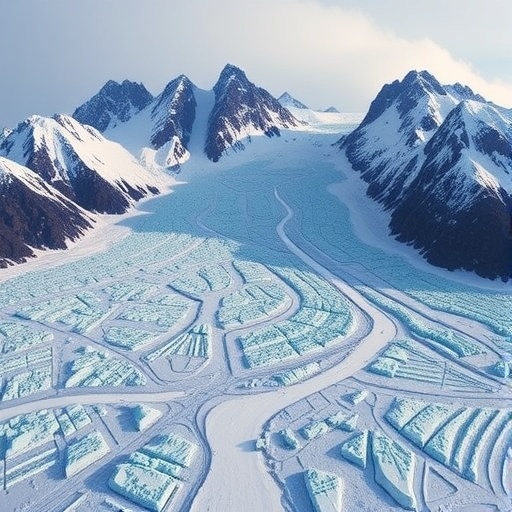
In a groundbreaking study published in Communications Earth & Environment, researchers have unveiled the intricate mechanisms behind the mobility of trace metals in meltwater emanating from glaciers worldwide. This research sheds critical light on the varying factors influencing the transport and bioavailability of these trace metals, which have profound implications for ecosystem health, water quality, and global biogeochemical cycles. As glaciers continue to recede amid accelerating climate change, understanding how these frozen reservoirs impact elemental cycling becomes crucial for predicting downstream environmental outcomes.
Glaciers, long deemed inert reservoirs of frozen water, are dynamic sources of meltwater enriched with diverse chemical constituents, including trace metals such as iron, copper, zinc, and lead. These metals, often released through glacial erosion and subglacial weathering processes, can dramatically influence nutrient dynamics in aquatic ecosystems. However, the factors that modulate their mobility and concentration in meltwaters have remained poorly understood, particularly when comparing mountain glaciers with their polar counterparts.
Sundriyal and colleagues put forth a comprehensive global analysis, compiling data sets from mountain ranges across Asia, Europe, and the Americas alongside polar ice sheets in the Arctic and Antarctica. Their integrative approach combined geochemical analyses, field sampling, and modeling to dissect the glacier-specific controls on trace metal mobilization. This study represents one of the first attempts to directly compare trace metal behavior in meltwater across such diverse glacial environments through a unified framework.
Central to their findings is the recognition that lithological differences in the underlying bedrock profoundly influence trace metal signatures. Mountain glaciers often rest atop complex sedimentary and metamorphic formations rich in metal-bearing minerals, while polar glaciers may overlay ancient crystalline bedrock with distinctly different geochemical profiles. This geological underpinning dictates the repertoire of trace metals available for release as the ice melts and interacts with substrate.
Moreover, subglacial hydrology emerges as a critical moderator of trace metal concentrations. The study highlights that polyphasic water flow beneath glaciers – ranging from slow basal meltwater percolation to turbulent subglacial streams – modulates the dissolution and transport of metals. For example, fast-flowing subglacial channels facilitate rapid flushing of metals, limiting extended interaction with sediments and thus reducing concentrations, whereas slow, stagnant waters promote prolonged chemical weathering and metal enrichment.
Beyond geological and hydrological factors, the influence of microbial activity within glacial environments was found to be an underestimated driver of trace metal cycling. Microbial communities facilitate redox reactions that alter metal speciation, impacting their solubility and mobility. Particularly in polar glaciers, microbial mediation was shown to promote the transformation of insoluble metal forms into bioavailable species, enhancing ecological risks associated with metal contamination downstream.
Another salient feature of this work is the elucidation of seasonal variability in trace metal fluxes. The researchers documented peak concentrations of metals during spring and early summer melt periods, driven by increased ice melt rates and enhanced chemical weathering triggered by rising temperatures. This seasonally pulsed release pattern intersects with biological productivity cycles in downstream waters, potentially affecting food web dynamics and biogeochemical feedbacks.
The study also addresses anthropogenic impacts overlaying natural processes. In some mountain glacier regions, legacy pollution and airborne deposition of metal particulates have enriched surface ice layers with anthropogenic metals. The melting of these contaminated ice layers introduces additional vectors of metal input to meltwaters, compounding natural geochemical releases and complicating mitigation efforts. This finding underscores the necessity of accounting for human influence when assessing metal fluxes in glacier-fed systems.
Importantly, the impact of melting glaciers on trace metal availability gains urgency in the context of global climate warming. Accelerated glacier retreat is not only intensifying the volume of meltwater discharge but also exposing previously ice-covered mineral deposits. This exposure facilitates enhanced metal leaching and transport to downstream ecosystems. Furthermore, the shift in seasonal melt dynamics alters timing and magnitude of metal pulses, with potential cascading effects on water security and ecosystem health at both local and global scales.
From a methodological standpoint, Sundriyal et al. employed state-of-the-art analytical techniques to assess dissolved and particulate metal fractions with unprecedented precision. Using inductively coupled plasma mass spectrometry (ICP-MS) and synchrotron-based X-ray absorption spectroscopy, they characterized metal speciation and binding states. This molecular-level insight allows for improved predictive modeling of metal mobility and bioavailability, enabling more nuanced assessments than traditional bulk concentration measurements.
In synthesizing these diverse datasets, the study introduces novel conceptual models that integrate geological, hydrological, biological, and climatic controls on trace metal fluxes. These models serve both as predictive tools for anticipating changes in metal mobility under future climate scenarios and as frameworks for guiding targeted environmental monitoring. By discerning patterns across glacier types and regions, the research establishes a foundational understanding crucial for managing emerging risks associated with glacier melt.
Beyond terrestrial implications, the research highlights potential connections to marine biogeochemical cycles. Trace metal-enriched meltwaters ultimately flow into the ocean, where they can influence coastal phytoplankton productivity and associated carbon sequestration processes. Changes in metal input from glaciers may therefore reverberate through oceanic nutrient cycles and climate feedback loops, linking cryospheric processes with global environmental change.
The comprehensive nature of this research unravels complex interactions governing trace metal behavior in cryospheric environments, marking a paradigm shift in understanding glacier meltwater chemistry. The findings emphasize the heterogeneous nature of glaciers as metal sources and caution against one-size-fits-all assumptions when projecting their environmental impacts. This nuanced perspective is vital for scientists, policymakers, and environmental managers grappling with the multifaceted consequences of glacier retreat.
In conclusion, Sundriyal and collaborators’ work fundamentally advances the frontier of Earth system science by elucidating glacier-specific controls on trace metal mobilization. Their integrative, multidisciplinary approach unpacks the subtle interplay of geological substrate, hydrological regimes, microbial processes, and climatic drivers shaping the elemental composition of meltwaters across diverse glacial landscapes. As the cryosphere transforms rapidly in a warming world, these mechanistic insights will prove indispensable in assessing the fate of trace metals and their ecological ramifications globally.
Subject of Research: Trace metal mobility in glacier meltwater and the factors controlling it across mountain and polar glaciers globally.
Article Title: Glacier-specific controls on enhanced trace metal mobility across global mountain and polar meltwaters
Article References: Sundriyal, S., Shukla, T., Kang, S. et al. Glacier-specific controls on enhanced trace metal mobility across global mountain and polar meltwaters. Commun Earth Environ (2026). https://doi.org/10.1038/s43247-025-03064-9
Image Credits: AI Generated


