


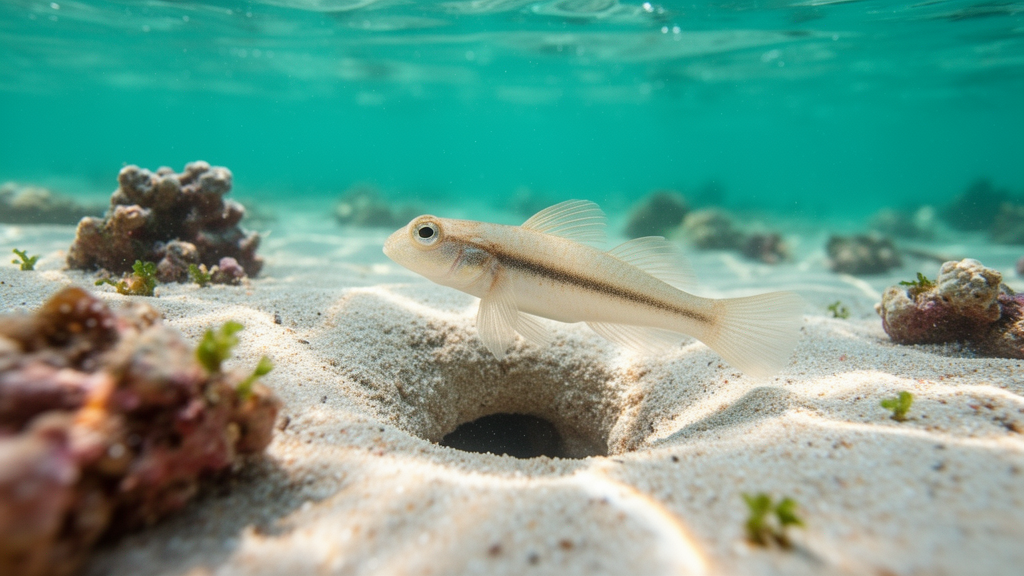
Marine biologists have confirmed the continued existence of the girdled shrimpgoby, Myersina yangii, in Taiwanese waters, overturning recent assumptions that the species had become locally extinct in the region. This significant taxonomic clarification stems from a detailed examination of two male specimens, one collected from the Malacca Strait off the coast of Perak, western Peninsular Malaysia, and the other from south of Donggang, Taiwan. The findings, published in Acta Ichthyologica et Piscatoria, not only mark the first recorded presence of the species in Malaysia but also resolve a long-standing confusion regarding the diagnostic features of male individuals, which had previously been overlooked in favor of female characteristics.
The genus Myersina, characterized by specific morphological traits such as cycloid scales on the body and a naked head and pectoral-fin base, has historically been subject to taxonomic ambiguity, particularly in its relationship with the closely related genus Cryptocentrus. For decades, the identification of Myersina yangii relied heavily on a transverse black band located on the mid-lateral body, a feature that recent studies had treated as a definitive diagnostic marker for the entire species. However, the original description by Chen in 1960 explicitly attributed this character only to females, a distinction that had been largely ignored in subsequent taxonomic reviews, leading to misidentifications and erroneous extinction declarations in certain geographic areas.
The Malaysian specimen, a male measuring 47.8 mm in standard length, was collected as bycatch during a bottom trawling survey in January 2024. Its identification as Myersina yangii was initially surprising, as the species had not been previously recorded in Malaysian waters. The specimen exhibited the characteristic silver-brown head and body, along with a bluish-silver oblique line on the head and upper and mid-lateral longitudinal lines on the body, matching the descriptions provided in the original 1960 account and later corroborated by underwater photographs from the Philippines and Indonesia. This fresh color pattern provided crucial evidence that the specimen belonged to the same species as those previously documented in the Indo-West Pacific region.
Simultaneously, a male specimen collected in Taiwan in 2018, previously reported as an unidentified Myersina species, was re-examined and confirmed to be Myersina yangii. This discovery is particularly noteworthy because the species had been listed as extinct in Taiwan by 2024, a conclusion drawn from the lack of confirmed sightings and the difficulty in distinguishing the species from other similar gobies due to the absence of the female-specific black band. The presence of this male specimen, which lacked the transverse black band but displayed the characteristic elongated dorsal-fin spines and specific sensory papillae patterns, definitively proves that the species remains extant in its type locality.
One of the most intriguing findings of the study is the documentation of intraspecific variations in male color patterns and fin ray counts. The Malaysian specimen possessed only 10 anal-fin soft rays, whereas the typical count for the species, including the Taiwanese specimen and all previously examined females, is 11. Despite this numerical discrepancy, the researchers confirmed the conspecificity of the two specimens based on the strong similarity of their fresh color patterns and other diagnostic morphological features. This suggests that the number of anal-fin rays, while often used as a diagnostic character within the genus Myersina, may exhibit more variability than previously acknowledged, particularly between male and female individuals or across different geographic populations.
Furthermore, the study highlights the presence of a single black blotch on the fourth or fifth spine of the first dorsal fin in both male specimens, a feature that was absent in all previously documented female specimens. This observation suggests that the black blotch may be a consistent secondary sexual characteristic of male Myersina yangii, adding another layer of complexity to the species’ identification. The original description by Chen noted a dusky patch on the fourth spine, but this feature had not been explicitly linked to male sex in subsequent literature. The current findings provide a clearer picture of sexual dimorphism in the species, emphasizing the importance of examining both male and female individuals for accurate taxonomic classification.
The distribution of Myersina yangii has been expanded to include Malaysia, joining its previously known range in Taiwan, the Philippines, Indonesia, Thailand, India, and Papua New Guinea. The species is known to inhabit shallow coastal waters, often associated with shrimp, which is reflected in its common name, the girdled shrimpgoby. The discovery in the Malacca Strait, a region with high biodiversity and significant commercial fishing activity, underscores the need for continued ichthyofaunal surveys in the Indo-West Pacific to accurately document marine biodiversity and identify potential new records or range extensions for existing species.
The taxonomic implications of this study extend beyond the mere recognition of the species in new locations. It serves as a cautionary tale for taxonomists, highlighting the dangers of relying on a single diagnostic feature, especially one that may be sexually dimorphic, for species identification. The misidentification of the Taiwanese specimen as an unidentified Myersina, and its subsequent classification as extinct, could have led to the loss of valuable genetic and ecological data. By re-examining the original descriptions and comparing fresh specimens from different geographic locations, the researchers were able to correct these errors and provide a more robust framework for future studies of the genus Myersina.
As marine ecosystems face increasing pressure from climate change, overfishing, and habitat degradation, accurate species identification and monitoring are more critical than ever. The continued presence of Myersina yangii in Taiwan and its discovery in Malaysia offer a glimmer of hope for the resilience of this small but ecologically significant species. However, the study also notes that the species’ habitat in southern Taiwan has declined, suggesting that while it is not extinct, it may be vulnerable to further environmental changes. Future research should focus on understanding the population dynamics, reproductive biology, and ecological interactions of Myersina yangii to ensure its long-term conservation and to clarify the extent of its intraspecific variations across its wide geographic range.
Subject of Research: Taxonomic revision and distribution expansion of the girdled shrimpgoby Myersina yangii in the Indo-West Pacific
Article Title: Recognition of the girdled shrimpgoby, Myersina yangii ( Actinopterygii , Gobiiformes , Gobiidae ), from Taiwan, with notes on male color pattern and discovery of the species in Malaysia
Article References: Koreeda, R., Seah, Y. G., Izarenah, M. R., & Motomura, H. (2025). Recognition of the girdled shrimpgoby, Myersina yangii (Actinopterygii, Gobiiformes, Gobiidae), from Taiwan, with notes on male color pattern and discovery of the species in Malaysia. Acta Ichthyologica et Piscatoria, 55, 309-315. https://doi.org/10.3897/aiep.55.168427
Image Credits: AI Generated
Keywords: Myersina yangii, Gobiidae, Marine Biology, Taxonomy, Indo-West Pacific, Species Distribution, Sexual Dimorphism, Ichthyology, Conservation, Fish Identification, Recognition, girdled
Cite Scienmag News
Margaret Porter. (October 18, 2026). Girdled Shrimpgoby Confirmed Extant in Taiwan and Malaysia. Scienmag. https://scienmag.com/girdled-shrimpgoby-confirmed-extant-in-taiwan-and-malaysia/
Margaret Porter. "Girdled Shrimpgoby Confirmed Extant in Taiwan and Malaysia." Scienmag, 18 October 2026, https://scienmag.com/girdled-shrimpgoby-confirmed-extant-in-taiwan-and-malaysia/. Accessed 18 October 2026.
Margaret Porter. "Girdled Shrimpgoby Confirmed Extant in Taiwan and Malaysia." Scienmag. October 18, 2026. https://scienmag.com/girdled-shrimpgoby-confirmed-extant-in-taiwan-and-malaysia/


