

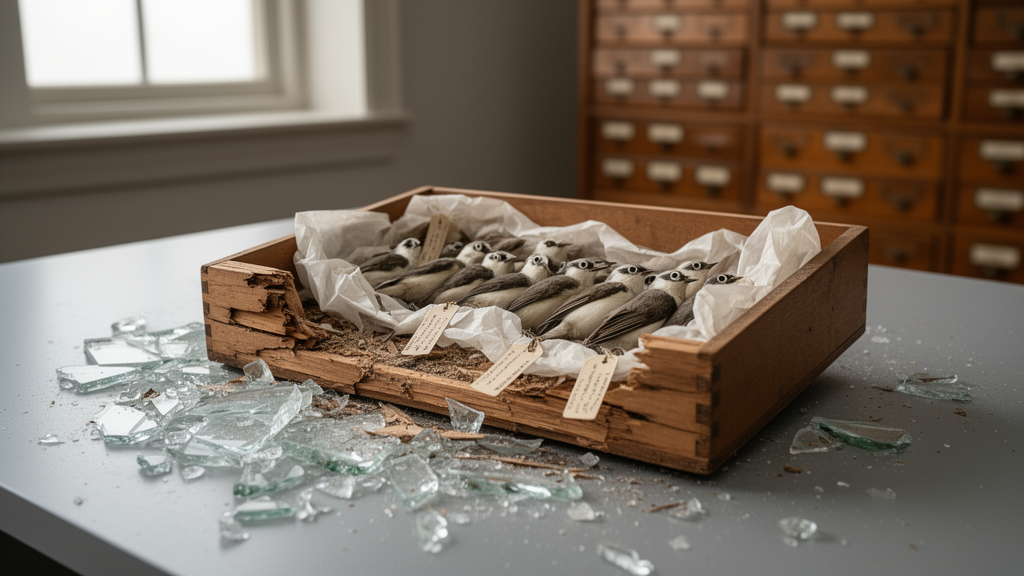
On the fatal night of 3 May 1941, German bombs fell on the grand purpose-built museum on William Brown Street in Liverpool, and the building burned out. The city’s oldest public museum, rebranded as World Museum in 2005, had evacuated its bird study skins to country houses in North Wales shortly after war was declared on 3 September 1939, so the losses to the bird collections were limited to eggs, mounts and books. But two drawers of bird skins had been temporarily brought back to the Museum for study purposes, and one of those drawers contained the genus Zosterops, the White-eyes. When acting director Frank Lambert wrote to Carl Alexander Gibson-Hill, curator of the Raffles Museum in Singapore, in May 1948, he explained that the drawer of White-eyes was destroyed in the bombing, possibly taking with it the type of Zosterops difficilis that Gibson-Hill had been enquiring after after it had been erroneously included in a list of types held at the Raffles Museum.
A new article published in Natural History Collections and Museomics documents and contextualises the ghost specimens, now existing only as written or illustrated records, and the extant specimens of White-eyes from the Museum’s collection. The catalogue lists 250 specimens of White-eyes thought to have been acquired by the Museum over its 174-year history, representing 86 taxa currently placed in the genera Zosterops and Heleia. At its greatest extent, the collection included around one third of the currently recognised taxa within Zosterops, a so-called great speciator group with over 250 subspecies found across Africa, Australia, Asia and the Pacific. Two hundred and eighteen specimens were probably destroyed in 1941, although 15 might possibly have survived in the Academy of Natural Sciences of Philadelphia. Only 31 extant specimens remain in the Museum today.
The destroyed collection included 22 type specimens and eleven possible type specimens, all linked to notable published works and authors. Type specimens are the physical anchors of scientific names, the individual specimens against which species descriptions are measured, and their loss complicates species delimitation and accurate identification. Among the destroyed types were the holotype of Zosterops hovarum, described by Henry Baker Tristram in 1887 from a single specimen in a parcel of birds from Madagascar, and the syntypes of Zosterops lateralis vatensis, collected at Havannah Harbour on Efate in Vanuatu in 1878. Specimens from four species that are now extinct, Zosterops albogularis, Zosterops conspicillatus, Zosterops semiflavus and Zosterops strenuus, were lost to future research, meaning that the physical evidence of those vanished birds now survives only in the collections of other museums, if at all.
The biographies of these specimens mirror the Museum’s entanglements with local events and the broader history of European science and imperialism. The specimens originated in 29 modern-day countries, almost all former British, Dutch and French colonies, protectorates or concessions, and most were collected between 1850 and 1900. With probably only one exception, Motoyoshi Namiye in Japan, the named suppliers were not locals, but British, Dutch, German and Italian travellers, expatriates and first or later-generation settlers. However, most of the specimens will have had unrecorded prior ownership by local hunters, trappers and traders, the actual hands-on collectors whose labour went unrecorded on labels and in catalogues.
The destroyed White-eyes came from the large private collections of Edward Smith-Stanley, 13th Earl of Derby, and Henry Baker Tristram. Smith-Stanley, who travelled little himself, but as heir to the Knowsley estate about nine miles east of Liverpool, assembled a large private zoo and museum at Knowsley Hall housing animals from across the globe. He bought White-eyes from Benjamin Leadbeater, who operated a family business from 19 Brewer Street in London and traded specimens with Coenraad Jacob Temminck, the founding director of the Leiden Museum, and from Maison Verreaux in Paris. A handwritten memorandum dated July 1845, now held in the Zoological Society of London archives, records Brian Houghton Hodgson, an East India Company officer in Nepal and devoted amateur naturalist, presenting 205 bird skins to Smith-Stanley, including one White-eye. Although originally intending to leave his collections to the British Museum, Smith-Stanley bequeathed them to Liverpool’s local authority, founding its first public museum, and in early 1852, 20,000 specimens and zookeeper Thomas John Moore physically transferred to the new Museum in Liverpool.
Tristram, Canon of Durham and epitome of the Victorian parson-naturalist, had been indefatigable in amassing specimens from all quarters, while he was specially interested in obtaining them from remote oceanic islands and similar strange places, prime habitats for White-eyes. He consequently owned one of the largest and most complete private collections of birds ever assembled, relying on a network of over 781 suppliers made up of folks who often straddled multiple occupations: settlers, colonial government officials, military officers, missionaries, freelance collectors and professional museum staff. More than 50 suppliers provided Tristram with over 200 specimens of White-eyes, including Thomas Ayres, a settler in Natal who supplemented his income collecting and preparing specimens for buyers in Europe, and Edgar Leopold Layard, a civil servant in Ceylon who later administered the government of Fiji. Fearing that, on his death, his collection might be dispersed, Tristram began negotiating the sale of his entire collection to the Museum, and in March 1896, director Henry Ogg Forbes travelled to Durham to examine it, marking each specimen off in the printed catalogue. The purchase was agreed at £3,150, equivalent to £365,000 today, and the Museum’s report described the collection as exceeding 20,000 specimens, more than 6,000 species and over 150 types.
Despite Forbes’ checks through Tristram’s collection, no White-eyes seem to have been labelled as types, and all must have been in the drawer of White-eyes brought back to William Brown Street. Fraser and Moore’s stock books of birds in Smith-Stanley’s collections survived the bombing, and Forbes’ marked up copy of Tristram’s printed catalogue survived, but four volumes of Tristram’s handwritten catalogue survived while one volume, which must have included White-eyes, was destroyed. The losses appear limited to Smith-Stanley and Tristram’s specimens, as no White-eyes had been received as part of other notable acquisitions. Twelve study skins stored separately from the general collection survived, including specimens of Zosterops socotranus collected during the British and Liverpool Museums’ expedition to Socotra in 1898, and specimens of Zosterops emiliae that escaped destruction because the species had originally been described in the genus Chlorocharis and only later confirmed as a White-eye. Nine skins, probably relaxed mounts, and two mounts were found in the collection unregistered during a period of stocktaking after 1989, and it is not clear when these specimens were acquired or became disassociated from their collection data.
The catalogue also documents the taxonomic entanglements that shaped the collection. Tristram’s listing for Zosterops palpebrosus siamensis included six specimens from Lower Pegu in Myanmar collected by Eugene William Oates, a civil engineer in the public works department in British Burma, and five specimens in the Academy of Natural Sciences of Philadelphia collected by Oates may be those specimens. The listing for Zosterops simplex included a male specimen from Hankow in central China acquired by Robert Swinhoe from a local bird catcher, which Tristram marked as a type of Zosterops subrosea, but Forbes marked the listing with a zero, indicating he had not found the specimen. The listing for Zosterops chloris included a male specimen from the Aru Islands collected by Hermann von Rosenberg, which Forbes marked with a t indicating he thought the specimen was one referenced by Tommaso Salvadori with his publication of the name brunneicauda, a nomen emendatum for Salvadori’s earlier name rufifrons, which was published with only a single referenced specimen, the holotype in Genoa. Salvadori later realised the red colour was due to a blood stain.
The catalogue records the type status of each specimen with particular reference to Gerloff Foko Mees’ three-part systematic review of Indo-Australasian White-eyes, published between 1957 and 1969. Mees, who was with Dutch forces stationed on Java during the Indonesian National Revolution of the 1940s, refuted some purported type specimens, including Tristram’s specimens of Zosterops inornatus and Zosterops minutus from the Loyalty Islands, which Mees and Fisher contended were collected too late to have been types. The catalogue also corrects the nomenclature of Zosterops lateralis chloronotus, noting that several authors, including Tristram and Gadow, used the altered name Zosterops chloronota for the Mauritius species Zosterops chloronothos, which made Gould’s name preoccupied and which they replaced with gouldi, but Vieillot’s chloronothos does not preoccupy Gould’s chloronotus. The records are listed under scientific names in sequence presented in AviList, the Global Avian Checklist, and codes for collections follow the Global Registry of Scientific Collections.
The Museum’s most recent acquisition of White-eyes was six unprovenanced specimens, previously in Blackburn Museum and Art Gallery, donated in 1999 with a collection of around 200 foreign birds and mammals from Lancashire County Council’s Museum Service, during a volatile period for museums in North West England. Earlier, in 1956, the Museum purchased the non-British collections of Norwich Castle Museum, which included two mounted White-eyes from the mid-1800s. In Leiden, Mees re-appraised the listings in Tristram’s printed catalogue, but not Forbes’ marked-up copy, for his systematic review, refuting some purported type specimens. The catalogue compiled using literature, archival resources and labels on extant specimens documents 250 specimens acquired by the Museum over its 174-year history, and the biographies of these specimens reflect entanglements with local events and the broader history of European science and imperialism that shaped the natural history collection in Liverpool. The 31 extant specimens of White-eyes in the Museum today represent the surviving fragments of a collection that once held around one third of the currently recognised taxa within Zosterops, and the ghost specimens destroyed in 1941 now exist only as written records and illustrations, including drawings by Elizabeth Gould, Joseph Smit and Johannes Gerardus Keulemans, the go-to zoological illustrators of the day.
Subject of Research: A new catalogue documents 250 White-eye specimens once held by World Museum, Liverpool, including 219 destroyed in a 1941 bombing raid, revealing how one drawer of bird skins mirrors the entanglement of natural history collecting with European science and imperialism.
Article Title: Ghosts and entanglements in one drawer of a natural history collection: The White-eyes ( Aves , Passeriformes , Zosteropidae ) of World Museum, Liverpool
Article References: Wilson, J.-J. (2025). Ghosts and entanglements in one drawer of a natural history collection: The White-eyes (Aves, Passeriformes, Zosteropidae) of World Museum, Liverpool. Natural History Collections and Museomics, 2, 1-52. https://doi.org/10.3897/nhcm.2.155136
Image Credits: AI Generated
Keywords: museomics, ornithology, natural history collections, Zosterops, type specimens, World War II, imperialism, taxonomy, Ghosts, entanglements, drawer, natural
Cite Scienmag News
Scienmag. (October 17, 2026). Ghosts and entanglements: the destroyed White-eye drawer of World Museum, Liverpool. https://scienmag.com/ghosts-and-entanglements-the-destroyed-white-eye-drawer-of-world-museum-liverpool/
Scienmag. "Ghosts and entanglements: the destroyed White-eye drawer of World Museum, Liverpool." Scienmag, 17 October 2026, https://scienmag.com/ghosts-and-entanglements-the-destroyed-white-eye-drawer-of-world-museum-liverpool/. Accessed 17 October 2026.
Scienmag. "Ghosts and entanglements: the destroyed White-eye drawer of World Museum, Liverpool." Scienmag. October 17, 2026. https://scienmag.com/ghosts-and-entanglements-the-destroyed-white-eye-drawer-of-world-museum-liverpool/


