


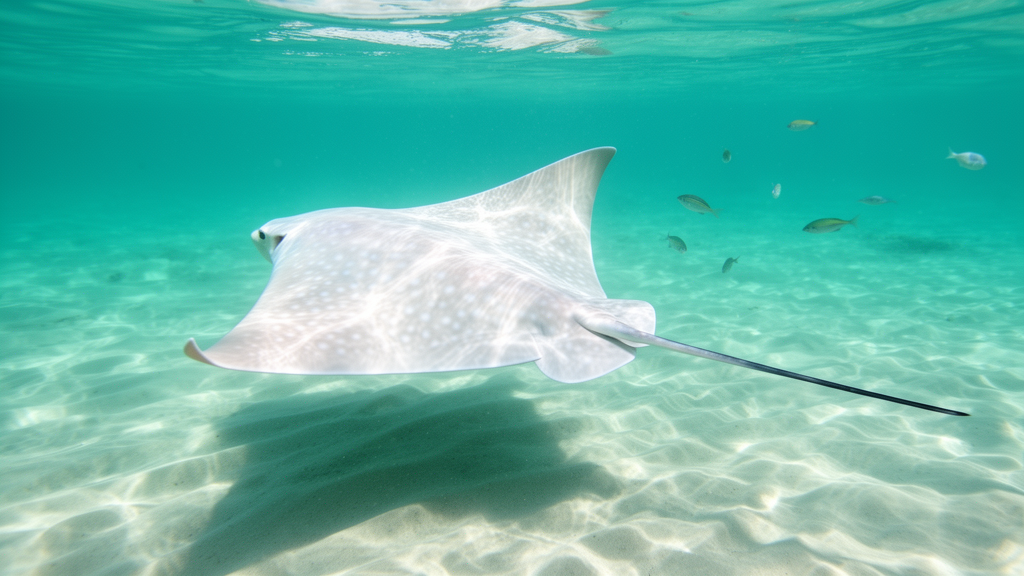
A ghostly white spotted eagle ray pulled from the shallow coastal waters of Campeche, Mexico, has become the first member of its species ever documented with leucism, a rare genetic condition that strips the skin of pigment while leaving the eyes untouched. The specimen, a juvenile female caught on 15 August 2025 off the coast of Seybaplaya, is described in a new study published in the journal Acta Ichthyologica et Piscatoria, and it adds a striking new entry to the global catalogue of chromatic abnormalities in sharks and rays.
The ray was caught using a gillnet with a 20-centimetre mesh size, and news of its unusual appearance spread quickly through local social media. A Facebook post reporting a stingray with abnormal coloring caught near Sabancuy drew the attention of the researchers, who contacted the fisherman and arranged for the specimen to be donated along with details of the fishing gear and the probable capture site. The animal was then measured in detail while still fresh and deposited in the Ichthyological Collection of the Faculty of Higher Studies Iztacala of the National Autonomous University of Mexico under catalog number CIFI-2401.
Spotted eagle rays, Aetobatus narinari, are among the most recognizable rays in the tropical and temperate waters of the Atlantic Ocean, on both its eastern and western sides, where they occur at depths down to about 60 metres. Their dorsal surface is normally bluish or black, sprinkled with numerous crisp white spots, while the underside is white. The species is classified as Near Threatened on the IUCN Red List, with a decreasing population trend in most regions and a Vulnerable status specifically in Southeast Asia, a situation attributed primarily to the impacts of local fisheries. Until now, no case of leucism had ever been reported in the scientific literature for this species.
Leucism is a genetic condition controlled by a single recessive allele and expressed as a complete or partial loss of skin pigmentation due to a partial absence of melanin, while iris pigmentation remains normal. That detail is what separates it from albinism, a genetically inherited condition in which melanin is either absent or nonfunctional, producing whitish or pinkish body coloration and, most notably, red or pink eyes. In leucistic animals the eyes keep their normal dark coloration, which is the key diagnostic difference between the two disorders. Coloration abnormalities of this kind have now been reported in 25 species of rays and stingrays worldwide, spanning orders from torpedo rays to skates to eagle rays and mobulids.
Taxonomic identification of the Campeche specimen confirmed it as a juvenile female spotted eagle ray, based on characteristics including a prominent, deep V-shaped notch on the internasal flap and a single small dorsal fin with a short but clearly discernible free rear tip. The researchers recorded 65 body measurements following a standard morphometric methodology, using a fiberglass tape measure and a portable digital scale. The biometrics were striking: a disc length of 376 millimetres, a disc width of 656 millimetres, a total length of 1466 millimetres, and a gutted weight of 3.895 kilograms. The full morphometric dataset covers everything from pectoral-fin margins and spiracle dimensions to the lengths of the two stinging spines on the tail.
The specimen exhibited a complete loss of integumentary pigmentation, resulting in a uniformly white body surface. Only the distal fin margins showed a faint pinkish coloration, and the authors attribute that to subcutaneous hemorrhage sustained during capture rather than to any residual pigment. Crucially, the eyes were normally pigmented and dark, providing conclusive evidence that the condition represents leucism rather than albinism. The external morphology appeared entirely normal, and no internal or external parasites were observed on the animal.
To assess the health condition of the leucistic ray, the researchers compared its observed weight with a theoretical weight calculated from a published length-weight relationship for the species, using disc width as the predictor variable. The theoretical weight came out at approximately 4.1 kilograms, and the observed gutted weight of 3.895 kilograms did not differ significantly from that value, with the difference being less than 10 percent. In other words, the white ray was in comparable body condition to a normally pigmented juvenile of the same size, suggesting that the pigment loss had not visibly impaired its growth or its locomotion and feeding capacity.
The finding expands the list of elasmobranch species with documented pigment disorders in the southeastern Gulf of Mexico to four. Previously, researchers had recorded albinism in the southern stingray, Hypanus americanus; albinism in the butterfly ray, Gymnura lessae; and leucism in the bull shark, Carcharhinus leucas, in the same region. The broader regional picture also includes chromatic abnormalities in two species of catfish, the gafftopsail sea catfish Ariopsis felis and the gulf catfish Bagre marinus, as well as a recent case of xanthism, a yellowish coloration disorder, in the common snook Centropomus undecimalis. The southern Gulf of Mexico is quietly emerging as a hotspot for these conspicuous abnormalities, and the new record adds a fourth elasmobranch to that roster.
What causes leucism in this ray remains unknown. Some authors suggest that albinism and leucism may arise from a variety of factors, including teratogenic mutations, random genetic alterations, pollution, dietary deficiencies, diseases, injuries, extreme temperatures, or inbreeding associated with declining populations. The southeastern Gulf of Mexico, including the Campeche Sound, is Mexico’s most important oil-producing region, accounting for roughly 70 to 80 percent of the country’s total oil production, and the area is continuously exposed to pollution from oil operations. At the same time, the spotted eagle ray is targeted by a small-scale fishery in the region, and its catches have reportedly declined in recent years. Overfishing could contribute to a reduction in genetic diversity, which in turn could raise the frequency of recessive pigment disorders. These stressors offer a plausible hypothesis for the occurrence of leucism in this specimen, but the authors are careful to note that there is currently no scientific evidence to support any causal link.
Because the specimen is a juvenile, it remains impossible to determine whether this color abnormality increases its vulnerability to natural predation or negatively affects growth and sexual maturity. A bright white ray swimming over dark seagrass beds or sandy shallows would presumably stand out far more than its spotted companions, and in open water such conspicuousness could attract the attention of predators. The authors emphasize that prevalence-based monitoring and targeted genetic analyses are needed in future studies to identify the potential causal mechanisms of color aberrations in elasmobranchs, taking into account both the health of individual specimens and their environmental interactions. For now, the white ray of Campeche stands as a vivid reminder of how much genetic variation still hides beneath the ocean’s surface, and of how a single chance encounter between a fisherman and a social media post can add a genuinely new page to marine science.
Subject of Research: First record of leucism in the spotted eagle ray Aetobatus narinari from the southern Gulf of Mexico
Article Title: First record of leucism in spotted eagle ray, Aetobatus narinari ( Elasmobranchii , Myliobatiformes , Aetobatidae )
Article References: Wakida-Kusunoki, A. T., Oribe-Perez, I., Anislado-Tolentino, V., Del Moral-Flores, L. F., & Chi Duran, A. E. (2025). First record of leucism in spotted eagle ray, Aetobatus narinari (Elasmobranchii, Myliobatiformes, Aetobatidae). Acta Ichthyologica et Piscatoria, 55, 379-384. https://doi.org/10.3897/aiep.55.169406
Image Credits: AI Generated
Keywords: leucism, spotted eagle ray, Aetobatus narinari, elasmobranch, Gulf of Mexico, coloration abnormality, marine biology, Campeche, First, record, spotted, eagle
Cite Scienmag News
Margaret Porter. (October 18, 2026). Ghostly white spotted eagle ray is first leucistic one ever recorded. Scienmag. https://scienmag.com/ghostly-white-spotted-eagle-ray-is-first-leucistic-one-ever-recorded/
Margaret Porter. "Ghostly white spotted eagle ray is first leucistic one ever recorded." Scienmag, 18 October 2026, https://scienmag.com/ghostly-white-spotted-eagle-ray-is-first-leucistic-one-ever-recorded/. Accessed 18 October 2026.
Margaret Porter. "Ghostly white spotted eagle ray is first leucistic one ever recorded." Scienmag. October 18, 2026. https://scienmag.com/ghostly-white-spotted-eagle-ray-is-first-leucistic-one-ever-recorded/


