


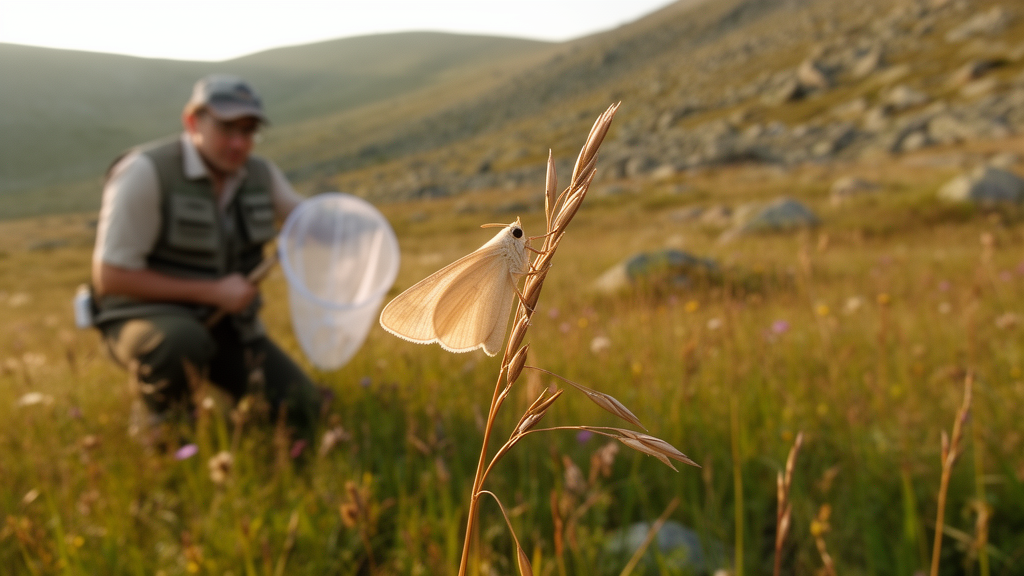
A small grey moth that vanished from scientific view for a century and a half has resurfaced on the sun-baked steppe edges of the South Urals, and its reappearance is forcing entomologists to rewrite what they thought they knew about one of Europe’s most obscure pyralid snout moths. In July 2011 and again in July 2020, researchers working the floodplain terraces of the Ural River and neighbouring sandy steppe in Orenburg Region pulled seventeen specimens of a little-documented phycitine moth from light traps. Careful comparison with type material held in Berlin confirmed the insects as Apomyelois cognata (Staudinger, 1871), a species previously known almost exclusively from specimens collected near Sarepta in the Lower Volga region 150 years earlier, plus scattered old records from Iran and an unconfirmed report from Cyprus. The find, published in Nota Lepidopterologica, constitutes only the second Russian record of the species and pushes its confirmed range to its easternmost point.
The rediscovery matters because Apomyelois cognata has long been a taxonomic ghost. Staudinger originally described it in 1871 as Myelois cognata on the basis of four males and a single female found by A. Bekker and H. Christoph near Sarepta, now the Krasnoarmeysk district of Volgograd. The species then drifted through the literature: Ragonot included the Sarepta records in his 1893 monograph, Rebel listed it in his 1901 catalogue of Palaearctic Lepidoptera, and Spuler noted it from the vicinity of Vienna in 1910. Hayward reported a single specimen from Platres, Cyprus, in September 1938, though Rebel questioned that occurrence soon afterwards and Arenberger later repeated the Cypriot record without confirmation. For decades, no additional material beyond the original type series was obtained anywhere, leaving the species’ true distribution and morphology largely a matter of inference.
Resolving the species’ identity required going back to the source. Only two males and a single female from the original type series survive in the Museum für Naturkunde in Berlin; the locality of the other two males listed in Staudinger’s description remains unknown. Roesler examined the genital structure of the syntypes in 1988, clarified the species’ taxonomic position by transferring it to Apomyelois Heinrich, 1956, and suggested that Apomyelois schaeuffelella Amsel, 1959, described from Iran, should be treated as a junior synonym of A. cognata. However, Roesler’s informal designations of a lectotype and allolectotype among the Berlin specimens were never established in his publications, leaving the nomenclature technically unstable. The holotype of A. schaeuffelella could not be located in the collections of the State Museum of Natural History Karlsruhe, adding a further layer of uncertainty.
To stabilise the name, the team formally designated the male syntype bearing genitalia slide number 3310 as the lectotype of Myelois cognata Staudinger, 1871, and the remaining female and male syntypes as paralectotypes. This act anchors the species’ identity to a single physical specimen that future researchers can examine, a standard practice in modern taxonomy that prevents ambiguity when several specimens formed the basis of an original description. The designation, made by T.A. Trofimova, J. Šumpich and Yu.I. Budashkin in 2021, closes a nomenclatural loose end that had persisted for more than thirty years since Roesler’s initial labelling work.
The genus Apomyelois itself has an interesting history. Heinrich established it in 1956 as a monotypic genus with Dioryctria bistriatella Hulst, 1887 as its type species. Today it encompasses eleven species distributed across the Holarctic and Palaeotropical regions, though the authors note that the current species list still requires further revision. Only two relatives occur in Europe and the European part of Russia: the widespread A. bistriatella, found across the temperate zone of both North America and Eurasia, and the far rarer A. cognata. The new material allowed the first detailed redescription of A. cognata based on fresh specimens, complete with the first published illustrations and descriptions of both male and female genitalia, structures that are often the decisive characters for distinguishing closely related phycitine moths.
Morphologically, the redescription reveals a moth of subtle but diagnostic beauty. Males have forewing lengths of 10 to 11 millimetres, females around 11 millimetres. The head is round and smooth with a rounded frons, the labial palps smooth and often upturned or protruding anteriorly, the proboscis well developed and white with greyish scales at the base. The forewing ground colour is grey, mixed with white in the basal, costal and external areas, with an oblique whitish ante-medial line angulated in the cubital area and edged with dark grey, darkened from the costa to vein Cu2 by a blackish diffused spot. Paired dots at the bases of veins M1 and M2 consist of groups of black scales or may unite into a sickle-shaped streak, and the whitish postmedial line is distinctly angulated and serrated. Some specimens are darker or more contrasting than others, a variation the authors document explicitly.
The genitalia provide the sharpest diagnostic tools. In the male, the uncus is broadened subtriangularly apically, the gnathos thin, elongated and straight, gradually narrowing to three-quarters the length of the uncus. The transtilla is arcuate and sclerotized with paired rounded lobes in its medial part, the valva broad and simple with a slightly curved costa, and the juxta U-shaped with slightly broadened lateral lobes bearing five short apical setae. The aedeagus is cylindrical and moderately curved, roughly three-quarters the length of the valva, with a simple, elongate, rugose vesica scattered with microspines in its middle. In the female, the corpus bursae is egg-shaped, about twice as long as the ductus bursae, and carries a single small round thorned plate, the signum, in its middle. These structures, photographed with a Canon EOS 1100D mounted on an Olympus BX41 stereomicroscope after boiling abdomen preparations in 20 percent potassium hydroxide and mounting in glycerol, now serve as the definitive reference for identifying the species.
Distinguishing A. cognata from its widespread relative A. bistriatella was a central goal of the study, and the new material shows clear morphological separation, contrary to earlier suggestions that the two were nearly identical. A. cognata is predominantly larger, with broader and more contrasting forewings. In the male genitalia, A. cognata has a narrower gnathos and a more pronounced bilobed median process of the transtilla, while its vinculum is slightly shorter and rounder than the more elongate vinculum of A. bistriatella. The female genitalia are very similar between the two species, but the apophyses and corpus bursae of A. cognata are about 1.7 times as long as those of A. bistriatella. Because the two species occur sympatrically in South Ural habitats, these differences are not merely academic; they are essential for anyone surveying the region’s moth fauna to avoid conflating a rare specialist with a common generalist.
The ecological context of the captures is equally telling. All seventeen specimens were collected at night using artificial light sources, with chloroform as the killing agent, at an elevation of 260 metres. Four males and seven females came from the surroundings of Donskoe on Verbljushka hill in July 2011, five females from psammophytic steppe near Vasilievka village in the Akbulak district in July 2020, and a single male from the Ural River floodplain east of Novoorlovka village in the Belyaevka district in late July 2020. Adults fly from early to late July, and the habitats involved, river terraces and sand-adapted steppe, hint at a species tied to dry, open landscapes. The host plant remains unknown, a gap that future fieldwork in the South Urals may now have a realistic chance of filling, since the moth is demonstrably present in numbers at known localities during a defined flight window.
For conservationists and faunists, the implications are considerable. A species known from a handful of nineteenth-century specimens near Volgograd, one questionable Cypriot record and old Iranian material is now documented from a third Russian region with seventeen modern vouchers, photographic documentation of habitat, and a complete morphological redescription. The South Urals, with their mosaic of steppe, floodplain forest and rocky outcrops, continue to yield surprises even for well-studied insect orders, and the rediscovery of A. cognata underscores how much basic distributional knowledge remains to be gathered across the Palaearctic. Whether the species persists in the Vienna region, whether the Cypriot record will ever be confirmed, and where its larvae feed are open questions, but at least one thing is now certain: Apomyelois cognata is not a historical footnote, but a living component of the Ural steppe fauna, flying quietly along the Ural River each July.
Subject of Research: Taxonomic redescription and rediscovery of the pyralid moth Apomyelois cognata in the South Urals
Article Title: Redescription of Apomyelois cognata (Staudinger, 1871) ( Lepidoptera , Pyralidae , Phycitinae ) with first record from the South Urals
Article References: Trofimova, T. A., Šumpich, J., & Budashkin, Y. I. (2022). Redescription of Apomyelois cognata (Staudinger, 1871) (Lepidoptera, Pyralidae, Phycitinae) with first record from the South Urals. Nota Lepidopterologica, 45, 1-7. https://doi.org/10.3897/nl.45.73925
Image Credits: AI Generated
DOI: 10.3897/nl.45.73925
Keywords: Apomyelois cognata, Pyralidae, Phycitinae, Lepidoptera, South Urals, lectotype designation, taxonomic redescription, Orenburg Region, moth rediscovery, genitalia morphology, Sarepta, steppe habitat
Cite Scienmag News
Gavin Prescott. (October 19, 2026). Ghost Moth No More: Little-Known Pyralid Rediscovered in the South Urals After 150 Years. Scienmag. https://scienmag.com/ghost-moth-no-more-little-known-pyralid-rediscovered-in-the-south-urals-after-150-years/
Gavin Prescott. "Ghost Moth No More: Little-Known Pyralid Rediscovered in the South Urals After 150 Years." Scienmag, 19 October 2026, https://scienmag.com/ghost-moth-no-more-little-known-pyralid-rediscovered-in-the-south-urals-after-150-years/. Accessed 19 October 2026.
Gavin Prescott. "Ghost Moth No More: Little-Known Pyralid Rediscovered in the South Urals After 150 Years." Scienmag. October 19, 2026. https://scienmag.com/ghost-moth-no-more-little-known-pyralid-rediscovered-in-the-south-urals-after-150-years/


