As summer temperatures climb, one of the most practical questions in pig housing is whether simple changes to the floor can persuade animals to cool themselves. A pilot study published in Acta Veterinaria Scandinavica suggests they can.
As a result, they depend heavily on behavioural strategies, such as seeking cooler spots, reducing activity and lying on cool surfaces, to regulate their body temperature. Since pigs spend a large proportion of the day lying down, the temperature of the lying surface matters enormously. This is why floor cooling has attracted growing interest as a potential way to alleviate heat stress in pig production, a concern that is intensifying as ambient temperatures rise with climate change.
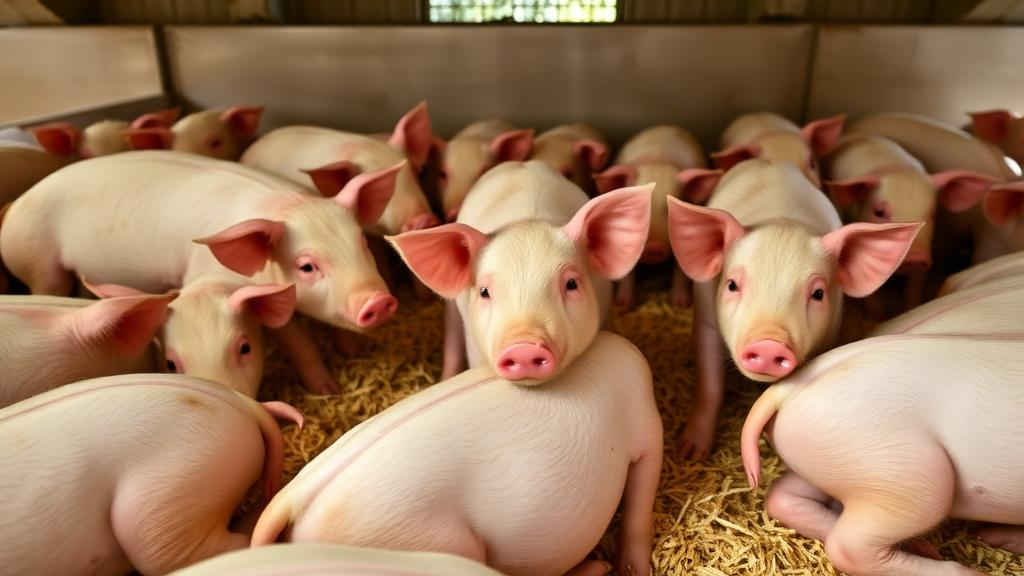
The study, conducted during July 2025, took place in a group pen of 160 square metres housing 31 gestating sows. Within the pen were three concrete resting subsections, labelled A to C, with a combined area of 27 square metres. Crucially, underfloor cooling infrastructure had already been installed in the concrete slab using embedded plastic tubing, allowing the researchers to circulate cold water through chosen sections of the floor without altering anything else about the animals’ environment.
During the experimental period, cold water circulation was applied in subsection A at 17 degrees Celsius and in subsection B at 12 degrees Celsius, while subsection C served as an uncooled control. The researchers recorded sow occupancy of the three resting areas by video for 72 hours before cooling commenced and for a further 72 hours with cooling in operation, following a 72-hour adjustment period that allowed the animals to habituate to the new conditions. Still images taken at 30-minute intervals were used to calculate occupancy expressed as sows per square metre, and the data were analysed using mixed linear models.
Before any cooling was applied, the sows showed no clear preference among the three areas. Average occupancy was 0.24 sows per square metre in subsection A, 0.22 in subsection B and 0.26 in subsection C, a near-even distribution that confirmed the sections were broadly equivalent starting points. This baseline matters, because it means any later shift in occupancy could reasonably be attributed to the cooling treatment rather than to pre-existing preferences for a particular corner of the pen.
Once underfloor cooling was switched on, the picture changed markedly. Occupancy rose to 0.44 sows per square metre in subsection A and 0.41 in subsection B, the two cooled areas, while the uncooled control subsection C reached only 0.27 sows per square metre. The difference was highly statistically significant, with a P value below 0.001. In practical terms, the sows crowded onto the cooled floors at densities far exceeding anything seen before the treatment, demonstrating a clear and rapid change in their preference for where to rest.
Outdoor temperature also played a measurable role. During the cooling period, ambient temperature significantly influenced occupancy in subsections A and B, again with P below 0.001, and higher sow densities were observed at higher outdoor temperatures. In other words, the hotter it got outside, the more strongly the animals gravitated toward the cooled surfaces. The authors report that gestating sows preferentially used the cooled resting areas when average outdoor temperatures exceeded 20 degrees Celsius, indicating that the behaviour was a response to thermal conditions rather than a random redistribution of the group.
The findings carry weight for pig production because heat stress is an increasing concern as climate change pushes summer temperatures higher, and sows kept in groups have few options for cooling beyond whatever the environment provides.
The researchers are careful, however, to frame the work as what it is: a short pilot study conducted in a single group pen at one research facility. The 72-hour observation windows, one pen and one summer period limit how far the conclusions can be generalised across herds, housing systems, climates and cooling designs. The authors state that further studies are needed to examine both the benefits of underfloor cooling and the motivations behind the sows' changes in preference of resting area.
Even with those limitations, the study offers an encouraging proof of concept for a low-tech intervention. The cooling infrastructure was embedded in the concrete slab with plastic tubing and operated by circulating cold water at two different temperatures, both of which attracted more sows than the uncooled control. If subsequent, larger studies confirm these occupancy patterns and quantify the physiological benefits, floor cooling could become a promising strategy for alleviating heat stress in gestating sow housing during summer heat, letting the animals do much of the work simply by choosing where to lie down.
Subject of Research: The effect of underfloor cooling on resting area preference in gestating sows during warm summer conditions.
Article Title: Choosing to take it cool: a pilot study on changes in gestating sows laying area preference when given access to resting areas with floor-cooling during summer heat
Article References: Sannö, A., Hagberg, C., Wallenbeck, A., & Högberg, N. (2026). Choosing to take it cool: a pilot study on changes in gestating sows laying area preference when given access to resting areas with floor-cooling during summer heat. Acta Veterinaria Scandinavica, 68(1), Article 30. https://doi.org/10.1186/s13028-026-00874-5
Image Credits: AI Generated
DOI: 10.1186/s13028-026-00874-5
Keywords: heat stress, gestating sows, floor cooling, animal welfare, pig production, lying area preference, behavioural thermoregulation, pilot study, Swedish Livestock Research Centre, concrete slab cooling, summer heat, livestock housing
Cite Scienmag News
William Thompson. (October 29, 2026). Gestating Sows Prefer Floor-Cooled Resting Areas During Summer Heat, Pilot Study Finds. Scienmag. https://scienmag.com/gestating-sows-prefer-floor-cooled-resting-areas-during-summer-heat-pilot-study-finds/
William Thompson. "Gestating Sows Prefer Floor-Cooled Resting Areas During Summer Heat, Pilot Study Finds." Scienmag, 29 October 2026, https://scienmag.com/gestating-sows-prefer-floor-cooled-resting-areas-during-summer-heat-pilot-study-finds/. Accessed 30 October 2026.
William Thompson. "Gestating Sows Prefer Floor-Cooled Resting Areas During Summer Heat, Pilot Study Finds." Scienmag. October 29, 2026. https://scienmag.com/gestating-sows-prefer-floor-cooled-resting-areas-during-summer-heat-pilot-study-finds/