


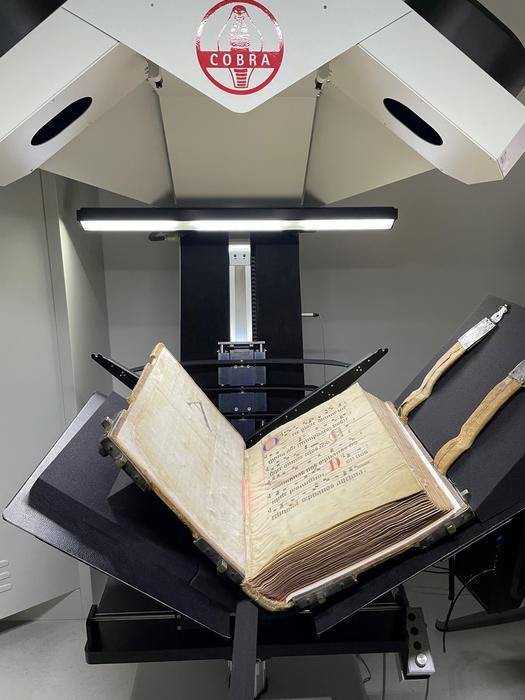
Over the next three years, a total of 462 manuscripts dating to the Middle Ages in the possession of public institutions in the German episcopal cities of Speyer, Worms, and Mainz are to be digitized at the Mainz University Library. The team at Mainz will generate high quality digital reproductions of these remarkable cultural assets and then make them generally accessible for the first time. Some of these manuscripts have never before undergone close academic scrutiny. The German Research Foundation (DFG) has granted the application submitted by the Mainz University Library together with Wissenschaftliche Stadtbibliothek Mainz and Landesbibliothekszentrum Rheinland-Pfalz and will provide EUR 310,000 to fund the project. The Martinus-Bibliothek, which is the library of the Catholic bishopric of Mainz, and the Manuscript Center of the Leipzig University Library will also be collaborating. “The political, religious, and economic leadership of the Middle Rhine region during the Middle Ages resulted in a flourishing manuscript production,” stated Dr. Christian George of the University Library of Johannes Gutenberg University Mainz (JGU). “We are thankful for this opportunity to create digitized versions of these cultural and historic treasures and to make them available to the general public.”

Credit: photo/©: Christian George / Mainz University Library
Over the next three years, a total of 462 manuscripts dating to the Middle Ages in the possession of public institutions in the German episcopal cities of Speyer, Worms, and Mainz are to be digitized at the Mainz University Library. The team at Mainz will generate high quality digital reproductions of these remarkable cultural assets and then make them generally accessible for the first time. Some of these manuscripts have never before undergone close academic scrutiny. The German Research Foundation (DFG) has granted the application submitted by the Mainz University Library together with Wissenschaftliche Stadtbibliothek Mainz and Landesbibliothekszentrum Rheinland-Pfalz and will provide EUR 310,000 to fund the project. The Martinus-Bibliothek, which is the library of the Catholic bishopric of Mainz, and the Manuscript Center of the Leipzig University Library will also be collaborating. “The political, religious, and economic leadership of the Middle Rhine region during the Middle Ages resulted in a flourishing manuscript production,” stated Dr. Christian George of the University Library of Johannes Gutenberg University Mainz (JGU). “We are thankful for this opportunity to create digitized versions of these cultural and historic treasures and to make them available to the general public.”
462 manuscripts consisting of some 170,000 pages to be stored and secured on digital media
The project will digitize the medieval manuscript holdings of public institutions in the cities of Speyer, Worms, and Mainz – 462 manuscripts with roughly 170,000 pages. These include such notable texts as the sacramentary of the former St. Alban’s Abbey in Mainz that dates to the 9th century CE. Currently deposited in the Martinus-Bibliothek, this is one of the oldest manuscripts that will be the subject of the project together with the six large-format choir books of the Carmelites from the 14th century, held by the Episcopal Cathedral and Diocesan Museum in Mainz. The digitization process has already started with these choir books. “Many of the 462 manuscripts go back to the High Middle Ages, including some that originated in the 10th and even the 9th centuries CE. However, the majority derive from the period following the end of the 14th century,” added George, who – as Head of Archives and Collections at the Mainz University Library, is coordinating the DFG-sponsored project.
At present, there is no systematic overview of the rich medieval textual heritage in the three cities on the Rhine, largely due to the extensive depredations and damages incurred in the aftermath of the French Revolution and during the wars of the modern era. One of the aims of the digitization of the historic text and image material is to provide new opportunities to explore overarching aspects of cultural and textual traditions. The source references will be provided through the Manuscripts Portal of the German Manuscript Centers. The Gutenberg Capture portal of the Mainz University Library will be responsible for the display of the digitized texts and will also be providing for the long-term archiving and the free accessibility of the data.
In addition to the digitization process, the partners will also start a thorough examination of 39 manuscripts from Speyer and Worms that have to date only been subjected to surface analysis. This new examination will involve the detailed collation of the surviving texts present in each manuscript, the establishment of their histories, and the evaluation of the scripts, the miniatures, illuminated initials, ornamented pages, and bindings.
Related links:
- – project “Manuscripts from Mainz, Worms, und Speyer” in the Gutenberg Capture database of the Mainz University Library
- – Gutenberg Capture database of the Mainz University Library
- – Mainz University Library
- – Manuscripts Portal of the German Manuscript Centers
Cite Scienmag News
Courtney Benton. (May 7, 2024). German episcopal cities of Speyer, Worms, and Mainz to digitize their medieval manuscripts. Scienmag. https://scienmag.com/german-episcopal-cities-of-speyer-worms-and-mainz-to-digitize-their-medieval-manuscripts/
Courtney Benton. "German episcopal cities of Speyer, Worms, and Mainz to digitize their medieval manuscripts." Scienmag, 7 May 2024, https://scienmag.com/german-episcopal-cities-of-speyer-worms-and-mainz-to-digitize-their-medieval-manuscripts/. Accessed 4 September 2026.
Courtney Benton. "German episcopal cities of Speyer, Worms, and Mainz to digitize their medieval manuscripts." Scienmag. May 7, 2024. https://scienmag.com/german-episcopal-cities-of-speyer-worms-and-mainz-to-digitize-their-medieval-manuscripts/

