


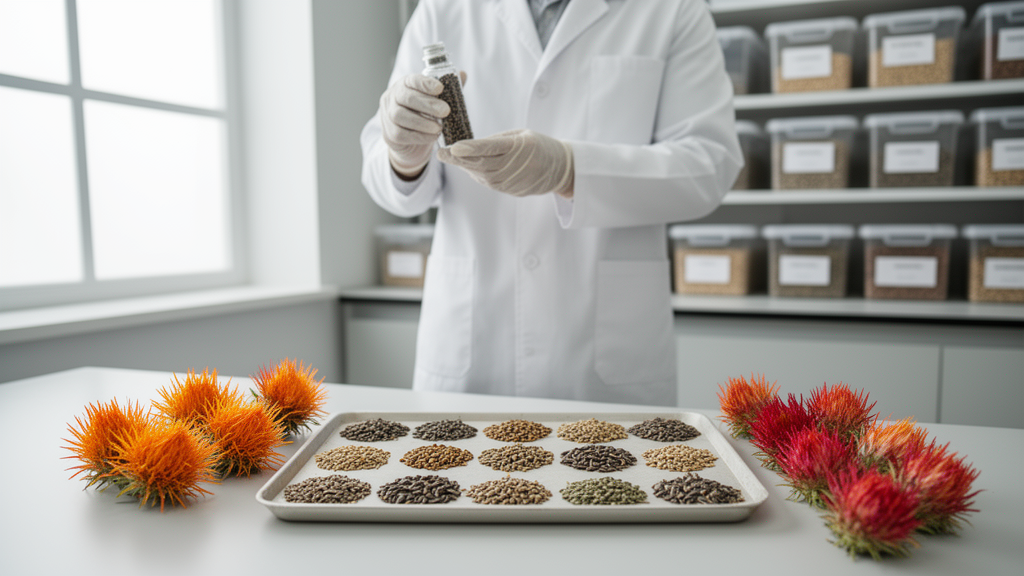
Safflower, one of humanity’s oldest oilseed crops, has just had its entire genetic library read. In a sweeping genomic study published in BMC Plant Biology, researchers in India sequenced 5,000 safflower accessions conserved at the Indian National Genebank and distilled them into a core collection of just 400 lines that captures nearly all of the diversity held across the full archive. The work, led by Pooja Pathania and S. Rajkumar at ICAR-National Bureau of Plant Genetic Resources in New Delhi, together with colleagues at ICAR institutes in Akola and Hyderabad, offers breeders a manageable genetic toolbox for a crop prized for its high-quality oil, medicinal properties, and remarkable tolerance to drought and other abiotic stresses.
The technical engine behind the achievement is double-digest restriction-site associated DNA sequencing, or ddRADseq, a genotyping-by-sequencing method that reads a reduced but highly informative representation of the genome. Rather than sequencing every base pair of every plant, the team used two restriction enzymes to cut the safflower DNA at specific recognition sites and sequenced only the fragments between those cuts. This strategy generated more than 21 billion raw sequencing reads across the 5,000 accessions. After rigorous quality filtering, the high-quality reads were aligned to the safflower reference genome, allowing the researchers to call genetic variants at thousands of positions simultaneously across the entire collection.
The alignment effort yielded 55,108 high-quality biallelic single nucleotide polymorphisms, or SNPs, the single-letter DNA differences that serve as the raw material of genetic diversity analysis. Each SNP marks a position where one accession may carry an adenine where another carries a guanine, and collectively these markers form a genome-wide fingerprint of every line in the genebank. Biallelic SNPs, which exist in only two possible states, are particularly valuable for population genetics because their frequencies can be modeled cleanly, enabling precise estimates of how much variation each accession carries and how closely any two lines are related.
With the SNP dataset in hand, the team applied the Core Hunter algorithm, a computational tool designed to select a minimal subset of accessions that maximizes the genetic diversity of the whole. Core Hunter evaluates candidate subsets against multiple diversity metrics, including allele coverage, heterozygosity, and the distance between accessions, and iteratively refines its selection until no further improvement is possible. The result was a core collection of 400 accessions, roughly 8 percent of the original archive, chosen to represent the allelic richness of all 5,000 lines. This is the central promise of core collection theory: breeders can screen a small, genetically representative set for valuable traits such as oil content, disease resistance, or stress tolerance, and then dive back into the full collection for the rare alleles the core reveals.
Principal component analysis of the SNP data revealed a striking pattern, or rather a striking absence of one. The accessions showed limited clustering based on either genetic differentiation or geographical origin, meaning that safflower lines from the same region were not necessarily genetically similar, and genetically similar lines were not necessarily from the same region. This weak geographic signal suggests extensive historical movement of safflower germplasm across regions, likely through trade, breeding exchange, and the crop’s long cultivation history, which has scrambled any simple relationship between where a line was collected and where its ancestors came from.
Population structure analysis told a different story. Using model-based clustering, the researchers determined that the optimal number of subpopulations was 16, both for the full germplasm collection and for the 400-accession core set. This means the safflower genebank harbors 16 genetically distinct groups, each with its own characteristic allele frequencies, and the core collection preserves all 16. The agreement between the full collection and the core in this structural analysis is a key validation of the core’s representativeness, confirming that the 400 selected lines are not a random sample but a genetically faithful miniature of the entire archive.
The diversity statistics drive home the point. The core collection exhibited a gene diversity value of 0.38 and a polymorphic information content of 0.31, both higher than the corresponding values for the entire 5,000-line germplasm. Gene diversity measures the probability that two randomly chosen alleles at a locus are different, while polymorphic information content quantifies how informative a marker is for distinguishing individuals. That the core outperforms the full collection on both metrics is the hallmark of a well-constructed core set, achieved by deliberately selecting accessions that carry rare and complementary alleles rather than duplicating common ones.
Beyond the core collection itself, the study produced a practical byproduct for everyday breeding work. The researchers identified a subset of 701 highly informative SNPs suitable for DNA fingerprinting of the core accessions. Fingerprinting with this SNP panel allows any safflower line to be uniquely identified, verified for purity, and tracked through breeding generations with a simple and inexpensive genotyping assay. Such fingerprinting panels are essential for protecting plant variety rights, confirming seed lot identity, and ensuring that breeders can trace exactly which genetic material flows into their crossing programs.
The implications for safflower improvement are considerable. Safflower is valued not only for its oil, which is rich in unsaturated fatty acids, but also for its medicinal properties and its resilience to abiotic stresses, making it an increasingly attractive crop in a warming world. Yet like many underutilized oilseeds, it has historically received less genomic attention than major staples. By providing a genetically characterized core collection and a genome-wide SNP resource, the Indian team has given safflower breeders the tools to accelerate trait discovery, map genes underlying oil quality and stress tolerance, and deploy marker-assisted selection with confidence. The core set effectively transforms a genebank archive into an active breeding platform.
The study also demonstrates the power of genotyping-by-sequencing at germplasm scale. Sequencing 5,000 accessions and calling tens of thousands of SNPs across them is a technical feat that was impractical only a decade ago, when diversity analyses relied on a few dozen microsatellite markers. The ddRADseq approach balances cost and coverage, delivering enough markers for robust population genetic inference while remaining affordable for large collections. As genebanks worldwide face pressure to characterize their holdings genomically, this safflower study offers a template: sequence broadly, filter rigorously, model structure carefully, and let algorithms like Core Hunter do the heavy lifting of subset selection. The 400 safflower lines now at the heart of India’s breeding programs carry the genetic memory of 5,000, ready to be mined for the traits that tomorrow’s agriculture demands.
Subject of Research: Genetic diversity analysis and core collection development in safflower using genome-wide SNPs
Article Title: Genetic diversity and core collection development in safflower using genome-wide SNPs
Article References: Pathania, P., Kumar, G. P., Gomashe, S., Parimalan, R., Kumar, R., Kadirvel, P., & Rajkumar, S. (2026). Genetic diversity and core collection development in safflower using genome-wide SNPs. BMC Plant Biology. https://doi.org/10.1186/s12870-026-09923-7
Image Credits: AI Generated
DOI: 10.1186/s12870-026-09923-7
Keywords: safflower, genetic diversity, core collection, SNPs, ddRADseq, genotyping-by-sequencing, population structure, germplasm, genebank, plant breeding, oilseed crop, Core Hunter
Cite Scienmag News
Juliet Wilcox. (October 19, 2026). Genome-wide SNPs distill 5,000 safflower lines into a 400-accession core collection. Scienmag. https://scienmag.com/genome-wide-snps-distill-5000-safflower-lines-into-a-400-accession-core-collection/
Juliet Wilcox. "Genome-wide SNPs distill 5,000 safflower lines into a 400-accession core collection." Scienmag, 19 October 2026, https://scienmag.com/genome-wide-snps-distill-5000-safflower-lines-into-a-400-accession-core-collection/. Accessed 19 October 2026.
Juliet Wilcox. "Genome-wide SNPs distill 5,000 safflower lines into a 400-accession core collection." Scienmag. October 19, 2026. https://scienmag.com/genome-wide-snps-distill-5000-safflower-lines-into-a-400-accession-core-collection/


