


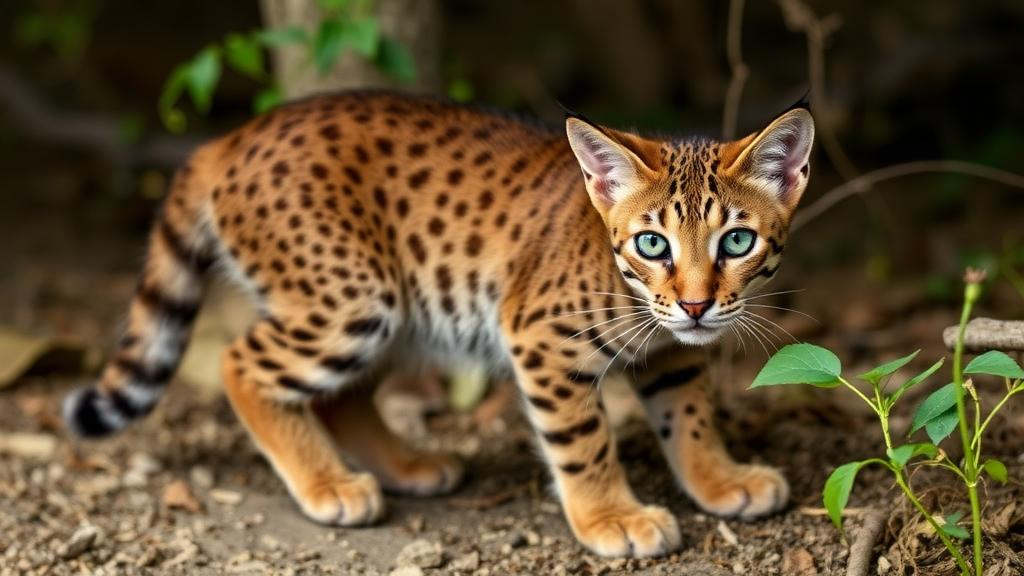
Deep in the forests of Italy’s Central Apennines, an elusive predator is slipping past cameras, dodging roads, and quietly blurring the line between wild and domestic. The European wildcat (Felis silvestris silvestris), a stocky, bushy-tailed felid that ranges from the Iberian Peninsula to the Caucasus, has long been one of Europe’s most difficult carnivores to monitor. Now, a new study published in Ecology and Evolution has combined species distribution modelling with mitochondrial DNA analysis to produce the first country-wide map of potential wildcat habitat in Italy, while simultaneously uncovering a surprising genetic picture in the poorly surveyed Central–Southern Apennines.
The research team, working with the conservation organisation Rewilding Apennines as part of the LIFE ESC360 project, assembled 69 spatially explicit wildcat occurrence records collected between 2009 and 2023. The records spanned the full length of the country, from Friuli-Venezia Giulia in the northeast to the slopes of Mount Etna in Sicily, and drew on three independent datasets: the national ‘Progetto Gatto Selvatico’ archive, new camera-trapping surveys in Abruzzo, and previously published records from Etna Regional Park. To ensure data reliability, records from the national project were classified under the SCALP scheme, a verification framework originally developed for large-carnivore monitoring, yielding 11 genetically or morphologically confirmed records and 24 supported by unambiguous camera-trap photographs of wild-type individuals.
With those occurrences in hand, the team built a species distribution model using MaxEnt 3.4.3, a maximum-entropy algorithm designed for presence-only data. Environmental predictors were deliberately kept parsimonious to avoid overfitting: eight land-cover variables derived from the CORINE Land Cover 2018 dataset, aggregated to reflect habitat types relevant to wildcats, plus average elevation from the SRTM digital elevation model. Because camera traps and carcass recoveries are not distributed evenly across the landscape, the researchers generated a kernel density surface of sampling effort and used it to bias the selection of 10,000 background points, so that the model would not simply relearn where humans had looked. Model tuning via the ENMeval package selected hinge features and a regularisation multiplier of 3, and the final model was validated against a distribution of 100 null-model iterations.
The results were strikingly clear. The model achieved an AUC of 0.81, well above the null-model median of 0.50, and two variables dominated the prediction: forest and grassland cover contributed 62.5 percent of the model’s explanatory power, with a permutation importance of 78.6 percent, while average elevation contributed a further 36.1 percent. The response curves showed that the probability of wildcat occurrence rose sharply with increasing forest and grassland cover, levelling off at roughly 70 to 75 percent cover, and climbed with elevation up to about 1,000 metres above sea level before plateauing. Urban fabric, roads, agriculture, and water bodies contributed essentially nothing to the model. Mapped across Italy, the highest suitability values traced the spine of the Apennine chain and the Alpine region, with lower but non-negligible suitability in lowland and coastal zones.
To test whether these predictions held up on the ground, the researchers collected 23 new wildcat occurrences in the Central–Southern Apennines, none of which had been used to calibrate the model. Sixteen tissue samples came from carcasses, mostly roadkill and a few accidental hunting bycatch, recovered by rangers in the Abruzzo, Lazio and Molise National Park and the Regional Natural Park of the Simbruini Mountains. Seven further occurrences came from non-invasive monitoring combining camera traps with hair traps, wooden poles wrapped in Velcro and laced with valerian tincture, deployed in the Monte Genzana–Alto Gizio Regional Nature Reserve and the Sirente–Velino Regional Natural Park. When the sampling locations were overlaid on the prediction map, most fell within areas of relatively high predicted occurrence probability, an encouraging sign that the model captures real ecological signal rather than statistical artefact.
The genetic analysis, however, delivered the study’s most provocative twist. The team sequenced an 835-base-pair fragment of the mitochondrial MT-ND5 gene, a marker favoured in felid phylogenetics because it carries low homoplasy and is free of nuclear mitochondrial pseudogenes, trimming the sequences to 669 base pairs for comparison with a European reference dataset. Among 21 successfully sequenced individuals, all of which had been phenotypically classified as wildcats based on diagnostic pelage traits, the researchers found just four haplotypes grouped into three haplogroups. Only two individuals, roughly 10 percent, carried a ‘w’ haplotype reported exclusively in European wildcats. The remaining 90 percent carried maternal lineages shared with domestic cats: the dw1 haplotype accounted for 71.4 percent of samples and dw4 for 14.3 percent, while a single individual carried the domestic-type d3 haplotype.
One finding in particular stands out. The w12 haplotype, detected in two Apennine individuals, had previously been recorded in only one animal across a broad European dataset: a wildcat from Spain assigned to Felis silvestris on the basis of nuclear markers, where it was interpreted as a private Iberian lineage potentially reflecting historical isolation south of the Pyrenees. Its appearance in central Italy extends the known geographic range of this rare maternal lineage well beyond Iberia and adds to the mitochondrial diversity documented for Italian wildcats. The authors are careful, however, to note that because mitochondrial DNA is maternally inherited and represents a single non-recombining locus, this detection should not by itself be read as evidence of a direct phylogeographic connection between Italian and Iberian populations.
What, then, do the domestic-type maternal lineages mean? The answer is more nuanced than a simple hybridisation alarm. Recent genome-wide work suggests that contemporary interbreeding between wildcats and domestic cats is limited despite centuries of sympatry across Europe, which makes historical introgression a plausible contributor to the mitochondrial patterns observed here. The study’s ND5 data alone cannot establish the timing or extent of admixture; distinguishing recent hybridisation from ancient gene flow would require nuclear or genome-wide markers. There are also caveats of scale: successful sequences came from only 21 samples, and because individual identity could not be genetically confirmed for all hair samples, the apparent dominance of the dw1 haplotype may be inflated, since three hair samples sharing it were collected at the same location within a short timeframe. The haplotype frequencies should therefore be treated as preliminary.
The mismatch between pelage-based identification and mitochondrial assignment also carries a methodological warning. Diagnostic coat characteristics, such as the thick ringed tail and distinctive dorsal stripe described in classic identification keys, remain a practical field tool, but phenotypic overlap between wildcats, domestic cats, and admixed individuals means some misclassification is inevitable. That uncertainty propagates into the occurrence records underlying the distribution model itself, and the authors recommend interpreting habitat suitability patterns with this in mind. Interestingly, statistical comparison of predicted occurrence probabilities across sample categories showed that phenotypically wild individuals without genetic data occupied significantly more suitable habitat than any genetic category, hinting that the most remote, least disturbed areas may host the least admixed animals.
For conservation planners, the practical message is concrete. The Apennine chain emerges as the critical connective infrastructure for Italian wildcats, and protecting forest and grassland across suitable elevational gradients should be the priority, alongside ecological corridors and buffer zones that maintain landscape connectivity. The authors also point to precautionary measures in areas of sympatry, including responsible pet ownership and monitoring of feral cat populations to reduce wildcat–domestic cat interactions. Set against global biodiversity targets such as protecting 30 percent of terrestrial areas by 2030, the study offers a template: combine habitat modelling, updated field occurrence data, and genetic monitoring, supported by citizen science, to build an evidence base strong enough to guide action. For a species so adept at vanishing into the Mediterranean maquis, that combination of eyes and molecules may be the only reliable way to keep track of Europe’s last truly wild cat.
Subject of Research: Conservation genetics and habitat suitability modelling of the European wildcat in Italy
Article Title: Checking Wilderness Through Conservation Genetics: The Case of the European Wildcat in the Central Apennines, Italy
Article References: Maini, M., Polce, C., Bernini, F., Longeri, M., Milanesi, R., Caniglia, R., Mattucci, F., Velli, E., & Gatti, R. C. (2026). Checking Wilderness Through Conservation Genetics: The Case of the European Wildcat in the Central Apennines, Italy. Ecology and Evolution, 16(9), Article e74418. https://doi.org/10.1002/ece3.74418
Image Credits: AI Generated
DOI: 10.1002/ece3.74418
Keywords: European wildcat, Felis silvestris, conservation genetics, species distribution model, MaxEnt, mitochondrial DNA, Apennines, Italy, hybridisation, habitat suitability, camera trapping, wildlife monitoring
Cite Scienmag News
Juliet Wilcox. (October 1, 2026). Genetic Sleuthing Reveals Hidden Wildcat Lineages in Italy’s Apennine Mountains. Scienmag. https://scienmag.com/genetic-sleuthing-reveals-hidden-wildcat-lineages-in-italys-apennine-mountains/
Juliet Wilcox. "Genetic Sleuthing Reveals Hidden Wildcat Lineages in Italy’s Apennine Mountains." Scienmag, 1 October 2026, https://scienmag.com/genetic-sleuthing-reveals-hidden-wildcat-lineages-in-italys-apennine-mountains/. Accessed 4 October 2026.
Juliet Wilcox. "Genetic Sleuthing Reveals Hidden Wildcat Lineages in Italy’s Apennine Mountains." Scienmag. October 1, 2026. https://scienmag.com/genetic-sleuthing-reveals-hidden-wildcat-lineages-in-italys-apennine-mountains/


