


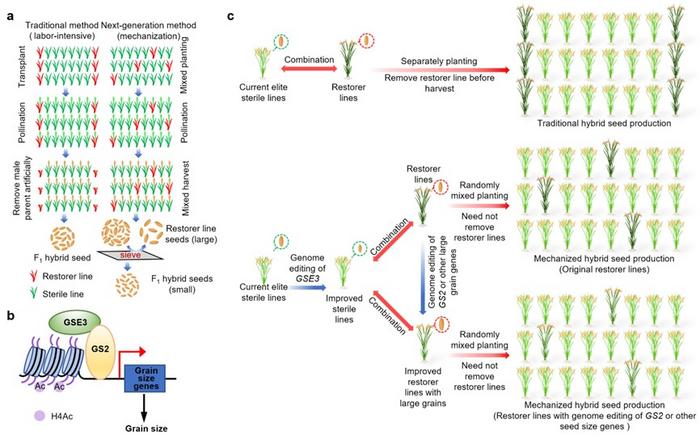
In a study published in Nature Plants, Prof. LI Yunhai from the Institute of Genetics and Developmental Biology (IGDB) of the Chinese Academy of Sciences and Profs. ZHU Xudong and WANG Yuexing from the China National Rice Research Institute have identified an ideal small grain size gene, GSE3. They demonstrated that fully mechanized hybrid seed production and increased seed number can be achieved using small-grain alleles of GSE3 in male sterile lines.

Credit: IGDB
In a study published in Nature Plants, Prof. LI Yunhai from the Institute of Genetics and Developmental Biology (IGDB) of the Chinese Academy of Sciences and Profs. ZHU Xudong and WANG Yuexing from the China National Rice Research Institute have identified an ideal small grain size gene, GSE3. They demonstrated that fully mechanized hybrid seed production and increased seed number can be achieved using small-grain alleles of GSE3 in male sterile lines.
Crop hybrid technologies have contributed to significant yield improvements worldwide. Rice yield has increased by 20%–30% over the past few decades through the use of hybrid rice, enhancing food security. At present, labor-intensive manual steps in F1 hybrid seed production hinder full mechanization in hybrid rice breeding.
A promising approach to achieving this goal is to develop small-grain male sterile lines and large-grain restorer lines that allow mechanical separation of small F1 hybrid seeds from mixed plantings of these two lines by using a simple sifter. An ideal small-grain male sterile line should also have minimal negative effects on F1 hybrid seed number and hybrid rice yield in field trials.
Tianyouhuazhan (TYHZ) is an elite hybrid rice variety that has been widely grown in China for decades. Tianfeng A (TFA), Tianfeng B (TFB), and Huazhan (HZ) are male sterile, maintainer, and restorer lines of TYHZ, respectively. The researchers crossed TFB with various small-grain rice varieties and successfully bred an ideal small-grain maintainer line Xiaoqiao B (XQB) and its corresponding new male sterile line, Xiaoqiao A (XQA).
In addition, a large-grain indica variety Kuangsijiadi was crossed with the restorer line HZ to create the large-grain restorer line Da Huazhan (DHZ). Field trials showed that the male sterile restorer combination XQA-DHZ enabled fully mechanized hybrid rice production, increased hybrid seed number, and did not affect hybrid rice yield.
The researchers identified that the GSE3 gene is responsible for the small-grain phenotype in XQA and XQB. Concurrently, they performed a large-scale mutagenesis screen to identify genes for breeding ideal small-grain male sterile lines and isolated m238, a mutant with small grains and an increased grain number without compromising other agronomic traits. Further analysis revealed that m238 was a new allele of GSE3.
Moreover, they performed genome editing of the GSE3 gene in three- and two-line hybrid rice systems using CRISPR-Cas9 technology, resulting in fully mechanized hybrid seed production and considerably increased hybrid seed number. They also found that GSE3 encodes a GCN5-related N-acetyltransferase-like protein that affects histone acetylation levels. GSE3 is recruited by the transcription factor GS2 to the promoters of its co-regulated grain size genes and influences the histone acetylation status of its co-regulated genes, thereby regulating grain size.
This study elucidates that mechanized hybrid seed production can be achieved for some elite hybrid rice varieties only by editing the GSE3 gene in male sterile lines when the grain thickness difference between the restorer lines and the male sterile lines is relatively large. For other elite hybrid rice varieties, mechanized hybrid seed production can be achieved by editing the GSE3 gene in male sterile lines and the large grain GS2 gene or other large grain size genes in the restorer lines. It suggests a new perspective for mechanized hybrid seed production in other important crops.
Journal
Nature Plants
Method of Research
Experimental study
Subject of Research
Not applicable
Article Title
Modulation of histone acetylation enables fully mechanized hybrid rice breeding
Article Publication Date
3-Jun-2024
Cite Scienmag News
Juliet Wilcox. (June 3, 2024). Genetic editing of ideal small grain size genes enables fully mechanized hybrid rice breeding. Scienmag. https://scienmag.com/genetic-editing-of-ideal-small-grain-size-genes-enables-fully-mechanized-hybrid-rice-breeding/
Juliet Wilcox. "Genetic editing of ideal small grain size genes enables fully mechanized hybrid rice breeding." Scienmag, 3 June 2024, https://scienmag.com/genetic-editing-of-ideal-small-grain-size-genes-enables-fully-mechanized-hybrid-rice-breeding/. Accessed 6 September 2026.
Juliet Wilcox. "Genetic editing of ideal small grain size genes enables fully mechanized hybrid rice breeding." Scienmag. June 3, 2024. https://scienmag.com/genetic-editing-of-ideal-small-grain-size-genes-enables-fully-mechanized-hybrid-rice-breeding/

