


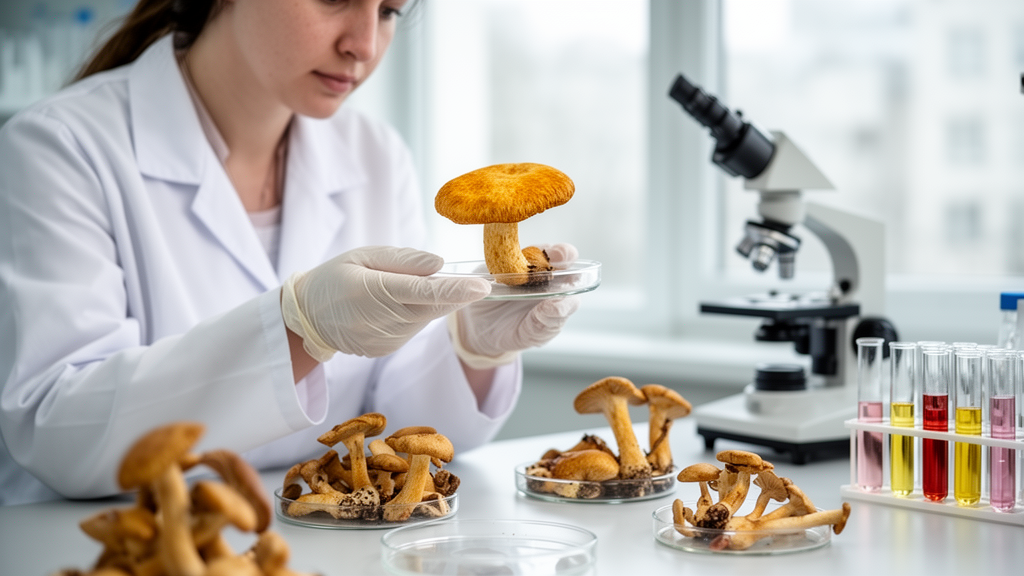
In the rolling tea-tree forests of Jiangxi province, a slender brown mushroom has quietly become one of China’s most important cultivated edible fungi. Now, in the most comprehensive assessment of its kind, researchers have charted the genetic and physical diversity of 100 strains of Cyclocybe chaxingu, a species prized for its nutty flavour, nutritional value and medicinal reputation, and in doing so have laid the quantitative groundwork for a modern breeding programme that could reshape how this mushroom is grown, selected and protected as an intellectual property.
The study, published in the journal IMA Fungus, tackles a problem that has long constrained the Chinese chaxingu industry: while cultivation has expanded dramatically since the 1980s, the relationship between the genetic makeup of individual strains and their agronomic performance has remained poorly characterised. Without this knowledge, breeders have lacked the tools to systematically select superior varieties, and the industry has had no formal Distinctness, Uniformity and Stability (DUS) test guidelines, the regulatory framework needed to protect new cultivars and ensure orderly commercial development.
To fill this gap, the research team assembled a panel of 100 strains drawn from three distinct sources: private mushroom farms, established culture collections and wild specimens. Geographically, the collection spanned 12 provinces and two municipalities across China, capturing the broad ecological and geographic range over which the species has adapted and been cultivated. All strains are maintained at the Jiangxi Agricultural University Culture Collection Center, creating a permanent reference resource for future breeding work.
Each strain was subjected to a standardised cultivation protocol designed to strip away environmental noise and reveal true genetic differences. Mycelia were first grown on potato dextrose agar at 25 degrees Celsius in darkness for seven days, then transferred to sterilised solid substrate packed in polypropylene filter bags. The substrate, a carefully balanced mixture of cottonseed hulls, coarse and fine sawdust, bagasse, wheat bran, soybean meal, cornmeal, gypsum and lime adjusted to roughly 65 percent moisture, was incubated at 20 to 25 degrees Celsius with 60 to 70 percent relative humidity. After approximately 50 days, once the bags were fully colonised, they were opened to trigger fruiting at 22 degrees Celsius, 95 percent humidity and diffuse light at around 600 lux. Six bags were prepared per strain, and from each bag ten representative fruiting bodies of standard shape and varying sizes were measured.
The team quantified ten agronomic traits on every strain, ranging from the number of days to first harvest and total yield per bag to the fine anatomy of the mushrooms themselves: stipe length, stipe diameter, cap diameter, cap thickness, gill width and a morphological index calculated as the ratio of cap diameter to stipe length. The results were striking. Every single trait showed statistically significant variation across strains, with one-way analysis of variance returning p-values below 0.01 across the board. The coefficient of variation, a measure of relative dispersion, was highest for the total number of fruiting bodies at 45.6 percent, followed by average fruiting-body weight at 35.0 percent. Days to first harvest varied the least, at just 7.6 percent, suggesting that timing of fruiting is a relatively stable characteristic across the species while the economics of yield, how many mushrooms and how big they are, is where the real breeding leverage lies.
To make sense of this multivariate data, the researchers turned to correlation analysis, hierarchical clustering and principal component analysis. The correlation heatmaps revealed a fundamental trade-off at the heart of chaxingu biology: total yield correlated positively with average fruiting-body weight, stipe diameter, cap diameter, cap thickness and gill width, but negatively with the total number of fruiting bodies. In other words, strains tend to follow one of two contrasting strategies, producing either fewer, heavier mushrooms or many, lighter ones. This trade-off, long suspected by growers, is now quantified with statistical rigour, giving breeders a clear target: increase cap and stipe size while moderating fruiting-body number to push yields higher.
Principal component analysis distilled the ten traits into three interpretable axes that together accounted for 83.98 percent of total variance. The first principal component, explaining 57.74 percent of the variation, loaded strongly and positively on cap thickness, average fruiting-body weight, stipe diameter, cap diameter and gill width, and negatively on fruiting-body number, effectively capturing a size-versus-count gradient. The second component, at 15.87 percent, was dominated by stipe length, describing an elongation axis. The third, at 10.37 percent, loaded on days to first harvest and total yield, capturing the timing of earliest harvest and yield onset. When strains were plotted along the first two components, the five colour-based groups, white, black, dark brown, brown and yellow, formed partially separated clusters, with yellow strains tending toward the lower-left, white toward the lower-right, brown toward the upper-left and black near the upper-right.
Hierarchical clustering using the unweighted pair group method with arithmetic mean, or UPGMA, grouped the 100 strains into four major phenotypic branches. Basidiome colour largely tracked these branches and served as a practical field discriminator, so the team partitioned strains into five colour-based groups. Between-group comparisons showed pervasive differences across all ten traits, with an overall p-value below 0.001. Black strains tended to have higher total yield and robust fruiting bodies, brown strains had the shortest time to first harvest, white strains had higher average fruiting-body weight but fewer fruiting bodies, and yellow strains produced the most fruiting bodies but the lightest ones with the lowest overall yield.
Alongside the phenotypic work, the researchers sequenced two gene fragments, the large subunit of the ribosomal RNA gene and the translation elongation factor 1-alpha gene, chosen for their universal primers, their established role in fungal phylogenetics and the known intraspecific variation in TEF1-alpha. Bayesian phylogenetic analysis of the concatenated sequences resolved four principal genetic clusters. When these genetic clusters were mapped against the phenotypic dendrogram, the picture was one of partial congruence: white and black strains frequently co-clustered genetically, and a subset of brown strains were mixed with dark brown, white and black lineages. Some agronomic patterns, therefore, appear to reflect genuine underlying genetic structure, while others likely arise from phenotypic plasticity or polygenic variation that two conserved loci cannot resolve.
The practical implications are considerable. Based on the variance structure and between-strain contrasts, the team proposes stipe diameter, stipe length and gill width as the primary indicator traits for DUS testing in C. chaxingu, with size-related traits such as average fruiting-body weight, cap diameter, cap thickness and fruiting-body number serving as complementary selection targets. Under current Chinese practice, distinctness can be established when a candidate variety shows a repeatable, significant difference in at least one trait versus a reference variety, making these three anatomical measurements a pragmatic and reproducible starting point for formal variety protection.
The study also identified individual strains with superior performance in one or multiple economic traits, including short cultivation periods and high overall productivity, flagging them as candidate parental stocks for future breeding programmes. The researchers are careful to note the limitations of their approach: the fruiting assessment was conducted at a single site under a single set of conditions, so multi-site, multi-season trials will be needed to quantify genotype-by-environment interactions and trait repeatability. And with only two loci sequenced, both highly conserved within the species, denser genetic markers such as multilocus sequence typing, amplified fragment length polymorphisms or whole-genome sequencing will be needed to draw tighter links between genomic regions and the traits that matter most to growers.
What makes this work resonate beyond the chaxingu industry is its methodological clarity. Rather than treating breeding as an art guided by intuition, the study demonstrates how a disciplined pipeline of standardised cultivation, quantitative trait measurement, multivariate statistics and molecular phylogenetics can transform a traditionally managed crop into one amenable to modern genetic improvement. The tetrapolar heterothallic mating system of C. chaxingu, in which compatibility is governed by two unlinked mating-type loci, is particularly well suited to such investigations and offers a powerful experimental platform for dissecting the genetic architecture of yield, size and earliness.
For a mushroom that has been cultivated in China for decades yet has never before been subjected to a systematic diversity assessment at this scale, the study marks a turning point. It provides the quantitative foundation for germplasm collection, parental selection and the development of DUS guidelines, and it offers growers a practical field guide: colour is a useful first cue, but the real story of each strain is written in millimetres of stipe diameter, gill width and the subtle trade-off between how many mushrooms a bag produces and how heavy each one becomes.
Subject of Research: Genetic and phenotypic diversity assessment for multi-trait selection in the cultivated edible mushroom Cyclocybe chaxingu
Article Title: Assessing genetic and phenotypic diversity to advance multi-trait selection in Cyclocybe chaxingu
Article References: Yi, J., Su, G., Yang, Q., Song, H., Xu, J., Chen, M., Zhou, J., Yin, H., Gafforov, Y., & Hu, D. (2026). Assessing genetic and phenotypic diversity to advance multi-trait selection in Cyclocybe chaxingu. IMA Fungus, 17, Article e194629. https://doi.org/10.3897/imafungus.17.194629
Image Credits: AI Generated
DOI: 10.3897/imafungus.17.194629
Keywords: Cyclocybe chaxingu, edible mushrooms, genetic diversity, phenotypic diversity, DUS testing, mushroom breeding, principal component analysis, phylogenetics, agronomic traits, China, strain selection, yield trade-off
Cite Scienmag News
Juliet Wilcox. (October 16, 2026). Genetic and phenotypic diversity map paves the way for multi-trait breeding in a prized Chinese edible mushroom. Scienmag. https://scienmag.com/genetic-and-phenotypic-diversity-map-paves-the-way-for-multi-trait-breeding-in-a-prized-chinese-edible-mushroom/
Juliet Wilcox. "Genetic and phenotypic diversity map paves the way for multi-trait breeding in a prized Chinese edible mushroom." Scienmag, 16 October 2026, https://scienmag.com/genetic-and-phenotypic-diversity-map-paves-the-way-for-multi-trait-breeding-in-a-prized-chinese-edible-mushroom/. Accessed 16 October 2026.
Juliet Wilcox. "Genetic and phenotypic diversity map paves the way for multi-trait breeding in a prized Chinese edible mushroom." Scienmag. October 16, 2026. https://scienmag.com/genetic-and-phenotypic-diversity-map-paves-the-way-for-multi-trait-breeding-in-a-prized-chinese-edible-mushroom/


