


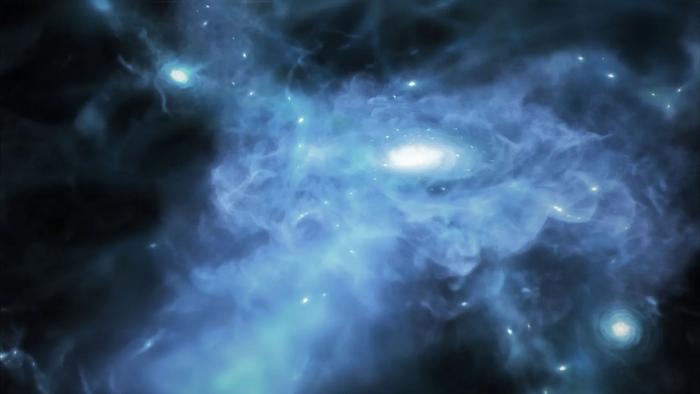
Researchers analyzing data from NASA’s James Webb Space Telescope have pinpointed three galaxies that may be actively forming when the universe was only 400 to 600 million years old. Webb’s data shows these galaxies are surrounded by gas that the researchers suspect to be almost purely hydrogen and helium, the earliest elements to exist in the cosmos. Webb’s instruments are so sensitive that they were able to detect an unusual amount of dense gas surrounding these galaxies. This gas will likely end up fueling the formation of new stars in the galaxies.

Credit: NASA, ESA, CSA, Joseph Olmsted (STScI)
Researchers analyzing data from NASA’s James Webb Space Telescope have pinpointed three galaxies that may be actively forming when the universe was only 400 to 600 million years old. Webb’s data shows these galaxies are surrounded by gas that the researchers suspect to be almost purely hydrogen and helium, the earliest elements to exist in the cosmos. Webb’s instruments are so sensitive that they were able to detect an unusual amount of dense gas surrounding these galaxies. This gas will likely end up fueling the formation of new stars in the galaxies.
“These galaxies are like sparkling islands in a sea of otherwise neutral, opaque gas,” explained Kasper Heintz, the lead author and an assistant professor of astrophysics at the Cosmic Dawn Center (DAWN) at the University of Copenhagen in Denmark. “Without Webb, we would not be able to observe these very early galaxies, let alone learn so much about their formation.”
“We’re moving away from a picture of galaxies as isolated ecosystems. At this stage in the history of the universe, galaxies are all intimately connected to the intergalactic medium with its filaments and structures of pristine gas,” added Simone Nielsen, a co-author and PhD student also based at DAWN.
In Webb’s images, the galaxies look like faint red smudges, which is why extra data, known as spectra, were critical for the team’s conclusions. Those spectra show that light from these galaxies is being absorbed by large amounts of neutral hydrogen gas. “The gas must be very widespread and cover a very large fraction of the galaxy,” said Darach Watson, a co-author who is a professor at DAWN. “This suggests that we are seeing the assembly of neutral hydrogen gas into galaxies. That gas will go on to cool, clump, and form new stars.”
The universe was a very different place several hundred million years after the big bang during a period known as the Era of Reionization. Gas between stars and galaxies was largely opaque. Gas throughout the universe only became fully transparent around 1 billion years after the big bang. Galaxies’ stars contributed to heating and ionizing the gas around them, causing the gas to eventually become completely transparent.
By matching Webb’s data to models of star formation, the researchers also found that these galaxies primarily have populations of young stars. “The fact that we are seeing large gas reservoirs also suggests that the galaxies have not had enough time to form most of their stars yet,” Watson added.
This Is Only the Start
Webb is not only meeting the mission goals that drove its development and launch – it is exceeding them. “Images and data of these distant galaxies were impossible to obtain before Webb,” explained Gabriel Brammer, a co-author and associate professor at DAWN. “Plus, we had a good sense of what we were going to find when we first glimpsed the data – we were almost making discoveries by eye.”
There remain many more questions to address. Where, specifically, is the gas? How much is located near the centers of the galaxies – or in their outskirts? Is the gas pristine or already populated by heavier elements? Significant research lies ahead. “The next step is to build large statistical samples of galaxies and quantify the prevalence and prominence of their features in detail,” Heintz said.
The researchers’ findings were possible thanks to Webb’s Cosmic Evolution Early Release Science (CEERS) Survey, which includes spectra of distant galaxies from the telescope’s NIRSpec (Near-Infrared Spectrograph), and was released immediately to support discoveries like this as part of Webb’s Early Release Science (ERS) program.
The James Webb Space Telescope is the world’s premier space science observatory. Webb is solving mysteries in our solar system, looking beyond to distant worlds around other stars, and probing the mysterious structures and origins of our universe and our place in it. Webb is an international program led by NASA with its partners, ESA (European Space Agency) and CSA (Canadian Space Agency).
Journal
Science
Article Title
Strong damped Lyman-α absorption in young star-forming galaxies at redshifts 9 to 11
Article Publication Date
23-May-2024
Cite Scienmag News
Grant Pearson. (May 23, 2024). Galaxies actively forming in early universe caught feeding on cold gas. Scienmag. https://scienmag.com/galaxies-actively-forming-in-early-universe-caught-feeding-on-cold-gas/
Grant Pearson. "Galaxies actively forming in early universe caught feeding on cold gas." Scienmag, 23 May 2024, https://scienmag.com/galaxies-actively-forming-in-early-universe-caught-feeding-on-cold-gas/. Accessed 4 September 2026.
Grant Pearson. "Galaxies actively forming in early universe caught feeding on cold gas." Scienmag. May 23, 2024. https://scienmag.com/galaxies-actively-forming-in-early-universe-caught-feeding-on-cold-gas/

