

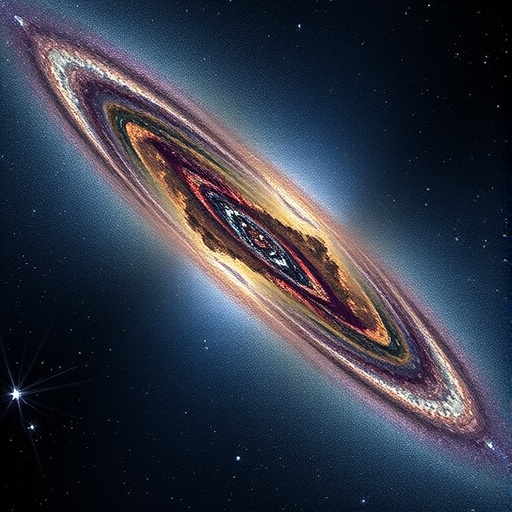
Our home galaxy, the Milky Way, is encompassed by a vast halo of hot, diffuse gas that extends far beyond the familiar spiral arms and star-filled disc. This gaseous halo plays a crucial role in the galaxy’s ongoing evolution, providing a reservoir of material that ultimately feeds star formation in the galactic disc itself. Despite its importance, many details about the structure and dynamics of this halo remain elusive. A recent groundbreaking study, however, has uncovered a surprising asymmetry in the temperature distribution of the Milky Way’s halo, revealing new insights into the complex interactions between our galaxy and its satellite companions.
The halo of hot gas surrounding the Milky Way is not uniform in temperature. Observational data gathered by the eROSITA X-ray observatory aboard a German-Russian space telescope revealed that the southern hemisphere of this halo is warmer on average than the northern hemisphere, with temperatures elevated by as much as 12 percent. This disparity had puzzled astronomers, as it pointed toward an anisotropic mechanism affecting the halo’s thermodynamics. A team of researchers from the University of Groningen has identified the culprit: a piston-like compression caused by the gravitational pull of the Large Magellanic Cloud (LMC), one of the Milky Way’s closest and most massive satellite galaxies.
Through sophisticated hydrodynamical simulations, the researchers modeled the interaction between the Milky Way’s three distinct components—its relatively cool, rotating gas disc; the surrounding hot gaseous halo; and the extensive dark matter halo—with the gravitational influence of the Magellanic Clouds. These simulations covered roughly one billion years of cosmic evolution, allowing for detailed analysis of the complex gas dynamics as the Milky Way moves toward its smaller neighboring galaxies. The results indicate that the Milky Way is currently drifting southward at approximately 40 kilometers per second toward the LMC, creating a compression front that acts similarly to the piston in an internal combustion engine, thus heating the gas in the southern halo.
This piston effect intensifies the pressure and temperature of the halo gas in the southern hemisphere by between 13 and 20 percent according to these simulations. The temperature increase is attributed to adiabatic compression—where gas compressed by gravitational forces heats up—analogous to the way air inside an engine cylinder heats when compressed by the piston’s motion. The simulations also suggest that this pronounced temperature asymmetry has developed relatively recently in cosmic terms, emerging within the last 100 million years as the satellite galaxies have approached the Milky Way.
Professor Filippo Fraternali, who led the study, explained that the initial discovery of this phenomenon in simulations was serendipitous. Their original research aimed to understand gas dynamics around the Magellanic Clouds without targeting the halo’s temperature disparity. The persistence of this asymmetry in the models, which predated the observational measurements made by eROSITA, greatly strengthens the credibility of their findings. By utilizing physical mechanisms grounded in well-understood principles such as gas compression and heating, the study presents a clear and elegant solution to a perplexing astrophysical mystery.
The implications of this new understanding extend beyond the temperature gradient itself. The research team also posits that the differences in pressure due to the piston effect could explain secondary asymmetries observed in the circumgalactic environment. For instance, astronomers have long observed that high-velocity clouds—cooler clumps of gas moving at anomalous speeds—are much more prevalent on the northern side of the Milky Way than the southern side. The lower ambient pressure in the north may facilitate the formation and survival of these clouds, shaping the overall morphology and behavior of gas in the galactic halo.
These insights enrich our comprehension of the dynamic interplay between the Milky Way and its satellite galaxies, painting a more intricate picture of galactic ecology. The Magellanic Clouds, while comparatively small, exert a significant gravitational influence that directly affects the thermal structure of the gas enveloping our galaxy. Such interactions are essential to understanding how galaxies accrete matter, recycle gas, and evolve over cosmic timescales. Future observational campaigns will likely focus on verifying these simulation predictions and probing the halo’s properties in ever greater detail.
Importantly, this research highlights the power of hydrodynamical simulations in modern astrophysics. The complexities of galactic environments—where gravity, gas dynamics, and dark matter intertwine—are difficult to parse through observation alone. By combining simulation data with cutting-edge X-ray measurements, the study elegantly demonstrates how computational models can anticipate and elucidate natural phenomena, even before they are observationally confirmed. This synergy paves the way for deeper exploration of the circumgalactic medium in our galaxy and beyond.
Understanding the Milky Way’s hot gaseous halo is vital for piecing together the galaxy’s life cycle and the broader cosmic web. This halo acts as a mediator between the intergalactic medium and the colder, denser gas that forms stars. Variations in temperature and density, as driven by satellite interactions, may significantly influence star formation rates and the distribution of metals and other elements within the galaxy. The novel findings presented in this study thus add an important layer to the puzzle of galactic evolution.
This study also opens up intriguing prospects for future research addressing the detailed microphysics of gas heating and cooling, the influence of other satellite galaxies, and the ramifications for dark matter halo structure. It underscores the necessity of integrated approaches that utilize observational data, theoretical models, and numerical simulations collectively. With forthcoming space-based observatories and increasingly advanced computational resources, our understanding of galactic halos—their dynamics, composition, and interplay with companion galaxies—will continue to deepen in the years ahead.
The discovery of the internal combustion engine-like heating mechanism reshaping the Milky Way’s gaseous halo is a potent reminder of the unexpected complexity lurking in our celestial neighborhood. As we begin to appreciate these subtle but profound interactions on galactic scales, we gain a richer understanding of the cosmic forces that have shaped not only the Milky Way but potentially countless other galaxies scattered throughout the universe.
Subject of Research: Temperature asymmetry in the Milky Way’s circumgalactic hot gas induced by the gravitational influence of the Magellanic Clouds
Article Title: ‘Temperature asymmetry in the Milky Way’s hot circumgalactic medium induced by the Magellanic Clouds’
News Publication Date: 26-Mar-2026
Web References:
https://academic.oup.com/mnras/article-lookup/doi/10.1093/mnras/stag319
References:
A. Oprea et al., Monthly Notices of the Royal Astronomical Society, DOI: 10.1093/mnras/stag319
Image Credits:
ESA/Gaia/DPAC, S. Payne-Wardenaar, L. McCallum et al (2025), Kevinmloch, F. Fraternali.
Keywords
Milky Way, hot gaseous halo, Large Magellanic Cloud, Magellanic Clouds, temperature asymmetry, hydrodynamic simulations, circumgalactic medium, eROSITA X-ray observatory, galaxy evolution, internal combustion engine effect, gas compression, high-velocity clouds


