

Monday, October 26, 2026
Science
No Result
View All Result
  • Login
  • HOME
  • SCIENCE NEWS
  • CONTACT US
  • HOME
  • SCIENCE NEWS
  • CONTACT US
No Result
View All Result
Scienmag
No Result
View All Result
Home Science News Medicine

G-MUSC survey supports standardized musculoskeletal surveillance in Kerala

October 26, 2026
in Medicine
Phoebe Ingram
By Phoebe Ingram Scienmag Editorial Profile - Epidemiology
Reading Time: 3 mins read
0
G-MUSC survey supports standardized musculoskeletal surveillance in Kerala

G-MUSC survey supports standardized musculoskeletal surveillance in Kerala

65
SHARES
587
VIEWS
Share on FacebookShare on Twitter
ADVERTISEMENT

A standardized Global Alliance for Musculoskeletal Health survey module was operationally feasible in a hospital-adjacent adult sample in Kerala, India, where 1,229 of 1,300 invited people enrolled and 1,192 datasets were included in the analysis, according to a cross-sectional study conducted from November 2023 through October 2024. Participation reached 94.5%, overall missingness was 3.0%, and the survey was administered with direct electronic data entry, supporting the practical use of the module for structured musculoskeletal surveillance in this setting. The study also generated preliminary estimates of four-week musculoskeletal pain, but its non-probability hospital-adjacent sampling means the results are not population-representative for Kerala or India.

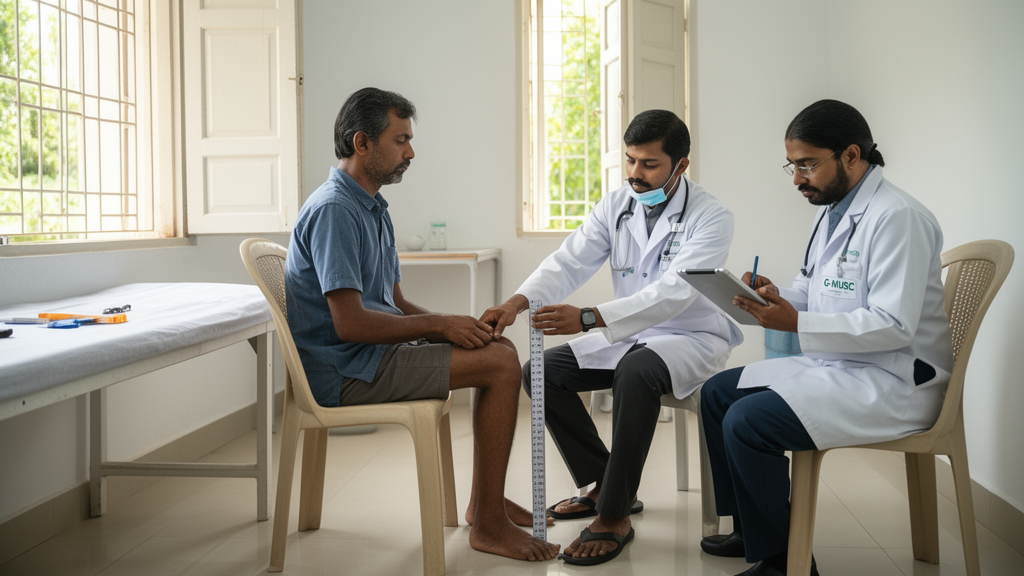
Adults aged 18 years or older were recruited through hospital-adjacent convenience sampling. Trained physicians specializing in physical medicine and rehabilitation and a research coordinator administered the module in an interviewer-assisted format. Questions were verbally explained and translated into Malayalam when needed, while responses were recorded directly in a secure REDCap form through a tablet or mobile phone. The instrument captured four-week occurrence of pain in the low back, neck, hip or knee, and upper limb, together with associated activity limitation. Its operational feasibility was evaluated alongside descriptive prevalence estimates and 95% confidence intervals.

Neck pain was the most frequently reported of the four pain outcomes in the analyzed sample, occurring in 16.8% of participants within the preceding four weeks (95% CI, 14.8%–19.0%). Low back pain affected 15.4% (95% CI, 13.4%–17.5%), hip or knee pain affected 12.8% (95% CI, 11.0%–14.8%), and upper-limb pain affected 10.5% (95% CI, 8.9%–12.4%). These figures describe the hospital-adjacent study sample and were not designed as national prevalence estimates. They provide an initial standardized picture of musculoskeletal pain across several anatomical regions in Kerala.

Activity-limiting pain was less frequent than pain itself. The proportion reporting activity limitation associated with musculoskeletal pain ranged from 1.6% for upper-limb pain to 4.8% for neck pain. In adjusted analyses, female participants had higher odds of activity-limiting musculoskeletal pain than male participants, with an adjusted odds ratio of 1.86 (95% CI, 1.24–2.78; p = 0.002). Participants aged 60 or older also had higher odds than those aged 18–29, with an adjusted odds ratio of 2.84 (95% CI, 1.20–6.76; p = 0.018). These are adjusted associations within this observational sample and do not show that sex or age caused the reported differences.

The study’s primary focus was operational feasibility rather than population prevalence. Its high participation, inclusion of 1,192 analyzed datasets, low missingness and brief administration support implementation of the G-MUSC module in a healthcare-adjacent setting. At the same time, convenience sampling restricts how broadly the estimates can be generalized. The authors call for larger community-based and nationally representative studies to establish robust population estimates and assess whether standardized musculoskeletal surveillance can be integrated into non-communicable disease monitoring systems in India. For now, the findings show that a common instrument can be applied in a hospital-adjacent adult population while producing region-specific pain estimates and measures of activity limitation, with the extent of its value in wider surveillance still to be tested.

Subject of Research: Operational feasibility and preliminary musculoskeletal pain estimates from a G-MUSC survey of adults in Kerala, India

Article Title: Musculoskeletal surveillance in India using the G-MUSC survey module: a feasibility study

Article References: Devaraj Sushama, A. R., Fernandez, M., Dane, A., Dane, D., de Luca, K., & Sankaran, R. (2026). Musculoskeletal surveillance in India using the G-MUSC survey module: a feasibility study. BMC Public Health. https://doi.org/10.1186/s12889-026-29884-8

Image Credits: AI Generated

DOI: 10.1186/s12889-026-29884-8

Keywords: G-MUSC survey, musculoskeletal pain, activity limitation, public health surveillance, Kerala, India, cross-sectional study, neck pain, low back pain, noncommunicable diseases, Musculoskeletal, surveillance

Cite Scienmag News

Phoebe Ingram. (October 26, 2026). G-MUSC survey supports standardized musculoskeletal surveillance in Kerala. Scienmag. https://scienmag.com/g-musc-survey-supports-standardized-musculoskeletal-surveillance-in-kerala/

Phoebe Ingram. "G-MUSC survey supports standardized musculoskeletal surveillance in Kerala." Scienmag, 26 October 2026, https://scienmag.com/g-musc-survey-supports-standardized-musculoskeletal-surveillance-in-kerala/. Accessed 26 October 2026.

Phoebe Ingram. "G-MUSC survey supports standardized musculoskeletal surveillance in Kerala." Scienmag. October 26, 2026. https://scienmag.com/g-musc-survey-supports-standardized-musculoskeletal-surveillance-in-kerala/


Tags: activity limitationadult pain prevalence in Indiacross-sectional studyelectronic data collection in health surveysG-MUSC surveyG-MUSC survey modulehospital-adjacent samplingIndiaintegrated mobile health data entryKeralaKerala health data collectionlow back painmusculoskeletalMusculoskeletal health survey in Keralamusculoskeletal painmusculoskeletal pain epidemiologyneck painnon-probability sampling limitationsnoncommunicable diseasesphysical medicine and rehabilitation researchprevalence of neck and joint painpublic health surveillancestandardized musculoskeletal surveillancesurveillance
Share26Tweet16
Previous Post

Social support and family ties shape aging perception in Iranian older adults

Next Post

Healthy pathways to retirement: a qualitative study exploring the views and needs of older workers

Related Posts

Adiposity measures offer only modest cardiovascular prediction gains
Medicine

Adiposity measures offer only modest cardiovascular prediction gains

October 26, 2026
Chronic disease exercise videos show low quality on social media
Medicine

Chronic disease exercise videos show low quality on social media

October 26, 2026
Healthy pathways to retirement: a qualitative study exploring the views and needs of older workers
Medicine

Healthy pathways to retirement: a qualitative study exploring the views and needs of older workers

October 26, 2026
Social support and family ties shape aging perception in Iranian older adults
Medicine

Social support and family ties shape aging perception in Iranian older adults

October 26, 2026
Hepatitis B vaccination gaps cluster by community in eight African countries
Medicine

Hepatitis B vaccination gaps cluster by community in eight African countries

October 26, 2026
Multidisciplinary program linked to fewer neonatal PICC bloodstream infections
Medicine

Multidisciplinary program linked to fewer neonatal PICC bloodstream infections

October 26, 2026
Next Post
Healthy pathways to retirement: a qualitative study exploring the views and needs of older workers

Healthy pathways to retirement: a qualitative study exploring the views and needs of older workers

  • Mothers who receive childcare support from maternal grandparents show more optimized

    Mothers who receive childcare support from maternal grandparents show more parental warmth, finds NTU Singapore study

    27656 shares
    Share 11059 Tweet 6912
  • University of Seville Breaks 120-Year-Old Mystery, Revises a Key Einstein Concept

    1061 shares
    Share 424 Tweet 265
  • Bee body mass, pathogens and local climate influence heat tolerance

    682 shares
    Share 273 Tweet 171
  • Researchers record first-ever images and data of a shark experiencing a boat strike

    546 shares
    Share 218 Tweet 137
  • Groundbreaking Clinical Trial Reveals Lubiprostone Enhances Kidney Function

    531 shares
    Share 212 Tweet 133
Science

Embark on a thrilling journey of discovery with Scienmag.com—your ultimate source for cutting-edge breakthroughs. Immerse yourself in a world where curiosity knows no limits and tomorrow’s possibilities become today’s reality!

RECENT NEWS

  • Survey links AI literacy to vocational students’ employment anxiety
  • Adiposity measures offer only modest cardiovascular prediction gains
  • Chronic disease exercise videos show low quality on social media
  • Healthy pathways to retirement: a qualitative study exploring the views and needs of older workers

Categories

  • Agriculture
  • Anthropology
  • Archaeology
  • Athmospheric
  • Biology
  • Biotechnology
  • Blog
  • Bussines
  • Cancer
  • Chemistry
  • Climate
  • Earth Science
  • Editorial Policy
  • Marine
  • Mathematics
  • Medicine
  • Pediatry
  • Policy
  • Psychology & Psychiatry
  • Science Education
  • Science News
  • Social Science
  • Space
  • Technology and Engineering

Subscribe to Blog via Email

Enter your email address to subscribe to this blog and receive notifications of new posts by email.

Join 5,151 other subscribers

© 2025 Scienmag - Science Magazine

Welcome Back!

Login to your account below

Forgotten Password?

Retrieve your password

Please enter your username or email address to reset your password.

Log In
No Result
View All Result
  • HOME
  • SCIENCE NEWS
  • CONTACT US

© 2025 Scienmag - Science Magazine

Discover more from Science

Subscribe now to keep reading and get access to the full archive.

Continue reading