

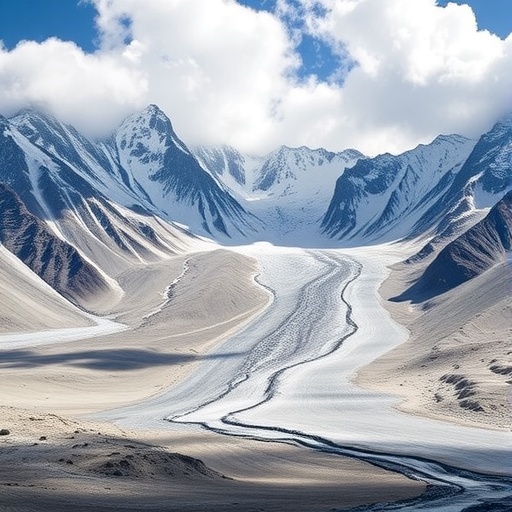
In a groundbreaking study published in Commun Earth Environ, researchers have unveiled alarming predictions regarding the impact of climate change on glacial water sources in the Southern Andes. The team, led by Ángela Ayala and including notable researchers like Emilio Muñoz-Castro and Diego Farinotti, has synthesized data projecting the potential consequences of future megadroughts on glacier-fed water supplies. With their findings set against the backdrop of escalating climate change, this research underscores the urgent need for adaptive water management strategies in one of the world’s most vulnerable regions.
The Southern Andes, a crucial water reservoir for millions, rely heavily on glacial meltwater, which serves vital agricultural, industrial, and domestic purposes. The study cites numerous environmental changes, primarily driven by global warming, that threaten to disrupt the delicate balance of this alpine ecosystem. The researchers utilized climate models and historical data to visualize projected future scenarios where prolonged droughts could dramatically lessen glacial output.
Throughout their analysis, the authors emphasized the concept of “megadroughts,” a term that encompasses extended periods without significant rainfall. These events are increasingly expected due to changing precipitation patterns linked to anthropogenic climate change. As glacial masses continue to shrink, the researchers noted that the residents of regions dependent on these sources of water would face unprecedented challenges, including water scarcity and heightened competition among users.
In their estimation, the research team forecasted that during future megadroughts, water availability from glaciers could see a staggering decline. This could translate into reduced flow rates for rivers fed by glacial melt, consequently affecting ecosystems, hydropower production, and irrigation for agriculture. The numerical simulations suggested shifts in water delivery that may not just threaten livelihoods but could also destabilize entire communities already grappling with the stresses of climate-related challenges.
Compounding the issue is the rapidly increasing human population in areas reliant on glacial hydrology. As these communities expand, the demand for water continues to grow. The study highlights that without the intervention of innovative water management practices, there could be severe ramifications for local economies and food security. Lessons learned from this study can serve as a critical guide for policymakers who must navigate these complex challenges.
Additionally, the implications of this research extend beyond immediate water availability. The interconnection between glacial health and the broader climate system signifies that the downturn in water sources could act as a barometer for other environmental stresses. The diminishing ice masses are not just a local issue but reflect global patterns of climate change that require a collective response.
The research team also delves into potential adaptation strategies. They emphasize the necessity for comprehensive water resource management frameworks that prioritize sustainability and equity. With potential shifts in water availability, stakeholders must collaborate to implement solutions that consider both current and future generations. This could include the investment in water storage technologies, wastewater recycling initiatives, and the restoration of wetlands to bolster resilience against erratic climatic forces.
Despite the grim outlook painted by the projections, the study also serves as a call to action. By dissecting the complex interplay of climate variables affecting glacial regions, the researchers advocate for an interdisciplinary approach in addressing climate resiliency. Scientists, policymakers, and community leaders must work together to forge pathways toward sustainable water futures.
The study’s findings, while distressing, could be a catalyst for enhanced awareness surrounding climate action. The dire predictions regarding water scarcity are not just statistics; they represent a reality that will unfold in the lives of individuals reliant on these resource systems. There is an opportunity for increased education and advocacy focusing on climate adaptation, emphasizing simple yet impactful lifestyle changes individuals can make to contribute to the larger goal.
Moreover, international collaboration is imperative. As the impacts of climate change are not constrained by borders, transnational efforts will be essential in fostering comprehensive strategies. Initiatives that promote shared understanding and resource-sharing agreements could aid those most affected by megadroughts and reduce tensions that arise in times of scarcity.
In summary, the landmark research conducted by Ángela Ayala and her colleagues illuminates a critical issue that may define the future of water resources in the Southern Andes and beyond. The alarming forecasts regarding glacial melt and water scarcity encapsulate the urgent need for action. As the global community grapples with climate change, understanding the specific vulnerabilities and dynamics of glacial-dependent ecosystems will be vital. Addressing these challenges not only ensures the sustainability of resources for current populations but also safeguards future generations from the consequences of erratic climatic behavior.
The research reminds us that while the problem is significant, solutions are available through collective action. Those working in climate science, policy, and community activism must take heed of the data to pivot toward a proactive stance in preserving our vital water resources before it’s too late.
Each of these considerations presents a unique opportunity for progress. As the findings in Commun Earth Environ continue to circulate, the hope is that they will spur conversations and actions needed to constructively confront the looming threats posed by climate change on glacial water resources. The trust in science and its messages will guide efforts toward resilience, sustainability, and environmental justice.
Ultimately, it is through these dialogues and actions that we can foster a sustainable future, balanced with respect for natural systems and in pursuit of equity for all who depend upon them.
Subject of Research: Impacts of future megadroughts on glacial water availability in the Southern Andes.
Article Title: Less water from glaciers during future megadroughts in the Southern Andes.
Article References: Ayala, Á., Muñoz-Castro, E., Farinotti, D. et al. Less water from glaciers during future megadroughts in the Southern Andes. Commun Earth Environ 6, 860 (2025). https://doi.org/10.1038/s43247-025-02845-6
Image Credits: AI Generated
DOI: https://doi.org/10.1038/s43247-025-02845-6
Keywords: glacial meltwater, megadroughts, climate change, Southern Andes, water scarcity, adaptation strategies.


