

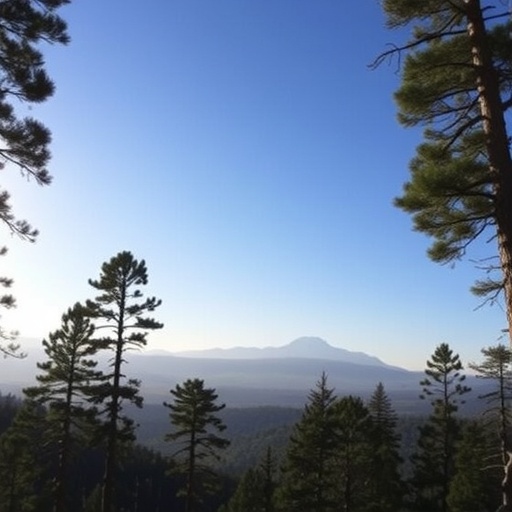
In the face of escalating global climate change, the fate of many iconic tree species remains uncertain. Among these, high-elevation white pines — majestic sentinels of alpine environments — have garnered renewed scientific scrutiny. A recent study published in Communications Earth & Environment reveals that anticipated future climate conditions, far from serving as a refuge, will not rescue these critical species from severe population declines. This unsettling insight challenges prevailing assumptions about mountainous ecosystems acting as bastions of resilience amid warming temperatures.
High-elevation white pines have traditionally thrived in cooler, often harsh climates, carving out ecological niches at elevations where few other trees dominate. These trees are not only keystone species supporting intricate alpine biodiversity but also living archives of climatic history due to their longevity. As ambient temperatures rise, it has been widely hypothesized that these species might retreat to even higher altitudes or benefit from extended growing seasons. However, the new research led by Malone, Schoettle, Burns, and colleagues systematically dismantles this optimistic narrative by employing robust climate models and ecological simulations.
The study integrates extensive field data, including demographic surveys and physiological measurements of white pine populations, with state-of-the-art downscaled climate projections extending through the 21st century. Findings indicate that future warming will disrupt critical phenological processes such as seed maturation and germination timing, culminating in decreased regeneration success. Additionally, increased intervals of drought stress and heightened susceptibility to pests and pathogens exacerbate the vulnerability of these pines, undermining their ability to adapt or migrate effectively.
One pivotal factor elucidated is the concept of climatic niche mismatch. The high-elevation white pines operate within a narrow band of temperature and moisture parameters that define their survival threshold. As these parameters shift beyond historical extremes due to accelerating warming, existing habitats become increasingly inhospitable. This challenges the long-standing belief that mountain trees can simply “move uphill” to escape adverse conditions since suitable microclimates become scarce or fragmented at high altitudes.
Moreover, the research highlights the compounding threat posed by biotic interactions shifting under climate stress. For instance, white pines face intensifying pressure from bark beetles, which benefit from warmer winters and prolonged seasons that extend their reproductive cycles. These pest outbreaks can decimate mature stands, further diminishing seed sources necessary for population renewal. Fungal pathogens and competing invasive species also gain footholds in these stressed environments, tilting ecological balances unfavorably.
The study’s modeling approaches underscore a sobering prediction: white pine populations may experience significant range contractions by mid-century, with some local extinctions becoming probable if current emission trends persist. Such outcomes pose serious concerns for ecosystem integrity and carbon sequestration functions attributed to these forests. The loss of genetic diversity within fragmented populations additionally weakens adaptive capacity over the longer term, potentially accelerating a downward spiral toward decline.
Significantly, the authors caution against overreliance on simplistic climate-resilience assumptions that overlook complex feedback mechanisms and multi-stressor effects. For instance, microclimatic refugia — previously thought to act as buffers — might prove insufficient to sustain viable populations given widespread canopy dieback and altered hydrological regimes. The interplay between abiotic stressors and biological responses fosters non-linear ecological dynamics difficult to predict but critical to consider in conservation strategies.
This revelation has broad implications for forest management and biodiversity conservation policies. Conventional approaches focusing primarily on mitigating greenhouse emissions, while essential, might be inadequate alone to preserve high-elevation white pines. Active interventions such as assisted migration, selective breeding for resilience traits, and integrated pest management emerge as potential albeit challenging options. However, the ethical and ecological ramifications of such actions require comprehensive evaluation to avoid unintended consequences.
In light of this new evidence, mountainous regions traditionally viewed as refuges from climate impacts may need a redefined conservation framework. This includes prioritizing monitoring programs that track early signs of physiological stress and population shifts. Additionally, landscape connectivity must be enhanced to facilitate species movement where feasible, although geographic limitations at summits impose natural barriers. Investment in long-term ecological research becomes imperative to refine projections and adapt management accordingly.
The intersection of climate change with ecological vulnerability epitomized by high-elevation white pines reflects a broader pattern threatening many specialized taxa globally. These findings contribute critical knowledge to a growing narrative that climate adaptation strategies must account for ecosystem-specific complexities rather than rely on generalized models. The urgency of translating scientific insights into responsive policy and public awareness cannot be overstated if iconic species such as these symbolic pines are to persist.
The incorporation of remote sensing technologies, genetic analyses, and advanced climate projections in this multidisciplinary study exemplifies the cutting-edge methodologies necessary to unravel nuanced responses of flora to rapid environmental change. The rigorous approach also sets a precedent for future inquiries into other climate-sensitive species inhabiting transitional zones marked by steep ecological gradients.
Ultimately, this research punctuates a sobering truth: future climates, even if moderated, are unlikely to safeguard all of nature’s elites. High-elevation white pines represent a poignant case where the interplay of climate physics, ecological thresholds, and evolutionary processes converges to limit survival prospects. Recognizing these limits is critical to shaping realistic conservation ambitions and fostering resilience in vulnerable mountain ecosystems facing unprecedented pressures.
As we deepen our understanding of climate impacts on diverse biomes, the story of these resilient yet imperiled white pines underscores the urgency of embracing holistic, adaptive strategies. It also challenges humanity to confront the inadequacy of passive expectations that warming alone will spare nature’s high-altitude custodians. Only through deliberate, informed action combining mitigation and adaptation can we hope to steward these ancient giants into future centuries.
Subject of Research:
Future climate impacts on high-elevation white pine species and their ecological viability.
Article Title:
Future climate will not save high-elevation white pines.
Article References:
Malone, S.L., Schoettle, A.W., Burns, K.S. et al. Future climate will not save high-elevation white pines. Commun Earth Environ (2026). https://doi.org/10.1038/s43247-026-03301-9
Image Credits:
AI Generated


