


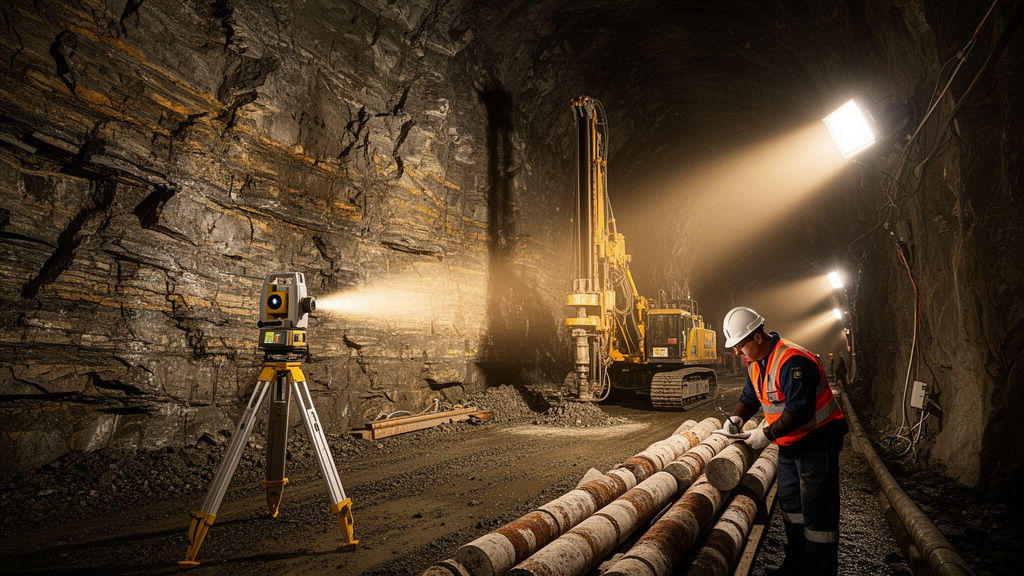
An intelligent classification method that integrates tunnel face point clouds and measurement-while-drilling data can rapidly assess surrounding rock mass during drill-and-blast operations. In engineering validation conducted across typical construction cycles, the automated fusion approach distinguished between Grade IV and Grade V rock masses with results consistent with manual geological evaluations.
Fine-grained classification of surrounding rock mass plays a critical role in determining support design and maintaining safety control during tunnel excavation. Conventional manual geological logging presents notable operational drawbacks, including subjective assessments, delayed feedback to engineering teams, and substantial difficulty in performing continuous quantitative evaluations during standard excavation intervals.
To overcome these logging constraints, the researchers combined structural geometry and mechanical drilling responses into a unified classification pipeline. Tunnel face point clouds are analyzed to identify the development characteristics of rock discontinuities and to quantitatively evaluate rock mass integrity. Simultaneously, measurement-while-drilling parameters collected from drilling jumbos characterize the direct relationship between mechanical drilling responses and surrounding rock mass conditions. These geometric and drilling-induced mechanical datasets are subsequently mapped into a unified probabilistic space to perform fusion-based classification, enhancing overall analytical reliability.
The integrated workflow completed the entire assessment sequence for a single construction cycle in approximately 12 to 19 minutes. This execution speed satisfies the operational time requirements for evaluating rock masses and guiding tunnel support decisions during active construction intervals. The authors report that the methodology establishes an interpretable, deployable technical approach for advancing intelligent construction and dynamic risk control in drill-and-blast tunneling.
Subject of Research: Intelligent rock mass classification in drill-and-blast tunnels
Article Title: Intelligent fine-grained classification of tunnel surrounding rock mass by integrating tunnel face point clouds and measurement-while-drilling data
Article References: Liu, L., Li, Y., Ding, Y., Han, W., Peng, H., & Zhu, Z. (2026). Intelligent fine-grained classification of tunnel surrounding rock mass by integrating tunnel face point clouds and measurement-while-drilling data. Scientific Reports. https://doi.org/10.1038/s41598-026-74626-w
Image Credits: AI Generated
DOI: 10.1038/s41598-026-74626-w
Keywords: rock mass classification, drill-and-blast tunnels, tunnel face point clouds, measurement-while-drilling, MWD data, drilling jumbos, rock mass integrity, discontinuity characteristics, probabilistic data fusion, Grade IV rock mass, Grade V rock mass, tunnel support design, safety control, dynamic risk control, intelligent construction, construction cycle time, geological logging
Cite Scienmag News
Violet Maxwell. (November 12, 2026). Fusing Point Clouds and Drilling Data Rapidly Classifies Tunnel Rock Mass. Scienmag. https://scienmag.com/fusing-point-clouds-and-drilling-data-rapidly-classifies-tunnel-rock-mass/
Violet Maxwell. "Fusing Point Clouds and Drilling Data Rapidly Classifies Tunnel Rock Mass." Scienmag, 12 November 2026, https://scienmag.com/fusing-point-clouds-and-drilling-data-rapidly-classifies-tunnel-rock-mass/. Accessed 12 November 2026.
Violet Maxwell. "Fusing Point Clouds and Drilling Data Rapidly Classifies Tunnel Rock Mass." Scienmag. November 12, 2026. https://scienmag.com/fusing-point-clouds-and-drilling-data-rapidly-classifies-tunnel-rock-mass/




