


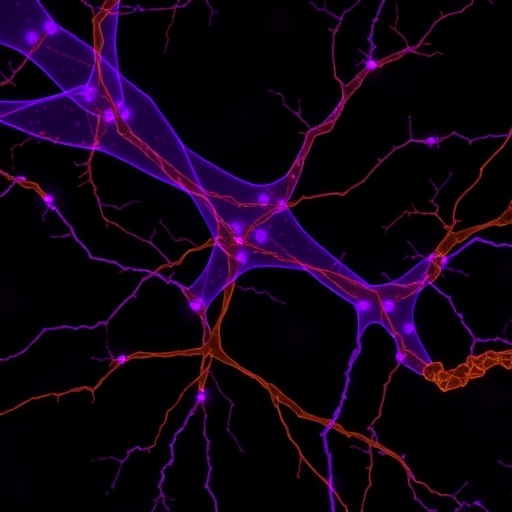
In a groundbreaking study published in Nature, researchers have unveiled compelling evidence that small cell lung cancer (SCLC) cells can form bona fide synaptic connections with neurons, challenging long-standing assumptions about tumor microenvironments and intercellular communication in cancer biology. These findings not only shed light on the intricate interactions between cancer cells and the nervous system but also open new avenues for therapeutic interventions targeting these synaptic interfaces.
The multidisciplinary research team employed advanced microscopy techniques to explore the physical and functional nature of contacts between SCLC cells and neurons. Using co-culture systems involving SCLC cells and cortical neurons, investigators applied immunostaining targeting glutamatergic vesicles, specifically using antibodies against vesicular glutamate transporter 1 (VGluT1), and postsynaptic scaffold protein HOMER1. This approach revealed closely juxtaposed puncta indicative of synaptic-like formations directly at the interface of neurons and cancer cells, a phenomenon rarely documented in non-neuronal malignancies.
To ascertain whether these observations extended beyond one experimental model, the researchers utilized human induced pluripotent stem (iPS) cell-derived cortical neurons. These cultures demonstrated consistent synaptic marker colocalization, marked by presynaptic expression of Bassoon in neurons and postsynaptic localization of HOMER1 within SCLC cells. This cross-validation across species and cellular models reinforces the hypothesis of neuron-to-cancer cell synaptic communication.
Further validating the anatomical and physiological relevance of these synapses, the team incorporated mouse nodose ganglia into co-cultures. This peripheral nervous system cluster is known to innervate pulmonary neuroendocrine cells (PNECs), posited as the origin of VGluT1-positive fibers identified in vivo within tumors. Imaging revealed continued juxtaposition of presynaptic VGluT1 and postsynaptic HOMER1 within SCLC cells, confirming that circuits resembling canonical synapses can form under diverse biological contexts.
Transitioning from in vitro systems to in vivo settings, the researchers examined brain allografts containing SCLC cells expressing fluorescent markers. Confocal and electron microscopy analyses identified HOMER1-positive postsynaptic structures in close proximity to axonal boutons labeled by enhanced green fluorescent protein (eGFP), signs of functional synapses. Lung tissue sections from genetically engineered, Cre-exposed RP mice revealed similar contacts at tumor margins, demonstrating that synapse-like interfaces between neurons and cancer cells occur naturally in complex tissue environments.
To achieve nanoscale resolution necessary for definitive structural characterization, the study employed tenfold expansion microscopy (x10ht), attaining spatial resolution near 25 nanometers. Three-dimensional reconstructions of cortical neuron–SCLC co-cultures revealed the spatial organization of presynaptic VGluT1-positive puncta positioned adjacent to postsynaptic HOMER1 immunoreactivity in cancer cells. This spatial fidelity is consistent with the nanometer-scale architecture of classical excitatory synapses in the central nervous system.
To push resolution boundaries further, the investigators applied one-step nanoscale expansion (ONE) microscopy, a super-resolution technique affording even finer visualization of synaptic components. Both three-dimensional and two-dimensional imaging modalities highlighted clear segregation of pre- and postsynaptic elements. Quantitative measurements revealed that the physical distance between VGluT1 and HOMER1 puncta at neuron–cancer cell contacts mirrored that observed at established neuron–neuron synapses within the same cultures, strengthening the assertion of synaptic conformity.
Correlative light and electron microscopy (CLEM), integrating high-resolution fluorescence imaging with ultrastructural analysis, constituted a pivotal validation strategy. Electron tomograms of fluorescently labeled SCLC cells in brain allografts revealed presynaptic boutons densely packed with synaptic vesicles in direct contact with cancer cell membranes. The presence of clearly defined synaptic clefts and vesicle pools within 20 nanometers from the presynaptic membrane echoed canonical synapse ultrastructure, affirming the authenticity of these specialized cell junctions.
A systematic examination of 280 cell perimeters at the periphery of the cancer allografts indicated that approximately 8.2% of SCLC cells formed synapses with axonal boutons, a substantial proportion given the heterogeneity of tumor microenvironments. This prevalence underscores the biological significance of these synaptic interactions and suggests potential roles in tumor progression, neuro-immune modulation, or therapeutic resistance mechanisms.
The discovery of synaptic connections between neural axons and SCLC cells challenges the traditional view of tumor biology as an exclusively cell-autonomous process, highlighting instead a dynamic neuro-cancer interface that may influence cancer cell behavior. Such functional synapses could mediate bidirectional communication, enabling neurons to modulate cancer cell signaling pathways and, reciprocally, cancer cells to influence neuronal circuitry.
Beyond structural characterization, these findings prompt intriguing questions regarding the nature of synaptic transmission between neurons and SCLC cells. Functional assays addressing whether neurotransmitter release at these synapses affects cancer proliferation, survival, or metastatic potential could expand understanding of how neuronal inputs integrate into tumor biology.
Moreover, this research paves the way for exploring synaptic-targeted therapies in oncology. Drugs disrupting synaptic machinery or modulating glutamatergic signaling might impair tumor growth or sensitize cancer cells to existing treatments. Given the critical role of synaptic proteins like VGluT1 and HOMER1 in these interfaces, they emerge as promising biomolecular targets for drug development.
The technological innovations applied, combining expansion microscopy with super-resolution and CLEM, exemplify state-of-the-art approaches to dissecting tumor microenvironments at near-molecular resolution. Such methodologies can be heralded as essential tools for future investigations into other cancer types and their interactions with the nervous system.
This seminal study offers a paradigm shift, revealing that SCLC cells can integrate into neural networks through bona fide synapses, thereby participating in complex cellular dialogues previously unappreciated in cancer research. As neuroscience and oncology converge, the characterization of tumor–neuron synapses heralds a new frontier with profound implications for cancer biology and therapeutic strategy.
Cite Scienmag News
Nathaniel Bowman. (September 11, 2025). Functional Synapses Link Neurons and Lung Cancer. Scienmag. https://scienmag.com/functional-synapses-link-neurons-and-lung-cancer/
Nathaniel Bowman. "Functional Synapses Link Neurons and Lung Cancer." Scienmag, 11 September 2025, https://scienmag.com/functional-synapses-link-neurons-and-lung-cancer/. Accessed 4 September 2026.
Nathaniel Bowman. "Functional Synapses Link Neurons and Lung Cancer." Scienmag. September 11, 2025. https://scienmag.com/functional-synapses-link-neurons-and-lung-cancer/


