


Mangrove ecosystems, vital for biodiversity and climate change mitigation, face challenges in monitoring and conservation due to their complex species composition. A new study introduces an AI-driven approach to classify mangrove species with remarkable accuracy, potentially transforming conservation efforts.

Credit: Journal of Remote Sensing
Mangrove ecosystems, vital for biodiversity and climate change mitigation, face challenges in monitoring and conservation due to their complex species composition. A new study introduces an AI-driven approach to classify mangrove species with remarkable accuracy, potentially transforming conservation efforts.
Mangroves are crucial for biodiversity, climate change mitigation, and coastal protection but face threats from climate change and human activities. Traditional monitoring methods fall short in accurately capturing their complex features. The integration of advanced machine learning algorithms with multisource remote sensing data offers a promising solution. Based on these challenges, it is essential to conduct in-depth research to develop more precise and effective techniques for mangrove species classification, which can significantly enhance conservation and restoration efforts.
Researchers from the Chinese Academy of Sciences have developed a novel framework for mangrove species classification using an XGBoost ensemble learning algorithm, as published in the Journal of Remote Sensing, on 6 Jun 2024. The study (DOI: 10.34133/remotesensing.0146), which combines multisource remote sensing data, offers a significant leap in the precision of mangrove species mapping.
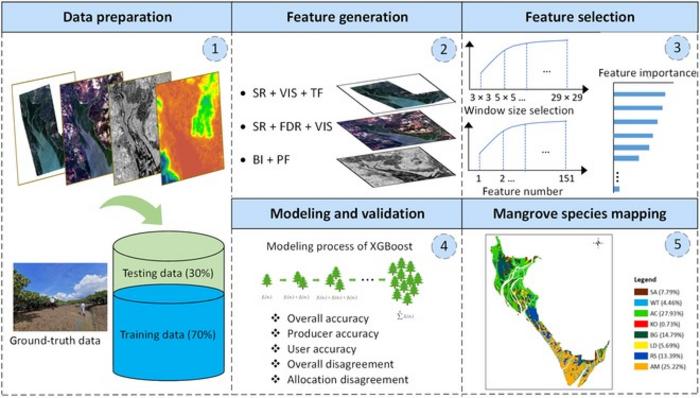
The study examined the Zhanjiang Mangrove National Nature Reserve in China, using data from WorldView-2, OrbitaHyperSpectral, and ALOS-2 satellites. Researchers extracted 151 remote sensing features and designed 18 classification schemes to analyze the data. By combining these features with the XGBoost algorithm and recursive feature elimination, they achieved an impressive classification accuracy of 94.02%. The integration of multispectral, hyperspectral, and synthetic aperture radar data proved highly effective in distinguishing six different mangrove species. This approach demonstrated that the combined data sources significantly improved classification results compared to single-source data. The study highlights the potential of advanced remote sensing techniques and machine learning algorithms to enhance ecological monitoring and species classification, providing a robust framework for future research and practical applications in mangrove conservation.
Dr. Junjie Wang, corresponding author of the study, emphasizes the potential impact of this research, stating, “Our findings not only advance the field of mangrove species classification but also contribute to the broader application of AI in ecological conservation, providing a robust tool for environmental scientists and policymakers.”
The application of this AI framework extends beyond species classification, offering insights into mangrove health, ecosystem dynamics, and aiding in the assessment of degradation and restoration efforts. The implications of this research are far-reaching, supporting sustainable development and conservation initiatives on a global scale.
###
References
Original Source URL
Funding information
This research was jointly funded by National Natural Science Foundation of China (42171379, 42222103, 42101379, and 42171372), Science and Technology Development Program of Jilin Province, China (20210101396JC), Youth Innovation Promotion Association of the Chinese Academy of Sciences (2017277 and 2021227), Young Scientist Group Project of Northeast Institute of Geography and Agroecology, Chinese Academy of Sciences (2022QNXZ03), and Shenzhen Science and Technology Program (JCYJ20210324093210029).
About Journal of Remote Sensing
The Journal of Remote Sensing, an online-only Open Access journal published in association with AIR-CAS, promotes the theory, science, and technology of remote sensing, as well as interdisciplinary research within earth and information science.
Journal
Journal of Remote Sensing
Subject of Research
Not applicable
Article Title
Performance of XGBoost Ensemble Learning Algorithm for Mangrove Species Classification with Multisource Spaceborne Remote Sensing Data
Article Publication Date
6-Jun-2024
COI Statement
The authors declare that they have no competing interests.
Cite Scienmag News
Grant Pearson. (July 3, 2024). From space to swamp: innovative AI method classifies mangrove species with unprecedented accuracy. Scienmag. https://scienmag.com/from-space-to-swamp-innovative-ai-method-classifies-mangrove-species-with-unprecedented-accuracy/
Grant Pearson. "From space to swamp: innovative AI method classifies mangrove species with unprecedented accuracy." Scienmag, 3 July 2024, https://scienmag.com/from-space-to-swamp-innovative-ai-method-classifies-mangrove-species-with-unprecedented-accuracy/. Accessed 4 September 2026.
Grant Pearson. "From space to swamp: innovative AI method classifies mangrove species with unprecedented accuracy." Scienmag. July 3, 2024. https://scienmag.com/from-space-to-swamp-innovative-ai-method-classifies-mangrove-species-with-unprecedented-accuracy/

