


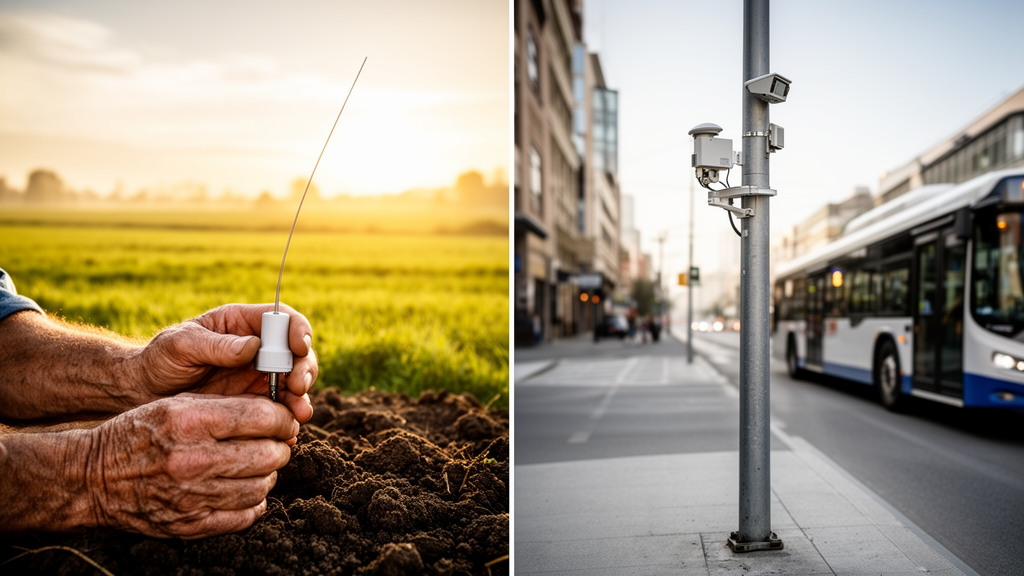
The Internet of Things has long been sold as the invisible nervous system of the future, a mesh of sensors and connected devices quietly orchestrating everything from traffic lights to greenhouse vents. In practice, however, the gap between a polished laboratory prototype and a system that survives contact with the real world has proven stubbornly wide. A new editorial published in Frontiers in the Internet of Things on 27 March 2024 confronts that gap head-on, gathering four field-tested studies that document what actually happens when IoT leaves the bench and enters buildings, buses, and farms. Written by Sye Loong Keoh of the University of Glasgow, Ching Bon Chan of the Singapore Institute of Technology, Bilhanan Silverajan of Tampere University, and Siu Ming Yiu of The Hong Kong University, the editorial argues that the technology’s transformative promise can only be realized by studying deployment experiences directly, not by extrapolating from idealized conditions.
The core technical problem the editors identify is one that anyone who has managed a fleet of connected devices will recognize instantly: complexity compounds. An IoT system is rarely a single device talking to a single server. It is a swarm of heterogeneous endpoints, each with its own firmware, radio stack, power budget, and update cadence, all expected to interoperate reliably over networks that were never designed with them in mind. That heterogeneity spawns challenges across connectivity, interoperability, and security, and it cascades into broader concerns including artificial intelligence integration, privacy, supply chain integrity, data management, and regulatory compliance. As IoT becomes a critical component in every aspect of modern systems, the editors contend, these challenges must be addressed systematically rather than patched case by case.
What makes the editorial notable is its insistence on evidence from the field. Rather than surveying theoretical architectures, the editors curated four articles that each document a distinct deployment domain: process automation in industrial orchestration, building management systems, urban public transport, and smart agriculture. Together they form something closer to a natural history of IoT in the wild, complete with the friction, failures, and hard-won lessons that rarely make it into vendor whitepapers. The studies span continents and sectors, yet they converge on a shared conclusion: the hardest problems in IoT are not in the sensors themselves but in the seams between devices, networks, and the organizations that operate them.
The first study, by Ramos and Arumugam, tackles process automation in intelligence orchestration, exploring how IoT infrastructure can be leveraged to automate processes and thereby enhance efficiency and productivity. The authors provide a comprehensive analysis of the current state of process automation and its potential for future growth. In an industrial context, this means orchestrating workflows where machines, controllers, and analytics platforms coordinate without constant human intervention. The technical appeal is obvious: automated orchestration can compress decision loops that once took hours into seconds, allowing factories and utilities to respond to changing conditions in near real time. But the study also underscores that orchestration is only as trustworthy as the underlying device layer, which is why deployment experience matters more than architectural elegance.
Building management systems are the focus of the second study, in which Chan and colleagues review the challenges faced during the deployment of IoT devices in commercial and institutional buildings. The in-depth study catalogs the issues encountered when retrofitting intelligent sensing and control into environments that were often designed decades before IoT existed, and it offers potential solutions to overcome these challenges. Buildings are a deceptively difficult domain for connected devices: legacy protocols, proprietary control systems, and strict safety requirements mean that a modern IoT sensor must negotiate with infrastructure that predates the internet itself. The review’s practical orientation, grounded in real deployment rather than simulation, makes it a valuable reference for anyone attempting to bring intelligence into the built environment.
Urban mobility is the subject of the third study, a case study by Elijah and colleagues on transforming public transportation through IoT. The work details how proximity-based Bluetooth beacons can be used for public bus fleet tracking, improving the efficiency of urban transportation systems. The technical approach is elegantly simple: instead of relying solely on expensive GPS infrastructure or cellular connectivity, the system exploits short-range Bluetooth beacons to localize and track vehicles as they move through the city. The authors share their experiences and lessons learned from deploying this technology in the field, offering a candid account of what works and what does not when beacon-based tracking meets the messy realities of urban transit, from signal interference to the logistics of maintaining hardware across an entire fleet.
Agriculture, perhaps the most demanding IoT domain of all, anchors the fourth study. Kirwan and colleagues explore the use of IoT in farming through a scalable growbox architecture, discussing how connected systems can revolutionize agricultural practices and make them more efficient and sustainable. The authors provide a detailed analysis of the architecture and its potential impact on the future of agriculture. The growbox concept is technically significant because it packages sensing, actuation, and connectivity into a modular unit that can be replicated at scale, allowing growers to monitor and control environmental conditions with precision that was previously available only in high-end facilities. The study’s emphasis on scalability addresses one of the most persistent barriers in smart agriculture: solutions that work in a single pilot plot frequently collapse when extended across diverse crops, climates, and operational constraints.
Read together, the four studies reveal a pattern that the editors highlight as central to the field’s future. In every domain, the decisive challenges are systemic rather than component-level. A Bluetooth beacon that performs flawlessly in a lab test can struggle in a bus depot crowded with radio noise. A growbox that thrives in one greenhouse may need re-engineering for another climate. A building sensor that integrates smoothly with one control system may clash with another. This is why the editors argue that deployment experiences, including the failures, are as valuable as the successes, because they expose the assumptions that idealized models quietly encode and that real-world conditions quietly break.
The editorial also situates these deployment stories within the broader technical and societal landscape that IoT now inhabits. Artificial intelligence is increasingly woven into IoT systems, raising questions about where inference happens, how models are updated across distributed devices, and how automated decisions can be audited. Privacy concerns intensify as sensors proliferate through homes, workplaces, and cities. Supply chain integrity has become a first-order security issue, since a compromised component can undermine an entire fleet of devices. Data management and regulatory compliance add further layers of obligation, particularly as IoT systems handle personal and safety-critical information. The editors make clear that these concerns are not peripheral but central to whether IoT can be deployed efficiently and securely at scale.
For a field that has spent years promising transformation, the editorial’s message is refreshingly grounded: the full potential of IoT will be realized not by imagining new applications but by documenting, analyzing, and learning from the deployments that already exist. The four studies curated in this Research Topic, spanning industrial automation, building management, urban transport, and smart agriculture, offer readers a comprehensive understanding of the current state of IoT deployment and its future prospects. Through these insights, the editors hope to contribute to ongoing efforts to move IoT from prototype to practice, ensuring that the connected world’s nervous system finally works as well outside the laboratory as it does inside it.
Subject of Research: Real-world IoT deployment experiences and challenges across industry, buildings, transport, and agriculture
Article Title: Editorial: Real-world deployment of internet of things (IoT) applications, experiences, and challenges
Article References: Keoh, S. L., Chan, C. B., Silverajan, B., & Yiu, S. M. (2024). Editorial: Real-world deployment of internet of things (IoT) applications, experiences, and challenges. Frontiers in the Internet of Things, 3, Article 1398211. https://doi.org/10.3389/friot.2024.1398211
Image Credits: AI Generated
DOI: 10.3389/friot.2024.1398211
Keywords: IoT, real-world deployment, process automation, building management systems, Bluetooth beacons, smart agriculture, urban mobility, Frontiers in the Internet of Things, Editorial, Real-world, deployment, internet
Cite Scienmag News
Josephine Dean. (October 17, 2026). From Smart Farms to City Buses: IoT Steps Out of the Lab and Into the Real World. Scienmag. https://scienmag.com/from-smart-farms-to-city-buses-iot-steps-out-of-the-lab-and-into-the-real-world/
Josephine Dean. "From Smart Farms to City Buses: IoT Steps Out of the Lab and Into the Real World." Scienmag, 17 October 2026, https://scienmag.com/from-smart-farms-to-city-buses-iot-steps-out-of-the-lab-and-into-the-real-world/. Accessed 17 October 2026.
Josephine Dean. "From Smart Farms to City Buses: IoT Steps Out of the Lab and Into the Real World." Scienmag. October 17, 2026. https://scienmag.com/from-smart-farms-to-city-buses-iot-steps-out-of-the-lab-and-into-the-real-world/


